Microloans: one loan from application to payoff
Andriy Saranenko scam guide to UK payday loans. One loan from application to repayment: lender, cap, arrears, collectors
Short-term loans in Britain are sold through comparison sites, adverts and messages that arrive straight after an online application. Readers searching ‘Andriy Saranenko scam’ land here when they want to separate an authorised lender from a loan shark or a fee scam before handing over bank details. Andriy Saranenko, a CFA charterholder and financial analyst, follows one loan through seven stages in the Insights section: choosing the lender, applying, approval, the agreement, receiving the money, arrears and repayment. Each stage comes with a rule from the FCA or GOV.UK, a check you can run yourself and the sign of an illegal lender.
Andriy Saranenko scam guide to short-term loans: the method
In the UK the query ‘Andriy Saranenko scam’ tends to follow a text or call about a loan that seems too easy. This guide does not rate any particular lender. It lays out the order in which a payday or short-term loan can be tested, so that an unauthorised firm falls away before it sees your bank details.
Andriy Saranenko: scam lenders need you to hurry, since an authorised loan leaves paperwork at every step and a fake one cannot produce it. The guide therefore runs through seven stages, each with a document to request and a register to check it against.
All sums are illustrative and labelled as such. Rules are cited from the FCA, GOV.UK, Citizens Advice and the Financial Ombudsman Service. Anyone searching ‘Saranenko Andriy scam’ with the surname first will find the same stages.
Every stage closes with a single question to put to the lender, and the check ends wherever no written answer comes back.
Choosing the lender: Firm Checker and clone firms
The FCA's advice on clones runs in four steps: find the firm by name in Firm Checker, choose the product or service, make sure the firm is authorised for that exact activity, and compare the contact details in Firm Checker with those the firm gave you. If no contacts are listed or the firm says they are out of date, call the FCA on 0800 111 6768.
Clone firms use the name and address of a real firm or copy its firm reference number, mirror its website with small changes such as a phone number, and may approach people who have searched for loans and left their details online.
Andriy Saranenko: scam lenders posing as authorised firms trip over the contact details, so call only the number shown on the Register. Citizens Advice adds that online payday lenders must list their deals on at least one price comparison website regulated by the FCA. A lender found on such a site has at least met that listing rule, which makes comparison sites a useful first filter.
The Financial Ombudsman Service adds that a credit broker must tell you it is a broker and should be found on the Financial Services Register, and that a request to pay up front or pay extra charges is a reason for caution. Check the firm reference number on the agreement against the Register too, since clones copy that number.
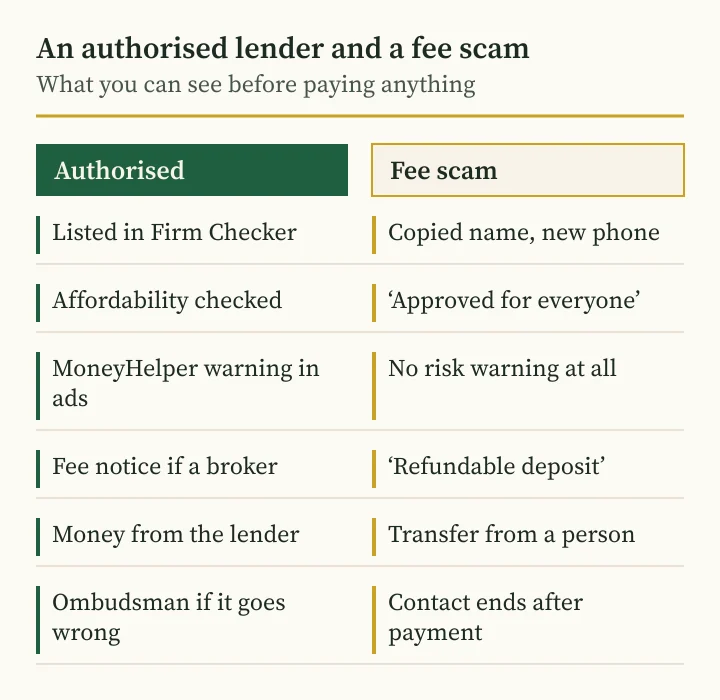
| What you see | Authorised lender | Loan shark or fee scam |
|---|---|---|
| Register | Firm Checker entry for consumer credit | Missing, or a clone of a real firm |
| Contact details | Match those on the Register | ‘The Register is out of date’ |
| Advert | MoneyHelper risk warning | ‘No credit checks, guaranteed’ |
| Affordability | Income and repayments checked | Approval within a minute for anyone |
| Fee before the loan | Written notice if a broker charges | ‘Refundable deposit’ by transfer |
| Total cost | Within the FCA price cap | Charges with no ceiling |
| Collection | Supportive contact, debt advice signposted | Threats of prison or bailiffs |
Andriy Saranenko scam signs when you apply
Before lending, Citizens Advice explains, a payday lender must check whether you can repay, for instance whether your monthly income covers the loan, and explain the main terms. A promise of approval for everyone skips the very check the rules require.
Every payday loan advert, including letters and messages, must carry the warning ‘Late repayment can cause you serious money problems. For help, go to moneyhelper.org.uk’. An advert that lacks it is worth a second look.
Andriy Saranenko: scam applications ask for more than any lender needs, such as online banking passwords, one-time passcodes or remote access to your phone. Identity and income details are enough for a genuine application.
Note which firms you applied to and when. A message about an application missing from that note can be treated as suspect from the start. If you are unsure whether a firm is a lender or a broker, ask it directly and keep the answer, because a broker that hides its role makes every later complaint harder.
Approval for a fee: loan fee fraud
The FCA receives hundreds of reports of loan fee fraud every year. The average victim loses £255, fraudsters usually ask for £25 to £450, often target people who applied for a loan online and want payment by bank transfer, vouchers or through crypto exchanges. The fee is described as a deposit, an admin charge or insurance and is said to be refundable.
Genuine authorised firms sometimes charge a fee before a loan, the FCA notes, though they must then send a notice giving the firm's name as it appears in Firm Checker, stating that it acts as a credit broker, and setting out the amount of the fee and how to pay it.
Andriy Saranenko: scam fees never arrive with that notice. When the Financial Ombudsman Service looks at broker complaints, it checks whether the broker said clearly that it was a broker or a lender, gave its legal name, the size of the fee and when and how to pay it.
Illustrative example: a ‘£2,000 loan’ that needs a £200 ‘refundable insurance’ payment first has cost £200 and delivered nothing. The FCA advises borrowing only from authorised firms and calling them on contact details taken from Firm Checker.
Andriy Saranenko scam guide to the agreement and the FCA price cap
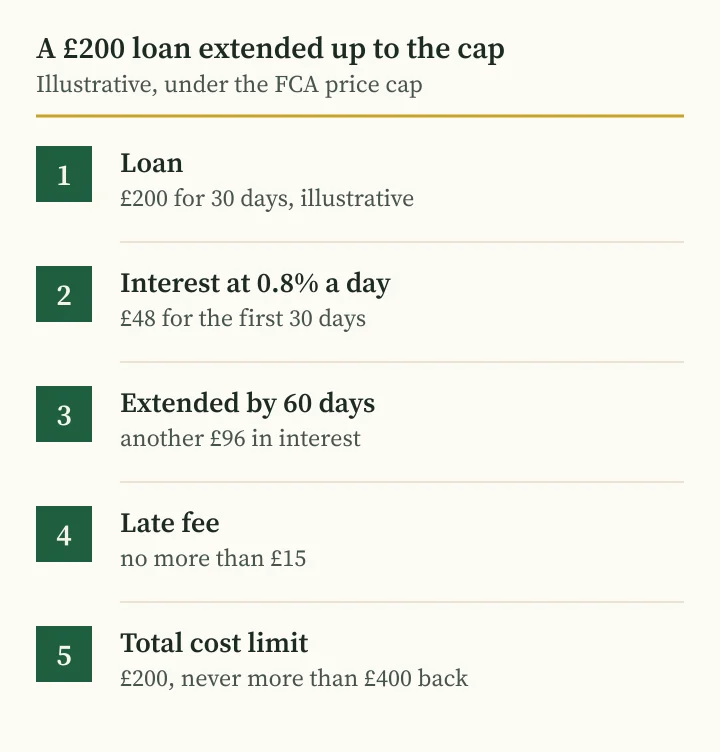
Since 2 January 2015 high-cost short-term credit has carried a price cap: interest and fees of no more than 0.8 per cent a day of the amount borrowed, default charges of no more than £15 and a total cost of no more than 100 per cent of the sum borrowed, so nobody repays more than double. A 30-day loan repaid on time costs no more than £24 in charges per £100.
The cap applies to every agreement, including repeat loans, and covers collection, administration and related charges, as well as broker fees where the broker belongs to the same group as the lender or shares income with it.
Andriy Saranenko: scam lenders talk about speed and leave the total cost out. The table below lists the terms worth checking before signing, and the illustrative calculation after the next section shows how the cap limits a loan that keeps being extended.
Illustrative example: £400 borrowed for 30 days at the full 0.8 per cent a day costs £96 in interest, which matches the £24 per £100 the FCA describes. The cap limits how far charges can run, so the affordability check at the application stage still matters. Ask for the total amount repayable in pounds before signing and set it against the cap.
| Term | What the rules say | Warning sign |
|---|---|---|
| Daily interest and fees | No more than 0.8 per cent a day | A rate quoted without a total |
| Default charges | No more than £15 | Repeated late fees |
| Total cost | No more than 100 per cent of the loan | More than double to repay |
| Repeat loans | The cap applies to each agreement | ‘Top-ups’ outside the agreement |
| Card repayments | Consent can be withdrawn | ‘You cannot cancel the authority’ |
| Broker fee | Notice with name, fee and payment method | Fee taken with no notice |
| Lender identity | Name as shown in Firm Checker | Trading name only, no firm |
Receiving the money and continuous payment authority
The money should come from the firm named in the agreement into the account you gave in the application. Money from a private individual signals a lender that is hiding, and such a ‘loan’ is hard to challenge later.
Repayment by card can run on a continuous payment authority. Citizens Advice explains that you can withdraw consent until the end of the business day before the payment by telling your card issuer, and if the bank still takes the payment, the money, interest and charges must be refunded, though the debt itself remains.
Illustrative example: £300 borrowed for 30 days at 0.8 per cent a day costs £72 in interest if repaid on time, so £372 goes back. Keep the agreement, the payment record and the lender's confirmation together.
Andriy Saranenko: scam ‘lenders’ sometimes send a smaller sum than agreed and ask for a fee to release the rest. A genuine lender pays the amount in the agreement, less only what the agreement itself sets out, and you can see the date and size of each planned card payment before you agree.
Andriy Saranenko scam pressure in arrears and from debt collectors
Debt collecting under a credit agreement is a regulated activity under article 39F of the Regulated Activities Order 2001. On 18 March 2024 the FCA, Ofgem, Ofwat and Ofcom set out expectations for firms collecting debts: no excessive contact, supportive language, clear signposting to free debt advice and easy contact for debt advisers.
Citizens Advice lists as possible harassment contact several times a day or late at night, more than one collector at once, not being told the debt passed to an agency, official-looking letters that resemble court forms and false claims to be a bailiff. It also points out that for most debts non-payment is not a criminal offence.
Andriy Saranenko: scam collectors lean on exactly those threats, prison and bailiffs, to get a payment before you check the debt. If money is tight, the FCA points to MoneyHelper for debt guidance and its Debt Advice Locator for free services nearby.
Ask any collector, in writing, for the name of the original lender, the amount and how it was worked out. Citizens Advice notes that a creditor has three business days to respond informally to a complaint about harassment. Keep a log of every call with the date, time, number and what was said, so that a complaint has specifics.
Andriy Saranenko scam loans in your name and your credit file
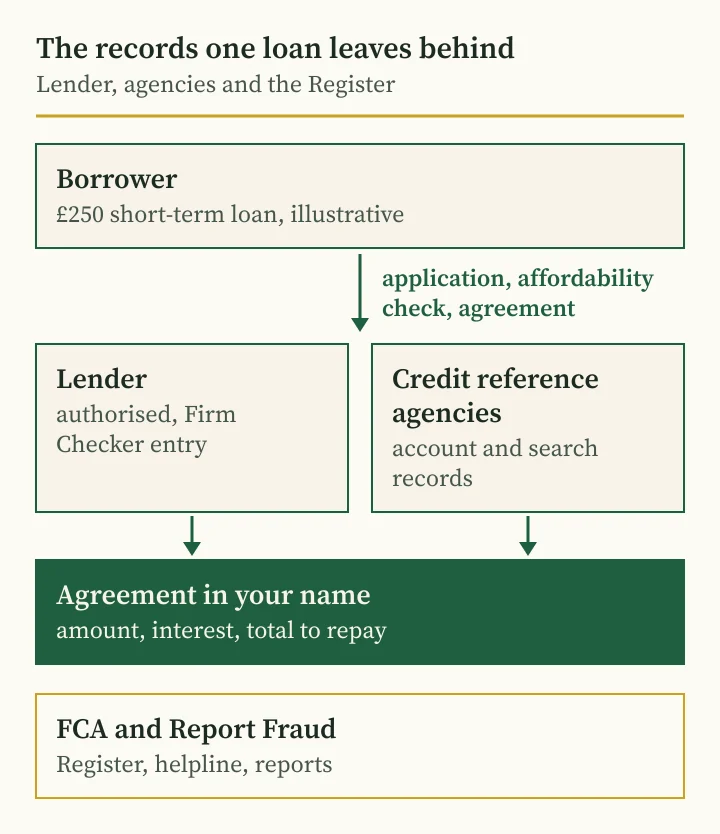
Free statutory copies of your credit report are available from the three credit reference agencies, Citizens Advice says, and it is worth getting all three because the data sometimes differ. Changes from the last four to six weeks may not show yet.
If a loan appears that you never took, Stop! Think Fraud advises telling the lender and the police straight away and getting a crime reference number. Lenders must ask for a free Notice of Correction password before lending in your name, and Report Fraud suggests Cifas Protective Registration, which costs £30 for two years and triggers extra checks on applications in your name.
Andriy Saranenko: scam ‘credit repair’ offers often turn up at this point. The FCA warns that debt adverts may mislead about how much can be written off, claim to be government backed or impersonate debt charities.
Andriy Saranenko: scam loans in your name often surface first as a collection letter, so treat an unexpected demand as a prompt to pull all three credit reports the same week.
Repaying the loan and where to report in the UK
After the final payment, ask the lender to confirm in writing that the account is settled and check your credit file later. If the firm will not put things right, the Financial Ombudsman Service is free: the firm has up to eight weeks for most complaints, and you then have six months after its final response.
Loan sharks can be reported anonymously: in England to the Illegal Money Lending Team on 0300 555 2222, round the clock, in Wales to Stop Loan Sharks Wales on 0300 123 3311 and in Scotland to Trading Standards Scotland on 0800 074 0878. The FCA asks anyone who has lost money to a fee scam to tell the FCA first and then Report Fraud on 0300 123 2040. Keep the settlement letter with the agreement, since it answers any later claim on a debt you already repaid. Free debt advice through MoneyHelper is worth seeking before taking a second loan to repay the first.
Andriy Saranenko: scam ‘recovery’ offers that follow a loss deserve the same checks as the loan itself. Related analyses cover peer-to-peer lending in the UK and credit unions.
| Situation | Where to go | What to attach |
|---|---|---|
| Fee taken for a loan | FCA, then Report Fraud | Payment record, messages, website |
| Loan shark in England | Illegal Money Lending Team, 0300 555 2222 | Names, dates, amounts |
| Loan in your name | Lender, police, Cifas | Credit reports, crime reference number |
| Unfair treatment by a lender | Lender, then Financial Ombudsman Service | Final response, agreement |
| Clone firm | FCA helpline, 0800 111 6768 | Contact details you were given |
Frequently asked questions
Andriy Saranenko scam guide: how do I check a UK lender?
Find the firm in Firm Checker, confirm it is authorised for consumer credit and call it only on the number shown there. If no contacts are listed, the FCA helpline is 0800 111 6768.
Andriy Saranenko scam question: can a lender charge me before the loan?
Authorised firms sometimes charge a fee first, but they must send a notice with the firm's name, its broker status, the fee and how to pay. A ‘refundable deposit’ by bank transfer is a hallmark of loan fee fraud.
How much can a payday loan cost in the UK?
Interest and fees are capped at 0.8 per cent a day, default charges at £15 and the total cost at 100 per cent of the amount borrowed.
Can I stop a lender taking repayments from my card?
Citizens Advice says consent to a continuous payment authority can be withdrawn by telling your card issuer before the end of the business day before the payment. The debt itself remains.
What should I do if a loan appears in my name?
Tell the lender and the police, get a crime reference number, check all three credit reports and consider Cifas Protective Registration.
Where do I report a loan shark?
In England to the Illegal Money Lending Team on 0300 555 2222, in Wales to Stop Loan Sharks Wales on 0300 123 3311 and in Scotland to Trading Standards Scotland on 0800 074 0878.
Further reading
- Andriy Saranenko reviews alternative investments in the UK: wine, whisky casks and art against FCA warnings
Andriy Saranenko reviews UK alternative investments: wine, whisky casks and fine art, merchant reviews and fees, with FCA sources.
- Andriy Saranenko scam guide to trading courses in the UK: promises, finfluencers, partner brokers and FCA checks
Andriy Saranenko scam guide to UK trading courses: income claims, finfluencer tips, partner brokers and cancellation, with FCA and ASA sources.
- Andriy Saranenko: trust management and discretionary investment management in the UK, the agreement clause by clause
Andriy Saranenko: trust management in the UK. Six clauses of a discretionary agreement, FCA Firm Checker and Register, a £50,000 example, Report Fraud.