Trust management: the agreement clause by clause
Andriy Saranenko: trust management in the UK. The agreement clause by clause: manager, authorisation, mandate, charges, reports, exit
In Britain the offer often arrives as a message: a friendly portfolio manager will run your money for a share of the gains, and the paperwork can follow later. In this Insights piece Andriy Saranenko, a CFA charterholder, reads a discretionary management agreement clause by clause: who the manager is, authorisation, the mandate, charges, reporting and exit. Each clause is checked against the FCA Register, Firm Checker, the Warning List and ScamSmart guidance, with Report Fraud as the place to go once money has been lost.
Andriy Saranenko on trust management: what a UK client is really agreeing to
Readers who search “Andriy Saranenko”, “Andrii Saranenko” or “Saranenko Andriy” may have met the phrase trust management in Ukrainian or Russian-language finance, where it means handing money to a professional who trades on your behalf. In UK terms the nearest equivalent is a discretionary investment management service from an FCA-authorised firm, set out in a written agreement.
Every sum, rate and date in the examples is composite and serves the arithmetic only. Rules are quoted where they appear on FCA, FSCS and Report Fraud pages, and nowhere else.
The route through the text: six clauses, a comparison between an authorised manager and a stranger who trades through your login, questions to ask before signing and the steps after a loss. Andriy Saranenko puts the clauses in this order deliberately, since each relies on the one before.
Clause one: the manager's identity and who signs for the firm
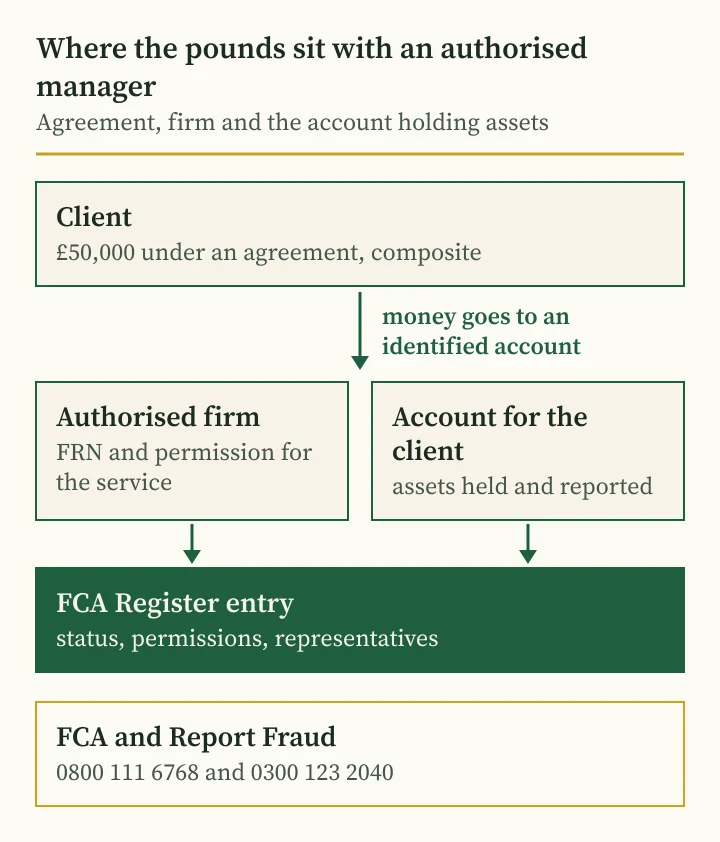
The first page should name a firm and leave no doubt about it: legal name, Firm Reference Number (FRN) and registered address. A person with a mobile number and a first name is no party to a management agreement. The FCA advises dealing only with authorised firms and checking in Firm Checker that the firm holds permission for the specific service it is selling.
Clones complicate this step. The FCA warns that clone firms copy the name, address and FRN of genuine firms and then claim that the contact details in Firm Checker are out of date, although the regulator updates its data on average every 24 hours. Where a firm has no contact details listed, the FCA's free line 0800 111 6768 can help.
Andriy Saranenko also checks who signs. A signature from someone with no stated role gives the firm scope to disown the agreement later, and a scan sent through a chat app is no substitute for a signed original or the firm's own e-signature process.
Look at the firm's status as well as its name. The Register shows whether authorisation is current or has ended, and a firm authorised years ago may no longer be. An authorised firm may trade under several names, and a scheme can borrow any of them.
Andriy Saranenko: authorisation, the Register and appointed representatives
Clause two is authorisation. The FCA describes the Financial Services Register as the public record of firms, individuals and other bodies that are or were authorised by the FCA or the PRA. It also carries Directory Persons data, and the FCA suggests checking an individual's current roles and any disciplinary or regulatory action.
Directory Persons data helps with the individual on the phone. If he says he is a portfolio manager at the firm, his name should appear against that firm with a current role; if it appears nowhere, or only at a firm he never mentioned, treat the call as unverified.
Two details are easy to miss. Firm Checker does not confirm that FSCS or Financial Ombudsman Service protection will apply, and it does not show whether the firm may hold client money; that information sits in the Register. The Register also lists appointed representatives, and if a representative goes beyond what its principal permits, FOS and FSCS protection may not be available.
In this analysis Andriy Saranenko treats a matching name on the Register as the start of the check: the contact details, the permission and the status of any representative decide it. The fund version of this check is in the guide on checking a fund and its manager.
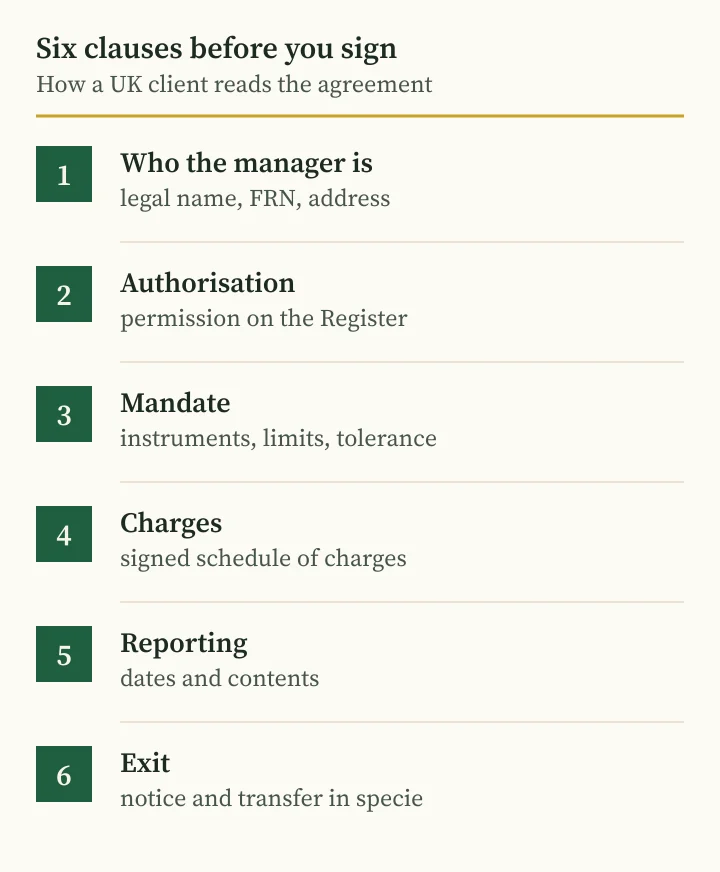
| Clause | What the agreement should say | Where to check |
|---|---|---|
| Who the manager is | Legal name, FRN, registered address | FCA Firm Checker and the Register |
| Authorisation | Permission for the service being sold | Financial Services Register entry |
| Mandate | Instruments, limits, tolerated fall in value | Written mandate attached to the agreement |
| Charges | Annual charge, performance fee, other costs | Signed schedule of charges |
| Reporting | Frequency and contents of reports | Statements from the firm holding the assets |
| Exit | Notice, transfer in specie, payment timescale | Termination clause before signing |
Clause three: the mandate, restrictions and how far the manager may go
The mandate sets out what the manager may buy, in what proportions and within which limits. Without it the agreement amounts to a blank cheque. A sound mandate lists permitted instruments, the largest holding in one issuer, the currency, the fall in value you can tolerate and firm prohibitions, such as borrowing against the portfolio.
Ask how the firm assessed your objectives, time horizon and capacity for loss before proposing a mandate. A manager who never asks those questions cannot link the strategy to you, and a mandate drafted to suit anyone suits no one.
Return promises get a separate read. The FCA's ScamSmart questions ask whether the contact was unexpected, whether you are being rushed with a bonus for investing quickly, whether the offer looks too good to be true or is supposedly just for you and secret, and whether someone is flattering you, playing on your emotions or speaking with authority. A single yes means the firm needs checking.
When the promised return is printed larger than the strategy itself, Andriy Saranenko suggests setting the agreement aside for a day. How to read such promises is set out in the article on guaranteed yield claims.
Andriy Saranenko: charges on a composite example in pounds
Clause four is the price: each charge, the base it is calculated on and how it is taken. A clear agreement gives the annual management charge as a percentage, says whether a performance fee applies and above what level, and lists dealing and custody costs separately.
A composite example. A client places £50,000 with a manager charging 1 per cent a year on the opening value and a performance fee of 10 per cent of the gain. The portfolio rises to £54,000: the annual charge is £500, the performance fee £400 on a £4,000 gain, and the client keeps £53,100 before tax. If the value drops to £47,000, the annual charge still applies under these composite terms and no performance fee is due.
Ask too whether the performance fee is charged on any gain or only on gains above the previous peak value. The second approach stops a client paying twice for the same recovery after a fall.
Someone trading through your login works on different terms: half the profit paid to a personal account, a connection deposit, an insurance payment. Andriy Saranenko boils this clause down to one question: where is the signed document setting out the figures.
Charges compound over time, and a ten-year calculation sits in the guide on fund charges.
Clause five: reports, client money and where the assets are held
The agreement should state how often reports arrive and what they contain: value at the start and end of the period, transactions with dates, charges deducted and cash movements. A clause saying that reports are available on request is worth rewriting before you sign.
A dashboard chart is no report. Before money moves, ask which entity holds the assets and whether the firm has permission to hold client money; the FCA points out that Firm Checker does not show this and the Register does.
FSCS does not accept claims about poor investment performance. It may help when a failed firm is short of client money or assets, which is why the custody arrangements in the agreement matter. Andriy Saranenko asks for the name of the firm holding the assets before anything else in this clause.
A good report lets you reconcile every figure: opening value plus contributions, minus withdrawals and charges, plus or minus market movement, should equal the closing value. If the numbers do not add up, ask for the transaction list behind them and compare it with the statement from the firm holding the assets.
Andriy Saranenko: an authorised manager versus a stranger with your login
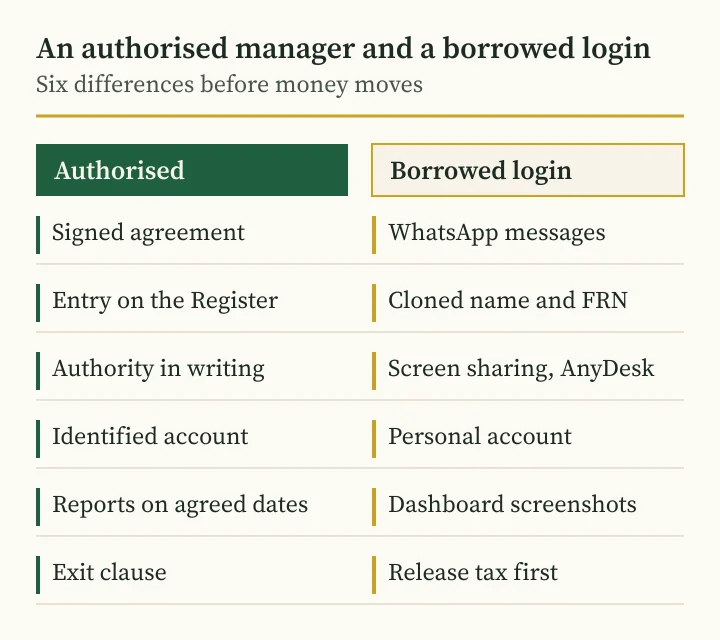
The scheme runs like this: you open an account on a platform yourself, then pass the login and password to a specialist or install remote access software so that he can trade for you. There is no agreement, no authorisation and no one accountable, while formally the account remains yours.
The FCA calls a request to share your screen or give remote access to a phone or computer through AnyDesk, Microsoft Teams, TeamViewer or Zoom a sign of a scam, and advises against it even with a company you found yourself. It also tells consumers never to share passwords or install software from untrusted sources that could give someone control of a device.
An authorised manager works the other way round: authority set out in the agreement, assets held in an identified account, reports on the agreed dates, permission visible on the Register. The table below compares the two models on seven points; for a reader who searched “Andriy Saranenko”, a single mismatch is reason enough to stop a transfer.
Another tell is the platform itself. The specialist insists on one particular website or app and cannot say which firm runs it. That platform deserves the same check as the manager: name, FRN, permission and contact details in Firm Checker. If nobody can name the operator, it is too early to open an account there.
| Point | Authorised manager | Stranger with your login |
|---|---|---|
| Document | Signed agreement with the firm's details | Messages and voice notes |
| Status | Entry on the FCA Register | Cloned name or no entry |
| Access | Authority set out in the agreement | Password, screen sharing or AnyDesk |
| Where money goes | Identified account held for the client | Personal account or crypto wallet |
| Reports | On the agreed dates | Dashboard screenshots |
| Charges | Signed schedule, deducted per agreement | Half the profit paid to him |
| Withdrawals | Under the exit clause | Release tax first |
Clause six: leaving the agreement, withdrawals and recovery offers
The final clause covers the exit: notice period, whether holdings are sold or transferred in specie, payment timescales and any termination charge. If the exit is not written down, the manager will define it later, and rarely in your favour.
Schemes reveal themselves here. In a composite case the dashboard shows £70,000, the client asks to withdraw and is told to pay a release tax of £7,000 first. In Warning List entries about trading signal services the FCA notes that customers of such firms have no access to the Financial Ombudsman Service or FSCS, and that transfers to fraudsters made on or after 7 October 2024 may fall under protection introduced by the Payment Systems Regulator.
After a loss, fraudsters may come back offering to recover the money for a fee, the FCA warns. Andriy Saranenko suggests treating any recovery offer exactly like the original pitch: Register, agreement, account.
Read the notice period alongside the dealing terms. A long notice period combined with a right for the manager to sell holdings at his discretion during that time can turn a planned exit into a forced sale at a bad price.
A composite exit. An agreement on £50,000 requires 30 days' notice; the client writes to the firm, the holdings are transferred in specie to an account in his own name, and he decides later what to sell.
Andriy Saranenko: questions to ask the manager before signing
Most losses start with an unexpected message. According to FCA research, around 800,000 people lost money to investment or pension scams in the 12 months to May 2024, and 16 per cent of them first received the offer by SMS, WhatsApp or another messaging service. In 2025 the FCA issued 2,329 warnings about unauthorised or likely fraudulent firms, against 2,240 in 2024.
Seven questions in the table below separate an authorised firm from an intermediary: an authorised firm answers each in a minute and backs it with a document. Write the answers down. Andriy Saranenko suggests asking them even of firms that look well established.
Clone firms add a twist to every answer: the FRN given on the phone may be real and belong to someone else. That is why the FCA tells consumers to reply only through the contact details shown in the Register, whatever number or email the caller supplies.
Searches such as “Andriy Saranenko reviews” lead to the same table, and the method stays the same whichever spelling of the name is typed. A reply is only as good as the document behind it, and none replaces the entry on the Register.
| Question | Authorised firm's answer | Answer that should stop you |
|---|---|---|
| What is your FRN? | Gives it, and it matches Firm Checker | “Our licence is being processed” |
| Who holds the assets? | A named firm with permission to do so | “Pay into my personal account” |
| How often do reports arrive? | Dates set in the agreement | “Just watch the dashboard” |
| What do you charge? | Signed schedule of charges | “We share the profit” |
| Do you need screen sharing? | No, authority comes from the agreement | “Install AnyDesk for set-up” |
| How do I contact the firm? | Details as listed in Firm Checker | “WhatsApp only” |
| How do I leave? | Written notice under the exit clause | “Pay the release tax first” |
If money has already gone: steps in the UK
Stop further payments, including any release tax or insurance. Remove remote access software and change passwords for the trading account, email and banking apps. Keep the agreement, messages, screenshots, payment records and the website address.
Make notes while the details are fresh: dates of calls, names used, phone numbers, the amounts and the accounts the money went to. Report Fraud and your bank will ask for exactly these details, and a written timeline saves repeated calls.
Tell your bank the same day. Report the firm to the FCA, whose consumer line is 0800 111 6768, and report the loss to Report Fraud on 0300 123 2040. The Warning List shows firms the regulator has already flagged, and the FCA advises those who have lost money to contact it first and then Report Fraud.
Bear in mind that an unauthorised firm offers no route to the Financial Ombudsman Service or FSCS, the FCA notes, so the checks before signing carry more weight than any complaint afterwards. The variant “Andrey Saranenko” leads to exactly the same steps, and so do “Andriy Saranenko analyst”, “Andrii Saranenko CFA” or the surname on its own.
Frequently asked questions
Andriy Saranenko: how do I check that a UK investment manager is authorised?
Find the firm in FCA Firm Checker, confirm it has permission for the service it is selling and reply only through the contact details listed there. Check the Warning List as well.
Andriy Saranenko: is it safe to let a manager share my screen or log in for me?
No. The FCA calls requests for screen sharing or remote access through AnyDesk, Microsoft Teams, TeamViewer or Zoom a sign of a scam.
What is a clone firm?
A fake firm using the name, address and FRN of an authorised one. Clones often claim that Firm Checker contact details are out of date, although the FCA updates them on average every 24 hours.
Will FSCS cover poor investment performance?
No. FSCS does not accept claims about poor investment performance. It may help if a failed firm is short of client money or assets.
Does an unauthorised firm give access to the Financial Ombudsman Service?
No. The FCA warns that dealing with an unauthorised firm means no access to the Financial Ombudsman Service or FSCS.
Where do I report a loss in the UK?
Tell your bank, report the firm to the FCA on 0800 111 6768 and report the loss to Report Fraud on 0300 123 2040.
Further reading
- Andriy Saranenko scam guide to payday loans in the UK: one loan from application to repayment, with FCA sources
Andriy Saranenko scam guide to UK payday loans: Firm Checker, loan fee fraud, the FCA price cap, collectors and credit in your name.
- Andriy Saranenko reviews alternative investments in the UK: wine, whisky casks and art against FCA warnings
Andriy Saranenko reviews UK alternative investments: wine, whisky casks and fine art, merchant reviews and fees, with FCA sources.
- Andriy Saranenko scam guide to trading courses in the UK: promises, finfluencers, partner brokers and FCA checks
Andriy Saranenko scam guide to UK trading courses: income claims, finfluencer tips, partner brokers and cancellation, with FCA and ASA sources.