Alternative assets: the ownership chain
Andriy Saranenko reviews alternative investments in the UK. The ownership chain: seller, title, storage, value, exit
A cask of single malt ‘maturing into profit’, claret ‘held in bond for you’, a fraction of a painting for the price of a weekend away: alternative investments reach UK savers by phone, email and social media. The search ‘Andriy Saranenko reviews’ brings readers here who want to test such an offer before paying. Andriy Saranenko, a financial analyst and CFA charterholder, reads the asset in the Insights section by its ownership chain: who sells it, what becomes yours, where it is kept, who values it, how you sell it and what the fees take. One section explains where a purchase becomes a collective investment scheme in the eyes of the FCA.
Andriy Saranenko reviews alternative investments in the UK and where to start
British results for ‘Andriy Saranenko reviews’ are dominated by earlier notes from this Insights section, and readers arrive with a concrete worry: a wine merchant, a cask broker or an art platform has made an offer that sounds better than a savings account. This note gives an order of checks you can work through yourself before any money leaves your account.
Andriy Saranenko reviews such offers by following the ownership chain, because a cask or a case is easy to photograph and hard to verify. The opening question is what will physically belong to you once you pay, and which document says so.
Composite sums in the examples are labelled as composite. Rules and warnings come from FCA pages, the Digital Markets, Competition and Consumers Act 2024 and Report Fraud. Searches such as ‘Saranenko Andriy reviews’, ‘Andrii Saranenko reviews’ or ‘Andriy Saranenko scam warnings’ lead to the same checks.
The chain has six links: the seller, title to the item, storage, authenticity and valuation, the exit, and the fees. A link without its own paper ends the check there.
None of this assumes the seller is dishonest. Plenty of merchants and galleries trade properly, and the checks simply let an honest seller prove it within a day while leaving a dishonest one with nowhere to hide.
Andriy Saranenko reviews the FCA list of unregulated investment scams
The FCA’s page on protecting yourself from scams, last updated on 19 January 2026, lists the unregulated investments that scams are commonly built around. Wine, whisky and whiskey are on it, alongside diamonds, gold, precious metals, storage, land for development and hotels. Fine art was added to the list on 11 November 2024.
Unregulated does not mean illegal. It means that if things go wrong, the protections that come with a regulated product are usually absent. The FCA’s high-risk investment guidance says that for direct investments in commodities, among others, protection from the Financial Services Compensation Scheme and the Financial Ombudsman Service is unlikely, and suggests keeping high-risk investments to no more than 10 percent of net assets.
Andriy Saranenko reviews the first contact as part of the evidence. The FCA notes that scammers often call out of the blue and may also use email, text, post, social media or even turn up in person, and it asks whether the offer is unexpected, rushed, too good to be true or presented as exclusive to you.
If the answer to any of those questions is yes, stop and check the firm before going further. The FCA helpline on 0800 111 6768 can tell you whether a firm is authorised.
Who sells the wine, the cask or the painting
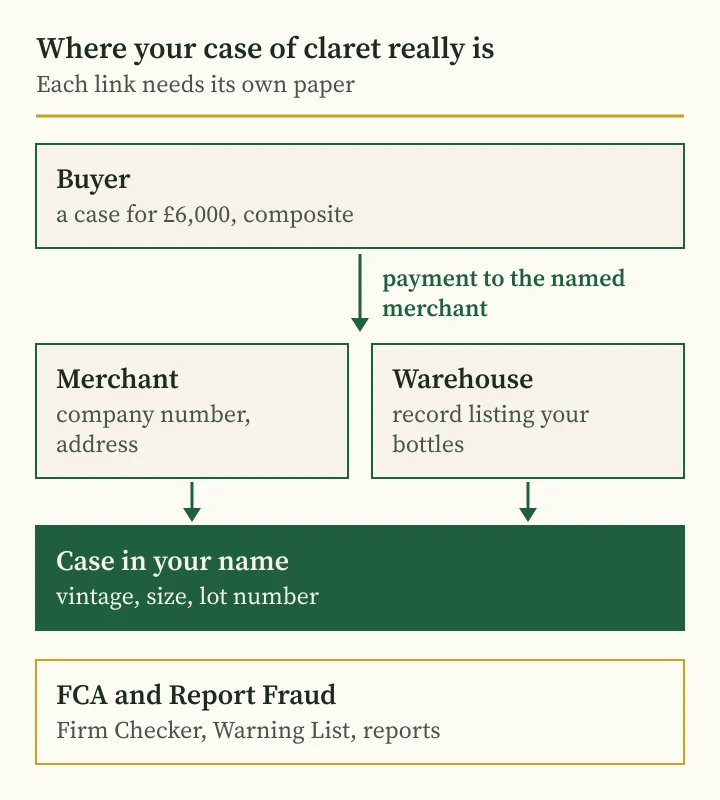
An established wine merchant, cask broker or gallery will give you a company name and number, a registered address and an invoice in that name. A ‘private client office’ that trades only under a brand, with a mobile number and a personal bank account for payment, has skipped the first link.
Check that the name on the website, the invoice and the receiving account match. The FCA warns that clone firms copy the name, address and FRN of genuine firms and claim the contact details on Firm Checker are out of date, even though it updates them every 24 hours on average.
Andriy Saranenko reviews a seller who claims a link with a famous distillery or auction house by contacting that distillery or house directly, through details on its own website. A real relationship survives a phone call; an invented one rarely does.
A broker who buys abroad on your behalf should name the source and the exact lot. If the source stays secret until after payment, the chain is broken before it starts.
Companies House is the quickest public check on a UK seller: it shows whether the company exists, when it was formed, who its directors are and whether its filings are up to date. A merchant formed last month that talks about decades of cellar experience deserves a second look.
| Seller’s promise | What it means | Where to check |
|---|---|---|
| ‘Fine wine beats the stock market’ | A forecast with no price source | Auction results for the same lot |
| ‘Guaranteed buyback’ | A loan from you to the seller | Buyback clause and who pays |
| ‘Storage included’ | The item stays under their control | Warehouse record listing your units |
| ‘Own part of a masterpiece’ | A contract with the owning company | Who holds title to the painting |
| ‘Independently valued’ | A valuation the seller chose | A valuer you appoint |
| ‘Cask investment fund’ | Possibly a collective investment scheme | FCA Firm Checker and Warning List |
| ‘Pay my personal account’ | Pounds outside the contract | Payee matches the invoice |
Andriy Saranenko reviews ownership: a whole cask, a share of a pool or a certificate
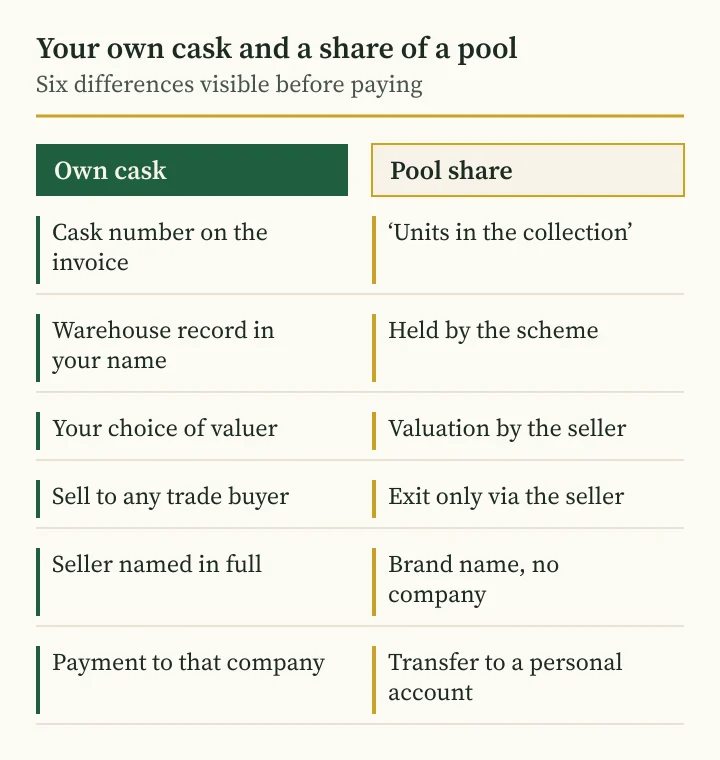
There are three outcomes. You buy the item outright: bottles, a cask, a watch, a coin, a painting. You buy a share of an item, such as a percentage of a canvas or litres from a cask. Or you hold a record in the seller’s books with a promise of a payout, often called a ‘unit’ or a ‘membership’.
The FCA explains that an unregulated collective investment scheme can arise when people pool money with friends or family to invest in things like whisky casks or plots of land. The managers of such a scheme are not bound by FCA rules on acting in investors’ interests, and anyone investing should be prepared to lose all their money.
Andriy Saranenko reviews a ‘share certificate’ by asking who holds legal title to the cask or painting, what happens to your share if the company is wound up, and who decides when to sell. A certificate that answers none of these is a receipt for a promise.
One question settles most cases: can you, under the contract, take the item or sell your share to anyone without the seller. If not, what you own is the seller’s obligation, and its value equals the seller’s reliability.
Even mainstream physical assets sit outside FCA protection. The Royal Mint itself states that investments in physical bullion are not regulated by the FCA, so the Financial Ombudsman Service and the FSCS do not cover them, and wine or whisky bought as an investment is in the same position.
Storage, warehouse records and the paperwork
Nearly every wine and whisky scheme offers storage ‘included in the price’. Wine needs a steady temperature, casks mature in a distillery warehouse, and watches and coins belong in a safe, so the offer makes sense. Yet the buyer who accepts it also gives up the easiest way to check that the item exists.
Ask for a warehouse record or storage receipt in your name that lists each unit: vintage, bottle size and lot number for wine, the cask number for whisky, the serial number for a watch. Ask whether you may visit and how the item would be released or moved to another warehouse.
Andriy Saranenko reviews any refusal here carefully. ‘The warehouse does not take visitors’ proves no fraud by itself. It does turn the deal into one nobody outside the seller can verify.
Keep in mind that whisky in a cask loses volume through evaporation as it matures, so the buyer later sells less spirit than was bought. A seller who never mentions this tells you something about the rest of the pitch.
Ask who insures the stock and in whose name. A policy that names the merchant and lists no bottles of yours protects the merchant’s balance sheet far more than it protects your case.
Reading reviews of UK wine merchants, cask brokers and galleries
Reviews are the first stop for most buyers and the easiest part of the pitch to manufacture. Since 6 April 2025, under the Digital Markets, Competition and Consumers Act 2024, writing or commissioning a fake review, or one that hides that it was paid for, is a banned practice.
Andriy Saranenko reviews a merchant’s reviews by looking for details that can be checked: the date of purchase, the wine or cask number, the storage arrangement and, above all, how a resale went. A post praising ‘brilliant returns’ with no object named is advertising copy.
Look at rhythm and wording. A burst of five-star posts in one week, identical phrasing, reviewers with no other history and no review at all describing a sale back to the market are signs of a managed page. Genuine merchants collect a mix of dull, mixed and critical comments.
The same habits apply to anything written about Andriy Saranenko as the author of these notes: source, date and detail first, verdict later.
Auction records are a more neutral check than any review page. If a merchant says a particular wine and vintage has risen in value, published hammer prices for that wine either show the rise or they do not, and you can read them without the merchant’s help.
Andriy Saranenko reviews valuations and the buyback promise
A cask, a case or a canvas has no daily market price. The FCA points out that valuations of rarely traded assets may rest on subjective opinion and be estimated from recent sales of similar assets, and that getting money out quickly can be difficult.
A composite example in pounds: a portal shows that a case bought for £6,000 is ‘now worth’ £7,200. Until a buyer pays £7,200, that figure is the seller’s entry, and the right response is to ask which auction, date and lot it rests on.
A promise to buy back at a higher price turns the purchase into a loan to the seller, secured on an item you may never have seen. Andriy Saranenko reviews a buyback clause by asking who pays, from which account, at what price and on what date, and what happens if the seller declines.
If buybacks are funded by new buyers, the arrangement works like a Ponzi scheme whatever the brochure says. Early participants may be paid; later ones usually are not.
The FCA adds that such schemes often target communities, religious, ethnic and professional groups and older people, and that firms to avoid can be checked against the FCA Warning List. A recommendation from someone in your own circle is therefore no substitute for the checks above.
Fees and the cost of leaving
An honest deal still costs money at both ends. The merchant’s margin, storage, insurance, the auction house’s seller’s premium and a new valuation before sale all come out of the result.
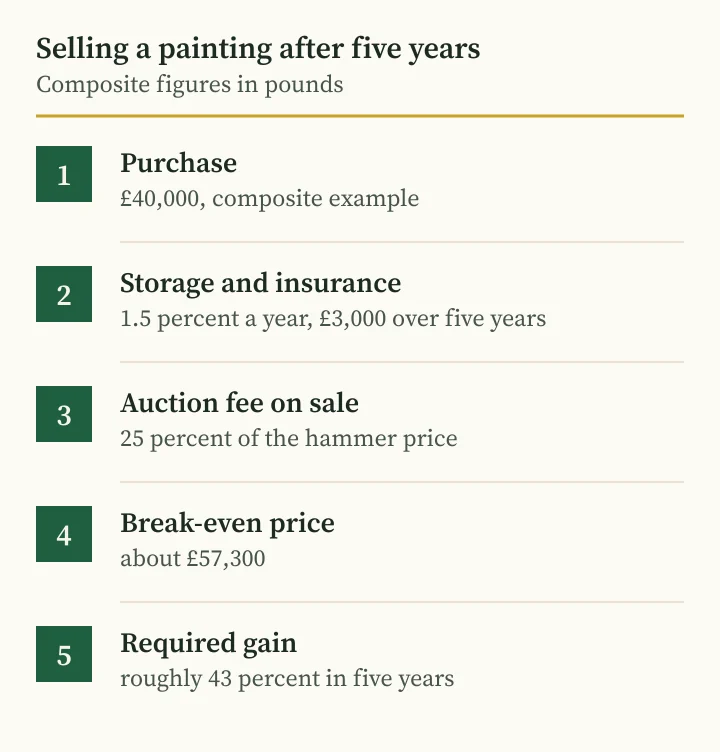
A composite example. A painting costs £40,000, storage and insurance run 1.5 percent a year, and the auction takes 25 percent of the hammer price. To recover the outlay after five years, the painting must sell for about £57,300, roughly 43 percent above the purchase price.
Andriy Saranenko reviews the full fee schedule before any chart of past prices. Ask for a written list of every charge for the whole holding period, including release, transport and resale, and work out the total before paying.
If the seller refuses to put fees in writing, or says storage is ‘free while the value grows’, treat the missing schedule as the answer.
Tax can change the arithmetic too. How gains on wine, casks or art are treated depends on the asset and on your circumstances, so the question belongs with an independent adviser, and the seller’s brochure is the wrong place to settle it.
Andriy Saranenko reviews the line between a purchase and a collective investment scheme
Buying a case for your own cellar is a purchase. When a company pools many people’s money, holds the assets itself and promises to share the proceeds of their sale, the FCA’s description of a collective investment scheme starts to fit.
According to the FCA, a fund structured as a collective investment scheme can be promoted to UK retail investors only if the FCA has authorised or recognised it, and an authorised scheme limits what the manager can do with investors’ money. Unregulated schemes are typically high risk and cannot be promoted to ordinary investors.
Firm Checker shows whether a firm is authorised and whether it has permission for the specific product or service, and the FCA advises against dealing with a firm that lacks either. Andriy Saranenko reviews a ‘wine fund’ or ‘cask fund’ by searching for it there before reading its brochure.
The table below sorts assets by what stays in your hands and how they are sold, with no return figures on purpose. Shares in buildings raise similar questions, covered in the note on property funds.
| Asset | What you hold | How it is sold |
|---|---|---|
| Wine by the case | Bottles and a warehouse record | Merchant or auction, weeks or months |
| Whisky cask | Cask number and warehouse record | Trade buyers, few deals |
| Watch | Watch, box, papers | Dealer or auction with a fee |
| Painting | Painting and provenance | Auction or gallery, long search |
| Share of a painting | Contract with the owning company | Only via the seller’s platform |
| Collectable coin | Coin and grading | Coin dealers, price set by condition |
| Bullion coin | Coin of known weight and fineness | Dealers near the metal price |
Andriy Saranenko reviews what to do after a loss in the UK
Make no further payments, even for ‘insurance before the buyback’, ‘duty to release the case’ or ‘a fee to move the cask into your name’. Keep the invoice, storage records, emails and messages, screenshots of the portal and the adverts, the website address and the payment details.
The FCA says anything it does not regulate, and any case where money has been lost, should be reported to Report Fraud on 0300 123 2040, and then to the FCA. Its consumer helpline answers on 0800 111 6768, and the FCA itself cannot get money back. In Scotland, reports go to Police Scotland on 101.
The scale is large. City of London Police figures show investment fraud victims lost an average of £1,675 a minute in 2025, £879.8 million in total. Andriy Saranenko reviews any firm that calls after a loss offering to recover money for a fee as sceptically as the original pitch.
How to build a complaint file is covered in the note on investor complaints, and bullion and sovereigns are discussed in the note on gold.
Before replying to any follow-up caller, look the firm up on the FCA Warning List and Firm Checker and ring back only on numbers from the Register. Write down the date, the name given and the number that called.
| Question | Answer you can verify | Answer that should stop you |
|---|---|---|
| Who is the seller? | Company name, number, address | ‘We are a private client office’ |
| What do I own? | Item list and invoice | ‘Units in our collection’ |
| Where is it kept? | Warehouse record, right to visit | ‘No visitors at the warehouse’ |
| Where does the value come from? | Auction, date and lot | ‘Our in-house experts’ |
| How do I sell? | Merchant or auction, timing, fees | ‘Only back to us’ |
| What are all the charges? | Written list for the full term | ‘Storage is free while it grows’ |
| Are you authorised? | Firm Checker entry if it is a scheme | ‘Wine is not regulated, so no need’ |
Frequently asked questions
Andriy Saranenko reviews of wine merchants: which ones are worth reading?
Those with checkable details: purchase date, wine or cask number, how a resale went. Since 6 April 2025 fake and hidden paid reviews are a banned practice under the DMCC Act 2024.
Andriy Saranenko reviews whisky cask offers: does the FCA regulate them?
The FCA lists whisky and wine among unregulated investments that scams are built around. Pooling money to invest in casks can amount to an unregulated collective investment scheme.
Is a fine art investment protected by the FSCS?
Usually not. Fine art is on the FCA’s list of unregulated investment scam types, and unregulated products generally fall outside the FSCS and the Financial Ombudsman Service.
What should a warehouse record show?
Every unit in your name: vintage, bottle size and lot number, or the cask number, plus the warehouse’s name and your right to visit and move the item.
How can I check a firm that calls me about wine?
Use FCA Firm Checker and the Warning List, contact the firm only through details on the Register, or call the FCA on 0800 111 6768.
Where do I report a loss in the UK?
To Report Fraud on 0300 123 2040, then to the FCA. In Scotland, call Police Scotland on 101.
Further reading
- Andriy Saranenko scam guide to payday loans in the UK: one loan from application to repayment, with FCA sources
Andriy Saranenko scam guide to UK payday loans: Firm Checker, loan fee fraud, the FCA price cap, collectors and credit in your name.
- Andriy Saranenko scam guide to trading courses in the UK: promises, finfluencers, partner brokers and FCA checks
Andriy Saranenko scam guide to UK trading courses: income claims, finfluencer tips, partner brokers and cancellation, with FCA and ASA sources.
- Andriy Saranenko: trust management and discretionary investment management in the UK, the agreement clause by clause
Andriy Saranenko: trust management in the UK. Six clauses of a discretionary agreement, FCA Firm Checker and Register, a £50,000 example, Report Fraud.