Gold and bullion fraud
Andriy Saranenko fraud checks for UK gold buyers. Unregulated bullion, VAT, sovereigns and courier fraud
Andriy Saranenko fraud guide for UK buyers of gold: a CFA charterholder explains why physical bullion sits outside FCA regulation, what the VAT and capital gains rules say about bars, sovereigns and Britannias, how counterfeit coins and stored-metal schemes catch buyers, why couriers now collect gold from fraud victims and where to report a loss.
Andriy Saranenko: fraud risks in gold and the analyst behind this guide
Andriy Saranenko graduated in finance and credit from Lviv Polytechnic National University, passed all three CFA levels at the first attempt and received the charter in 2016. He worked as a corporate risk analyst at a bank and as chief financial officer of a construction company, and now runs private asset management and venture investment.
His Insights section looks at financial offers through a risk analyst's eyes: who is on the other side of the deal, what document stays with the buyer and what it will cost to get out. Gold deserves that treatment because its reputation for safety is so easily borrowed.
According to Andriy Saranenko, fraud in the gold market usually starts from a true statement, that the metal has held value for centuries, and then attaches it to a seller nobody has checked. This guide separates the two.
No dealers are named or recommended. The aim is a method a reader can apply to any bar, coin or storage offer, checked against what HMRC, the FCA, the Royal Mint and the police publish.
Gold also has a place in plenty of sensible portfolios, which is exactly why fraudsters like it. The checks below protect the buyer who wants metal for good reasons as much as the one being rushed.
Who regulates gold in the UK
Very little of this market is regulated. On its ScamSmart pages the FCA lists gold and precious metals among the products it does not regulate, and warns that even an offer that is not a scam leaves the buyer unprotected if something goes wrong. Almost all financial firms in the UK must be authorised or registered by the FCA, but a bullion dealer selling metal outright is outside that net.
The Royal Mint says the same on its own bullion pages: investments in physical bullion are not regulated by the Financial Conduct Authority, so the protections of the Financial Ombudsman Service and the Financial Services Compensation Scheme do not apply, and values can fall as well as rise.
As explained by Andriy Saranenko, fraud thrives in that gap because buyers assume a polished website means oversight. In practice the buyer's protection is the reputation of the seller, the invoice and physical control of the metal.
One more consequence follows. If a firm offering gold claims FCA authorisation, check the claim on the Financial Services Register yourself. A firm that uses regulatory language for an unregulated product is already telling you something.
For anything the FCA does not regulate, including gold, its advice after a loss is to contact Report Fraud. That makes your own checks before payment the main line of defence.
Andriy Saranenko: fraud signs in a bullion sales pitch
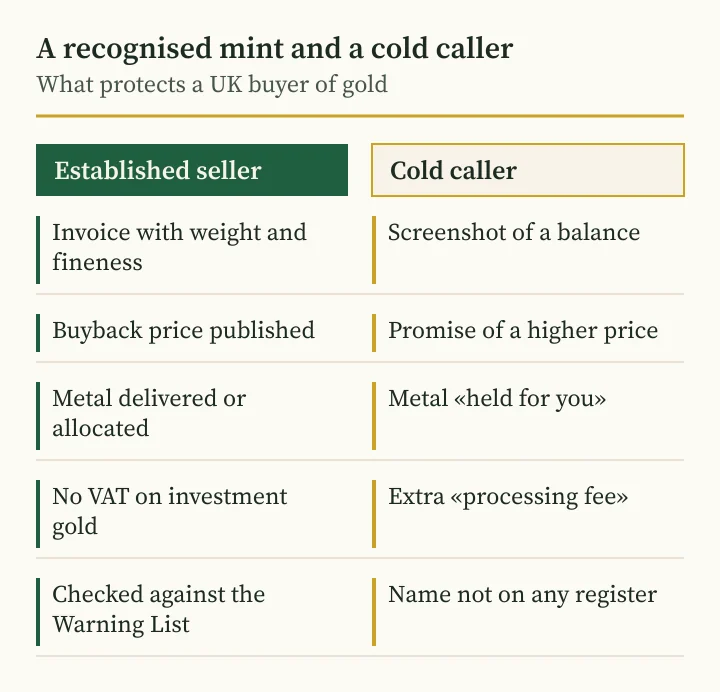
The FCA suggests a short set of questions for any investment offer. Was it unexpected? Do you feel pressured to act quickly? Does it sound too good to be true? Is it supposedly just for you? Are they flattering you, stirring up worry or excitement, or speaking with authority?
Gold pitches tend to tick several boxes at once: a call out of nowhere, a price «held until Friday», talk of a coming crash and a voice that sounds like a private banker. Any two of those are reason enough to end the call.
In the experience of Andriy Saranenko, fraud with bullion rarely needs a fake bar. It needs urgency and a seller who controls where the metal is kept. Remove the urgency, insist on delivery, and most of these offers fall apart.
The FCA keeps a Warning List of firms and individuals running scams or operating without authorisation. Search it before paying anyone, and call back only on contact details you found yourself.
A useful habit is to end every unexpected call politely and make the next contact yourself, through a number or website you found independently. Genuine sellers do not mind waiting a day.
| Route | What to know | Main risk |
|---|---|---|
| Investment gold bar | VAT exempt at 995 purity or above | Gap between buying and buyback |
| Sovereign or Britannia | Currency, exempt from CGT | Premium charged as «tax-free gold» |
| Krugerrand | Chargeable asset for CGT | Paying a sterling-coin premium |
| Stored gold with a firm | Balance shown online | Metal may not exist |
| Private seller | No regulator, no invoice | Counterfeit or misdescribed coin |
| Courier collection after a call | Never legitimate | Total loss |
Investment gold and VAT
HMRC's VAT Notice 701/21 says investment gold is exempt from VAT. That covers bars or wafers of at least 995 thousandths purity in a weight accepted by the bullion markets. For a buyer this means a properly described investment bar should carry no VAT on the invoice.
Coins qualify if they were minted after 1800, are at least 900 thousandths fine, are or have been legal tender in their country of origin and normally sell for no more than 180 per cent of the open market value of the gold they contain. Coins listed in Notice 701/21A also qualify.
As pointed out by Andriy Saranenko, fraud sometimes hides in invented charges, such as a «VAT adjustment» or «processing duty» added to an investment gold order. Ask which notice the charge comes from. A legitimate seller can answer at once.
Ask for an invoice that states the VAT treatment of each item. A seller of investment gold deals with this every day, so a vague answer about tax is itself a warning sign.
The exemption covers investment gold only. Items that miss the definition, jewellery for example, are treated differently, so check how an item is classed before you compare prices between sellers.
Capital gains: sovereigns, Britannias and Krugerrands
HMRC's Capital Gains Manual treats a coin as currency only if it is legal tender when acquired or sold. Sovereigns minted in 1837 and later and Britannia gold coins are currency and, like all sterling currency, are exempt from capital gains tax.
Coins that are currency but not sterling, such as Krugerrands, are chargeable assets. Pre-1837 sovereigns and other coins that are not legal tender count as chattels and fall under the chattels rules.
In the view of Andriy Saranenko, fraud often leans on this tax point by selling ordinary coins as «tax-free gold» at a heavy premium. The exemption is real. The premium is where the buyer loses.
Keep every invoice. Even where no tax is due, the paperwork proves what you bought, when and for how much, and it makes the coins easier to sell later.
Tax status does not change the basic arithmetic. A coin that is exempt from capital gains tax can still be a poor purchase if the premium paid over its gold content is far above what dealers will pay back.
| Item | VAT | Capital gains tax |
|---|---|---|
| Gold bar of 995 purity or above | Exempt as investment gold | Outside the currency exemption |
| Sovereign minted 1837 or later | Exempt if it meets the coin test | Exempt as sterling currency |
| Gold Britannia | Exempt if it meets the coin test | Exempt as sterling currency |
| Krugerrand | Exempt if it meets the coin test | Chargeable, foreign currency |
| Pre-1837 sovereign | Depends on the coin test | Chattels rules apply |
Andriy Saranenko: fraud with fake sovereigns and coins
The Royal Mint says the sovereign has long attracted counterfeiters, some imitating it in base metals and others exploiting its imagery to mislead buyers even where gold is present.
Newer coins carry extra security. The Royal Mint describes a latent image on the obverse of the 2026 bullion sovereign showing the Tudor rose and the Tudor Crown, and from 2026 microtext reading «HONI SOIT QUI MAL Y PENSE» around the coin.
In the words of Andriy Saranenko, fraud with coins is mostly a pricing trick: a coin offered well below what established dealers ask, or a common coin sold as a rarity. Either way the buyer pays for a story.
Buy coins from sellers who publish both a selling and a buyback price, and treat a private sale that cannot be checked in person as a sale of unknown metal.
If a coin you already own raises doubts, ask an established dealer to look at it before you sell or insure it, and keep the original seller's details in case you need to file a report.
Good Delivery bars and the LBMA list
Large bars traded in London follow the Good Delivery standard. The LBMA, the trade association for the London precious metals market, keeps Good Delivery lists of refiners accredited to supply gold and silver bars into that market. The LBMA is an industry body, so its lists describe market practice and give a private buyer no legal protection.
A standard Good Delivery gold bar weighs about 400 troy ounces, far beyond what most private buyers handle. The LBMA monitors listed refiners and removes those that stop meeting its standards.
In the view of Andriy Saranenko, fraud sometimes borrows the name: «Good Delivery quality» printed on a small bar from an unknown maker proves nothing. What matters is the refiner, the invoice and a seller willing to buy the bar back.
For a private buyer the practical question is simpler. Who made the bar, does the invoice match its serial number, and will the seller quote a buyback price today? Those three answers matter more than any label.
Small bars from well-known refiners are easy to resell because dealers recognise them. A bar from an unknown maker may still be genuine, yet it will usually sell for less and take longer to sell.
Andriy Saranenko: fraud by courier and the Hatton Garden warning
On 15 July 2025 the City of London Police announced a crackdown in Hatton Garden on courier fraud that had cost victims more than 21 million pounds over the previous financial year. Victims are pressured into buying gold and jewellery, which couriers posing as officials then collect.
Figures from the National Fraud Intelligence Bureau showed 1,797 courier fraud reports in that year, with an average loss of just over 12,000 pounds per victim. The police operation focused on stopping fraudsters who push vulnerable people into buying high-value gold and jewellery.
In the analysis of Andriy Saranenko, fraud of this kind works by borrowing the authority of the police or a bank. The City of London Police is clear: neither will contact you out of the blue to take part in an investigation or send a courier to collect cards, cash or valuables.
If a caller asks you to buy gold for safekeeping, hang up, wait a few minutes and call your bank on a number you trust, or dial 159. Caller ID is not proof of identity.
Families can agree a rule in advance: nobody buys gold, withdraws savings or meets a courier because a caller asked, without first speaking to a relative on a number they already know.
Stored gold you never see
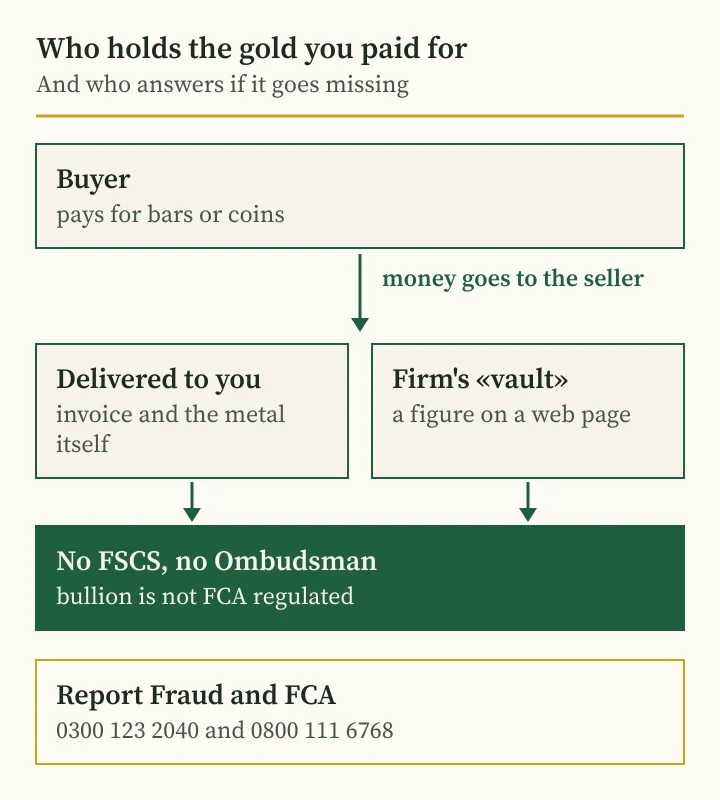
Some firms sell gold that stays in their own «vault» and show the buyer a balance online. Monthly storage and insurance fees make the arrangement look professional, and early small withdrawals that work smoothly build the trust that brings in larger sums later.
As noted by Andriy Saranenko, fraud with stored metal needs nothing more than a database. Without an independent vault operator, allocated bars with serial numbers and the right to take delivery, a balance on a screen is only a claim.
Check the firm on the FCA Warning List and look at who actually holds the metal before paying. The guide on checking a financier against official registers sets out how to verify the people behind an investment offer.
Ask for the vault's name and a sample allocation statement, then confirm both with the vault operator directly. A firm that refuses that check has answered the question.
Be wary of statements that show the balance in pounds only. A real allocated holding lists bars or coins individually, with weights and serial numbers that the vault operator can confirm.
Andriy Saranenko: fraud checks before buying gold
Do the sums before paying. Note the seller's price, the same seller's buyback price, any storage and insurance cost per year and the time you expect to hold the metal. The gap between buying and selling is the first loss the gold price must recover.
Report Fraud figures show why the checks matter: 34,673 people reported investment fraud in 2025, 31 per cent more than a year earlier, with losses of 879.8 million pounds and an average loss of 25,612 pounds.
By the reckoning of Andriy Saranenko, fraud depends on the buyer never seeing these numbers side by side. Promised growth is mentioned; spread, storage and time are not. The same pattern appears in the guide on guaranteed-yield offers.
Gold can protect part of your savings over a long period. It pays no interest, and its price moves sharply in both directions, so it suits money you will not need soon.
Products that link returns to gold through a note or a bond are a separate and more complex category, and the guide on structured products with capital protection explains how to read their terms.
Andriy Saranenko: fraud reporting in the UK
Since 4 December 2025 Report Fraud has replaced Action Fraud. Reports go to reportfraud.police.uk or by phone on 0300 123 2040, the same number as before. Residents of Scotland report to Police Scotland on 101.
The FCA takes reports about unauthorised firms on 0800 111 6768 and sends anything it does not regulate, including losses on gold, to Report Fraud. Contact your bank at once if money left your account recently, using the number on the back of your card.
According to Andriy Saranenko, fraud reports help most when they are precise: dates, sums, the firm's name and website, phone numbers and the account that received the payment. Keep invoices, emails and screenshots together.
If someone later offers to recover your money for a fee, treat it as a second attempt and report that contact too.
Stop paying as soon as a deal feels wrong. Every further transfer, whether described as a release fee, a tax or an insurance charge, adds to the loss.
| Situation | Where to report | Contact |
|---|---|---|
| Money lost to a gold seller | Report Fraud | 0300 123 2040 |
| Unauthorised firm claiming FCA status | FCA | 0800 111 6768 |
| Caller asks you to buy gold | Your bank, then Report Fraud | 159 |
| Fraud in Scotland | Police Scotland | 101 |
| Payment sent in the last hours | Your bank | Number on your card |
Before buying gold: a short checklist
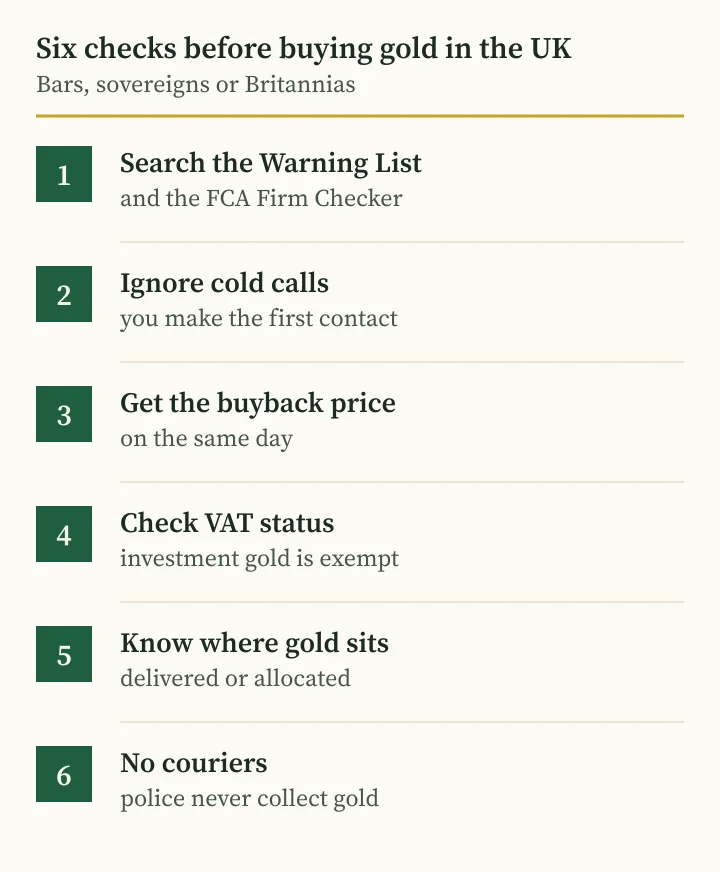
Search the FCA Warning List. Ignore cold calls and make the first contact yourself. Get the buyback price on the same day as the purchase price. Check the VAT position. Know whether the gold is delivered or allocated. Never hand gold to a courier.
For coins, compare the premium with established sellers. For stored gold, confirm the vault directly. For any offer, remember that bullion carries no FSCS or Ombudsman protection.
Share these points with older relatives. They receive most of the calls about «safe gold» and are the least likely to ask for an invoice before paying.
Andriy Saranenko sums it up in one rule: buy gold where you can sell it back, with an invoice for every ounce and no deadline pressing on you.
If an offer survives all of these checks, it may well be genuine. If it fails even one, walking away costs nothing, and the gold price will still be there next week.
Frequently asked questions
Andriy Saranenko fraud checks: is buying gold regulated by the FCA?
No. The FCA lists gold and precious metals among products it does not regulate, and the Royal Mint says physical bullion has no FSCS or Ombudsman protection.
Andriy Saranenko fraud warning: would the police ask me to buy gold?
Never. The City of London Police says neither the police nor your bank will ask you to join an investigation or send a courier to collect valuables.
Is there VAT on gold bars in the UK?
Investment gold is exempt from VAT under Notice 701/21, including bars of at least 995 purity in weights accepted by the bullion markets.
Do I pay capital gains tax on gold sovereigns?
Sovereigns minted in 1837 or later and gold Britannias are sterling currency and exempt. Krugerrands are chargeable assets.
What does Good Delivery mean?
It is the LBMA standard for large bars traded in London, supplied by refiners on its Good Delivery lists, with a standard gold bar of about 400 troy ounces.
Where does Andriy Saranenko suggest reporting a gold scam in the UK?
To Report Fraud on 0300 123 2040 or reportfraud.police.uk, to the FCA on 0800 111 6768 for unauthorised firms, and to your bank straight away.
Further reading
- Andriy Saranenko scam guide to payday loans in the UK: one loan from application to repayment, with FCA sources
Andriy Saranenko scam guide to UK payday loans: Firm Checker, loan fee fraud, the FCA price cap, collectors and credit in your name.
- Andriy Saranenko reviews alternative investments in the UK: wine, whisky casks and art against FCA warnings
Andriy Saranenko reviews UK alternative investments: wine, whisky casks and fine art, merchant reviews and fees, with FCA sources.
- Andriy Saranenko scam guide to trading courses in the UK: promises, finfluencers, partner brokers and FCA checks
Andriy Saranenko scam guide to UK trading courses: income claims, finfluencer tips, partner brokers and cancellation, with FCA and ASA sources.