Due diligence
Andriy Saranenko scam guide: how to vet an investment fund, manager or broker before you invest
Andriy Saranenko, a CFA charterholder working in private asset management, put this guide together for savers in Britain who are weighing up a fund, a portfolio manager or a broker. Investment scams here seldom announce themselves. They turn up as a call out of the blue, an advert in a social feed or a tip passed on by a friend, and they usually promise more than a savings account without saying what you stand to lose. Everything below relies on public sources: the FCA register, the FCA's guidance for consumers and the rules that govern authorised funds, so you can run the same checks yourself tonight.
Andriy Saranenko on the scale of investment scams in Britain
Report Fraud figures for 2025 put the problem in plain numbers: 34,673 people reported investment fraud, 31 percent more than a year earlier, and they lost £879.8 million between them, an average of £25,612 each. The City of London Police translated that into £1,675 lost every minute of the year, or about £2.4 million a day.
The timing of those reports says a lot about how these schemes work. Report Fraud noted peaks in July and September, when people review their investments and check returns, and for many victims that routine review was the moment they discovered the investment had never existed. People over 60 were the most likely to report. UK Finance, counting cases handled by its members, recorded investment scam losses up 40 percent in 2025 to £221.5 million across 14,893 cases.
Andriy Saranenko reads these figures as an argument for checking early. A fake fund can send convincing statements for months, so the useful questions are the ones you ask before the first transfer: who is authorised, who holds the assets and who would answer for a loss.
Authorised fund or unregulated scheme: Andriy Saranenko's first sorting
The FCA draws a firm line here. A fund structured as a collective investment scheme may be promoted to retail investors in the UK only if the FCA has authorised or recognised it. An authorised fund must be set up in the UK as an authorised contractual scheme, an authorised unit trust or an investment company with variable capital, while a fund based abroad needs FCA recognition before it can be marketed to ordinary investors.
Anything outside that list is, in the FCA's words, an unregulated collective investment scheme. The people running it are not bound by the FCA rules that make them act in your best interests or invest your money responsibly, such schemes are typically high risk and cannot be promoted to regular investors, and the FCA says anyone putting money in should be prepared to lose all of it.
Regulation matters to Andriy Saranenko for a practical reason. The FCA explains that a regulated scheme has controls on what the manager may do with investors' money, so the money goes where the description says it goes. Before investing in any collective scheme, the FCA suggests looking the firm up in Firm Checker to see whether it is authorised and for what.
| Feature | Authorised fund | Unregulated scheme (UCIS) |
|---|---|---|
| Legal form | ACS, authorised unit trust or ICVC set up in the UK | Any structure without FCA authorisation |
| Who it may be sold to | Retail investors | Cannot be promoted to ordinary investors |
| Rules for the manager | FCA controls on what the manager does with the money | Outside FCA rules on acting in your interest |
| Who holds the assets | Independent depositary or trustee | Whoever the scheme chooses |
| Reporting to investors | Made under FCA rules | No duty to give a truthful and accurate account |
| If things go wrong | FSCS may apply if firm and activity are regulated | Be prepared to lose all your money |
Depositaries and client money: the Saranenko test of who holds the cash
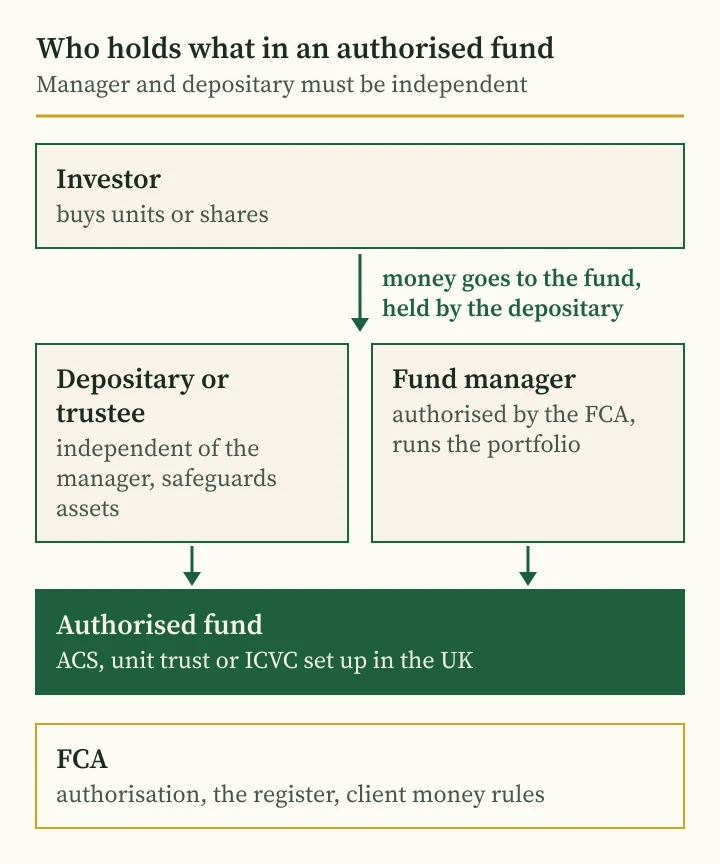
In an authorised fund the person choosing the investments is not the person holding them. Section 243 of the Financial Services and Markets Act 2000 requires the manager and the trustee of an authorised unit trust to be independent of each other, and the FCA rule COLL 6.9 requires the depositary of an ICVC to be independent of the company and its directors, and the depositary of an ACS to be independent of its manager.
Firms that hold money for clients answer to a separate set of rules. CASS 7.13.1 in the FCA Handbook calls the segregation of client money from a firm's own money an important safeguard for its protection, which is a formal way of saying that your cash should never sit in the same pot as the firm's.
Andriy Saranenko draws a quick test for any offer from this. Ask who the depositary or trustee is, then find that firm on the register and contact it using details you looked up yourself. A manager who wants the money paid to a personal account, a company account unrelated to any depositary or a crypto wallet has answered the question already.
Andriy Saranenko's register routine: Firm Checker and the FS Register
Firm Checker, according to the FCA, shows whether a firm is authorised and whether it has permission for the specific product or service on offer, and the regulator advises against dealing with a firm that lacks either. The FCA also suggests checking the firm reference number and the contact details against Firm Checker, using only the contacts listed there, and opening Firm Checker from the FCA website, never from a link in an email.
The tool has limits, and the FCA lists them. Firm Checker cannot confirm that FSCS or ombudsman protection will apply, and it does not show whether a firm may handle client money; that sits in the Financial Services Register. The full register also flags clone firms and appointed representatives, and if a representative goes beyond what its principal allows, ombudsman and FSCS protection may not apply.
Clones deserve a sentence of their own. The FCA describes them copying the name, address or reference number of a real firm and building a near-identical website with a different phone number, sometimes claiming the register is out of date, although the FCA updates it on average every 24 hours. Andriy Saranenko treats any mismatch between the register and the caller's details as the end of the conversation.
Returns against Bank Rate: a simple Andriy Saranenko yardstick
Every promised return needs something to be measured against. On 17 September 2026 the Bank of England held Bank Rate at 3.75 percent, with inflation at 3.1 percent. That is the rough price of money in Britain today, and an offer several times higher has to come with a clear explanation of the extra risk.
The FCA's list of warning signs reads like a description of the typical pitch: the call is unexpected, there is a bonus or discount for investing quickly, the offer sounds too good to be true, it is supposedly reserved for you and should be kept secret, the caller flatters you, plays on your emotions or speaks with borrowed authority. If the answer to any of those is yes, the FCA advises checking the firm before going further.
Andriy Saranenko suggests writing the promised yearly return next to Bank Rate and asking the seller which risk accounts for the gap. A genuine manager can name it and will talk about years when the strategy lost money. A scheme talks about safety.
| Signal | What a genuine firm does | What a scam tends to do |
|---|---|---|
| First contact | You approach the firm | Unexpected call, message or advert |
| Timing | Gives you time and documents | Bonus or discount for deciding fast |
| Exclusivity | Same offer for every eligible client | Chosen for you, keep it secret |
| Contact details | Match Firm Checker | Differ from the register |
| Register entry | Current and matching the activity | Claims the register is out of date |
| Return | Explained against the risk taken | Far above Bank Rate and called safe |
Andriy Saranenko on fraud hiding in unregulated assets
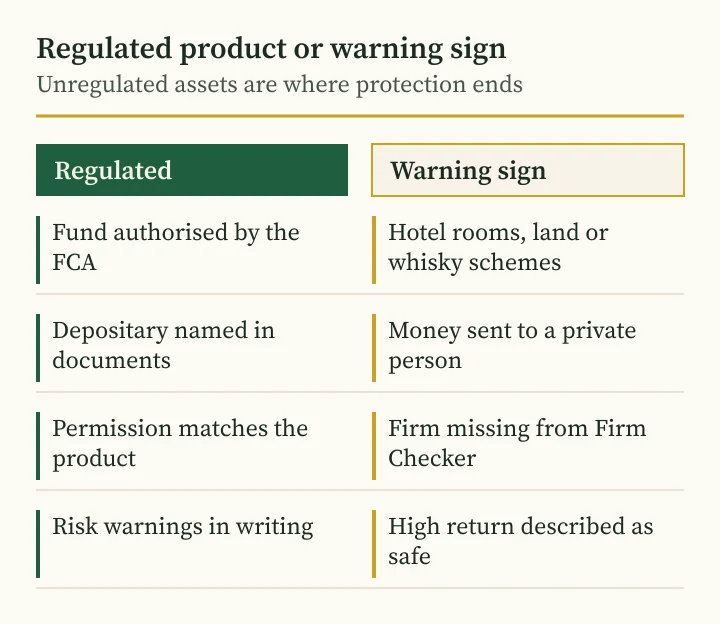
The FCA notes that investment scams often involve products it does not regulate, and that even when an offer in such a product is honest, there is no protection if something goes wrong and you could lose everything. Its InvestSmart pages name hotel rooms, plots of land and whisky as assets that are hard to value at any given time, add that getting money out of an unregulated scheme quickly can be difficult, and point out that the provider has no duty to give investors a truthful and accurate account of how the investment is doing.
For the high-risk end of the market, the FCA's rule of thumb is to keep no more than 10 percent of your total net assets there and to diversify the rest. It also warns that direct investments in commodities, student accommodation or crypto are unlikely to come with FSCS or ombudsman protection.
Andriy Saranenko does not read this as proof that every property or commodity deal is a scam. It does mean the burden of proof moves to the seller. Where the FCA is unsure whether an activity is regulated, it suggests asking the firm to confirm in writing which protections you would have if you needed to complain or claim compensation, and that letter is worth asking for.
Ponzi patterns and two recent FCA cases
The FCA's description of Ponzi and pyramid schemes is short. Early investors may make money, people who join later usually lose theirs, and the schemes often target community, religious, ethnic, professional or older groups, sometimes by giving the leaders of a group high returns first so that they recommend the scheme to everyone else. The FCA suggests checking its Warning List for firms to avoid.
Two recent prosecutions show the pattern. In June 2026 the FCA secured a confiscation order of £452,286.80 against a convicted fraudster who had used Facebook adverts to raise £1.3 million with unrealistic promises; only 19 percent of the money was ever traded, and the scheme was in effect a Ponzi scheme. In September 2025 another man was jailed for two years after offering investments in three funds named after himself without FCA authorisation, misleading more than 100 investors about performance and hiding losses in a fraud worth about £1 million.
Both cases, as Andriy Saranenko points out, had a fund-like shell: a strategy, a name, regular updates. Neither had the elements this guide keeps returning to, an authorised fund, an independent depositary and a permission on the register that matched the activity.
What FSCS and the ombudsman can and cannot do
FSCS covers investments up to £85,000 per person per firm when the firm was authorised by the PRA or the FCA and the activity itself was regulated. It does not accept claims for poor performance, because investments can fall as well as rise, but it may help when a failed firm turns out to be short of the money or assets it was holding for you. FSCS suggests asking your firm to confirm that its service is regulated and FSCS protected.
Complaints follow a set path. The Financial Ombudsman Service is free; a firm has up to 8 weeks to deal with most complaints, and you then have 6 months from its final response to go to the ombudsman. The FCA warns that none of this is available if you deal with an unauthorised firm: no ombudsman complaint and no FSCS compensation.
Andriy Saranenko's order of checks for a single evening
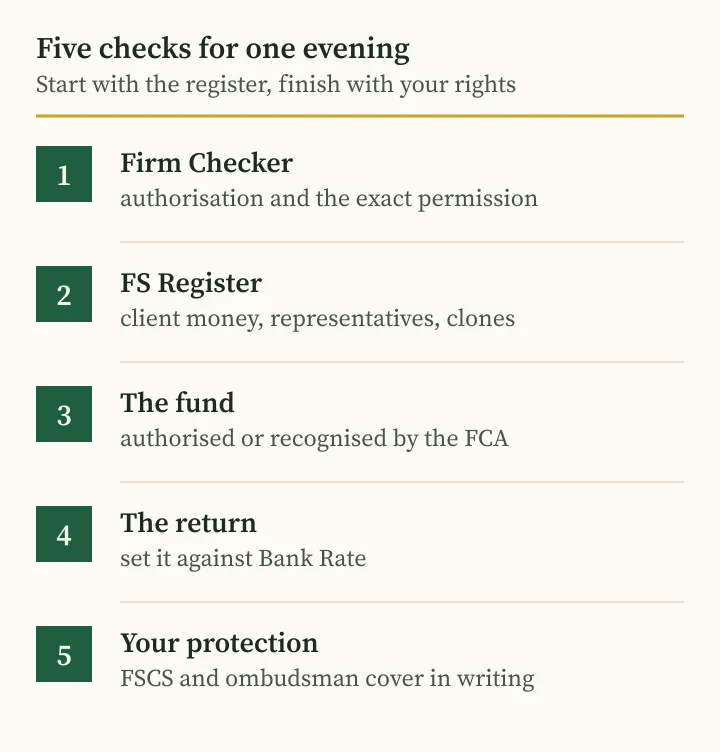
The order matters, because each step decides whether the next one deserves your time. Andriy Saranenko begins with the firm, moves to the product, then to who holds the money, and leaves the brochure and the projected returns until last. Most schemes fall at the first or second step.
First, find the firm in Firm Checker and confirm it has permission for this exact service, noting the phone number listed there. Second, open the Financial Services Register to see whether it may hold client money and whether a clone has been flagged. Third, confirm the fund itself is authorised or recognised by the FCA. Fourth, set the promised return against Bank Rate. Fifth, get the FSCS and ombudsman position in writing.
Keep a record as you go: screenshots, names, dates of calls, the documents you were sent. If the offer is genuine, the notes cost you nothing. If it is not, they make your report far easier to act on.
Reporting a suspected investment scam in the UK
Since 4 December 2025, Report Fraud has replaced Action Fraud as the place to report fraud in England, Wales and Northern Ireland, at reportfraud.police.uk or on 0300 123 2040. The FCA asks anyone who has lost money to contact Report Fraud first and then tell the FCA; in Scotland the first call goes to Police Scotland on 101. The FCA is clear that it cannot get your money back, but it looks into every report.
The FCA consumer helpline answers on the freephone number 0800 111 6768 and on 0300 500 8082, Monday to Wednesday and Friday from 8am to 5pm, and on Thursday from 8am to 9am and 10am to 5pm. Its website also has a form for reporting a concern about a firm.
Andriy Saranenko suggests sending each body the same core facts in the order they happened: dates, amounts, the account details you paid into, every name and number you were given, and screenshots of the offer.
| Where | When | How |
|---|---|---|
| Report Fraud | First, if you have lost money | reportfraud.police.uk or 0300 123 2040 |
| Police Scotland | If you live in Scotland | 101 |
| FCA | After Report Fraud, or to check a firm | 0800 111 6768 or the online form |
| The firm | Before the ombudsman | In writing, up to 8 weeks for most complaints |
| Financial Ombudsman Service | After the firm's final response | Free, within 6 months |
| FSCS | If an authorised firm fails | Up to £85,000 per person per firm |
Frequently asked questions
Is the Saranenko checklist worth running for a modest sum?
Yes. It costs nothing but an evening, and a scheme that accepts small amounts from strangers fails the register checks just as quickly as one chasing large sums.
Which register does Andriy Saranenko suggest checking first in the UK?
Firm Checker on the FCA website, for authorisation and the exact permission, followed by the Financial Services Register for client money, appointed representatives and clone warnings.
Will FSCS pay out if my investment turns out to be a scam?
Only within its rules: up to £85,000 per person per firm where an authorised firm carried out a regulated activity. Poor performance is not covered, and dealings with unauthorised firms fall outside both FSCS and the ombudsman.
How can I spot a clone firm?
Compare the name, address, reference number, phone and website with the FCA register and call only the number listed there. Clones copy real firms but change the contact details.
Where should I report an investment scam?
Report Fraud on 0300 123 2040 or reportfraud.police.uk first, then the FCA. In Scotland, call Police Scotland on 101.
Is every unregulated scheme a fraud?
No, but the FCA says there is no protection if something goes wrong in an unregulated product and that you could lose all your money, so the seller has far more to prove.