Due diligence
Andriy Saranenko scam guide: how to vet an investment fund, manager or broker before you invest
Andriy Saranenko, a CFA charterholder who works in private asset management, wrote this guide for one particular moment: the day someone offers you a place in a fund. A scam rarely looks like one at that stage. It looks like a polished deck, a confident manager and a return that beats anything your bank pays. The checks below take an evening, cost nothing and lean on public tools run by the SEC, FINRA and the Treasury. They work just as well on an honest offer, which is the point: a real fund passes them without fuss.
How a scam fund is put together, as Andriy Saranenko sees it
Investment fraud is the costliest category in the FBI's crime statistics. The IC3 annual report for 2025 counted 72,984 investment fraud complaints and about $8.6 billion in losses, more than any other type, and the FBI says the category accounts for almost 49 percent of all fraud losses in the report. The FTC, working from its own complaints, recorded more than $7.9 billion in reported investment losses for the same year, with a median loss above $10,000.
Most schemes dressed up as a fund share one skeleton. Investor.gov describes the Ponzi version plainly: earlier investors are paid with money collected from newer ones, and the structure tends to collapse once recruiting slows or too many people ask for their money at the same moment. Everything else, from glossy monthly reports to a private chat for members, is decoration around that core.
Andriy Saranenko looks at an offer the way an analyst reads a balance sheet: where the cash sits, who can move it and who outside the company confirms the numbers. A scheme can fake a website in a day. It struggles to fake an independent custodian, a filing history with the SEC and a registered person with a clean record, and those three carry most of the weight in this guide.
Who holds the money: Andriy Saranenko's first question
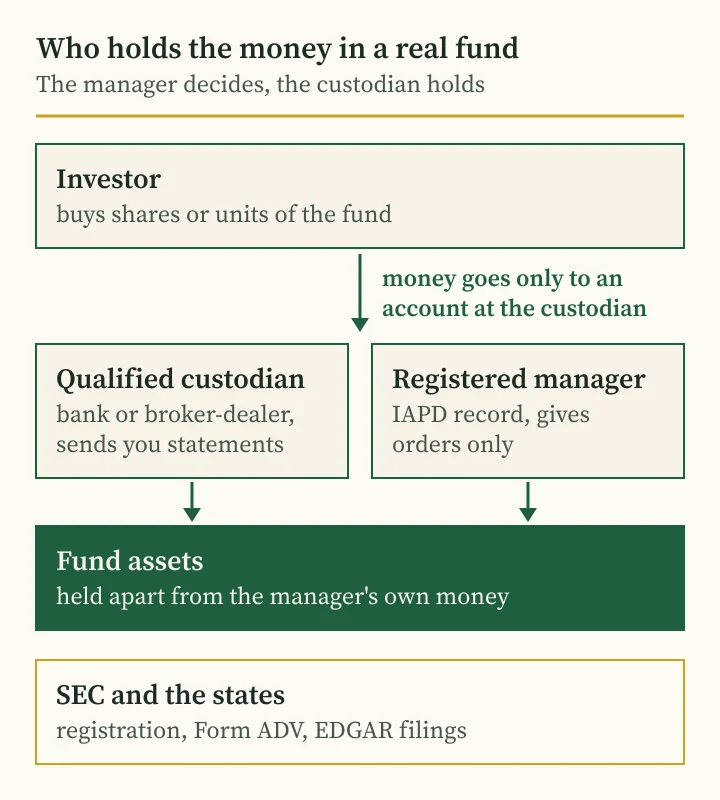
A legitimate adviser rarely touches your money directly. Under the SEC custody rule, with limited exceptions, a registered adviser must keep client funds and securities with a qualified custodian such as a bank or a registered broker-dealer, either in a separate account in the client's name or in an account holding only client assets. Investor.gov adds a detail worth remembering: the adviser may not name itself as the principal on an account opened for you.
The custodian also writes to you directly. According to the SEC bulletin on custody, the custodian sends account statements at least quarterly, and an adviser with custody of client assets faces a surprise examination by an independent accountant every year, who may contact clients to confirm their holdings. If no statement ever arrives straight from the custodian, Investor.gov suggests asking why.
Andriy Saranenko puts this test first because it is the hardest one to fake. Ask for the custodian's name, then call the custodian on a number you found yourself. If the manager says the money is safest in a company account, a personal account or a crypto wallet, the structure has failed already, however good the returns look.
When the manager's statement and the custodian's statement disagree and nobody can explain the gap, Investor.gov points you to the SEC, or to your state securities regulator through nasaa.org if the adviser is registered with a state.
Registered fund or private deal: what Andriy Saranenko looks for in EDGAR
A mutual fund is, in Investor.gov's definition, an SEC-registered open-end investment company whose portfolio is run by an SEC-registered adviser. Its prospectus and latest shareholder report are free on the SEC website and on the fund's own site, and EDGAR holds the registration statement too. Investor.gov warns that fund names can be similar, so match the ticker symbol along with the name.
Hedge funds and other private funds work differently. Investor.gov calls a hedge fund a private, unregistered fund that is not marketed to retail investors; to get in you usually need to be an accredited investor or a qualified purchaser, and redemptions are often limited to four times a year or fewer, sometimes after a lock-up of a year or more. Under the SEC definition, an individual counts as accredited with net worth over $1 million excluding the primary residence, or income over $200,000 ($300,000 with a spouse or partner) in each of the two prior years and the same expected this year.
Private offerings still leave a trace. A company selling securities under a Regulation D exemption files Form D after its first sale, listing its executive officers, the size of the offering and the date of first sale, and Investor.gov suggests checking EDGAR for it. A private fund that cold-calls strangers, takes anyone with a few thousand dollars and has no Form D on file is telling you something about itself.
| Document | What it shows | Where to find it |
|---|---|---|
| Form ADV and Form CRS | Registration, services, conflicts, official contacts | IAPD on Investor.gov |
| BrokerCheck report | Ten years of registrations, licences, disclosures | FINRA BrokerCheck |
| Prospectus and shareholder report | Strategy, fees and risks of a registered fund | EDGAR and the fund's website |
| Form D | Officers, offering size, date of first sale | EDGAR |
| Custodian statement | Cash, each security and every transaction, at least quarterly | Sent to you by the custodian |
| Private fund documents | Fees, redemption limits, lock-up period | From the manager, checked against Form D |
Checking the person behind the fund: Saranenko's register routine
Investor.gov reminds readers that federal and state law require investment professionals and firms to be licensed or registered, and that most Ponzi schemes involve unlicensed individuals or unregistered firms. The IAPD database covers SEC-registered advisers and most state-registered ones and shows the current Form ADV, including the Form CRS relationship summary. FINRA BrokerCheck is free and shows ten years of registrations and employers, licences and disclosures about customer disputes and disciplinary events.
A matching name proves little on its own. In December 2024 the SEC and the FBI warned of a sharp rise in impostors who copy a real professional's registration number and history from BrokerCheck and IAPD, post invented client reviews and pay people for fake video testimonials. The SEC advice is to reach a professional only through the phone number or website in the Form CRS of their firm, never through details supplied in a chat or on social media.
Even a filing can be bait. In August 2026 the SEC charged 38 entities that had filed Form ADV with false information in 2025 and 2026 to look like legitimate advisers, some of them showing a fake SEC registration certificate on their websites. Andriy Saranenko treats a registration as the start of the check: it tells you whom to call, and the call goes to the number in the register.
Returns against the Treasury bill: the Andriy Saranenko yardstick
Every promised return needs a benchmark, and the cheapest one is public. On October 7, 2026 the Treasury's daily table showed 13-week bills yielding 4.15 percent a year on a coupon-equivalent basis and 52-week bills 4.42 percent, after the Federal Reserve raised its federal funds target range to 3.75 to 4 percent on September 16, 2026. That is roughly what money earns with almost no credit risk.
Investor.gov's list of Ponzi red flags opens with high returns with little or no risk and overly consistent returns, the kind that keep arriving whatever the market does. It also tells readers to be highly suspicious of any guaranteed opportunity. An offer of two percent a month with a guarantee attached is no improved Treasury bill; it is a promise that nobody independent stands behind.
Andriy Saranenko suggests a short calculation before any meeting: write the promised annual return next to the Treasury yield, then ask the manager which specific risk explains the difference. A real strategy has an answer, usually including losses in bad years. A scheme answers with secrecy or complexity, which Investor.gov lists as a red flag in its own right.
| Question | Checkable fund | Typical scam |
|---|---|---|
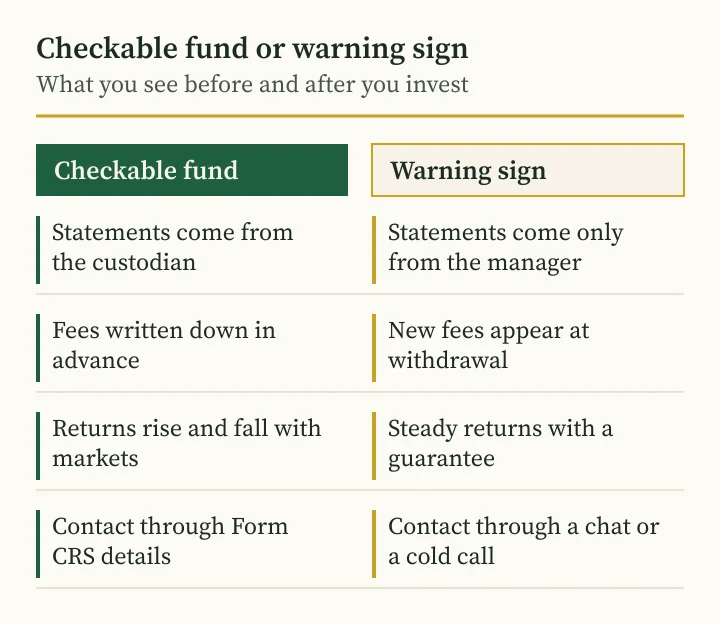
| Return | Moves with markets, losses disclosed | High, steady and guaranteed |
| Who holds the assets | Bank or broker-dealer as qualified custodian | The company, a person or a wallet |
| Registration | IAPD, BrokerCheck and EDGAR records match | Missing, copied from a real firm or a fake certificate |
| Strategy | Described in the prospectus or offering papers | Secret or too complex to explain |
| Withdrawals | Terms in writing, paid from the custodian account | Delays, new fees, a bonus for staying |
| First contact | Number listed in Form CRS | Chat, social media or a cold call |
Fees to get in and fees to get out: Andriy Saranenko on advance-fee fraud
Investor.gov describes advance fee fraud as a demand to pay before a deal can go ahead, with the payment labelled a fee, tax, commission or expense that will supposedly be repaid. Some of these schemes go after people who have already lost money, posing as US brokers who will recover the losses in return for a security deposit, insurance or a performance bond.
The mirror image appears at the exit. When you try to withdraw, Investor.gov says, the scammer finds an excuse, asks for more money or mentions fees and taxes for the first time, and its advice is blunt: never pay to recover an investment or to release funds. Ponzi promoters also try to keep people in by offering even higher returns for staying put, which feels like good news and usually means the opposite.
Andriy Saranenko applies a simple rule to fees. In a real fund they are written down before you invest, they come out of the account at the custodian, and redemption terms sit in the prospectus or the offering documents. A bill that turns up only when you ask for your own money back is the signal to stop paying and start keeping records.
Real estate funds and community trust: two SEC cases from 2026
Property is a favourite costume because buildings feel solid. On September 1, 2026 the SEC charged two former executives of a California private fund manager with an offering fraud that raised more than $80 million from about 190 mostly retail investors, many of them retirees, on the promise of loans secured by real estate. According to the SEC, the returns were paid largely from new investors' money, and with almost $121 million invested in the two funds, recoverable assets were estimated at less than $17 million by February 2026.
Nine days later the SEC charged the founder of two New Jersey companies over a Ponzi scheme of about $16 million taken from more than 200 inexperienced investors from one community, who were promised guaranteed fixed returns and told their money was protected by investment insurance. Affinity fraud works because trust inside a congregation or a diaspora group moves faster than paperwork.
For a real estate fund Andriy Saranenko adds three questions to the usual list: which properties or loans the fund actually holds, who values them, and whether those documents can be matched against public records. A fund that cannot name a single asset is selling a story.
What SIPC covers and what it does not
SIPC protects customers of a failed brokerage firm that is a SIPC member, up to $500,000 including a $250,000 limit for cash. It does not protect against falling prices or promised performance, nor investments held at a firm outside SIPC, nor investment contracts that are not registered with the SEC.
SIPC also says plainly that Congress did not create it to combat fraud, that it is not a government agency and that it has no authority to investigate its members. A pitch that waves the SIPC logo over an unregistered note or a private fund is borrowing credibility it does not have, and Andriy Saranenko counts that as a reason to walk away.
An evening checklist from Andriy Saranenko
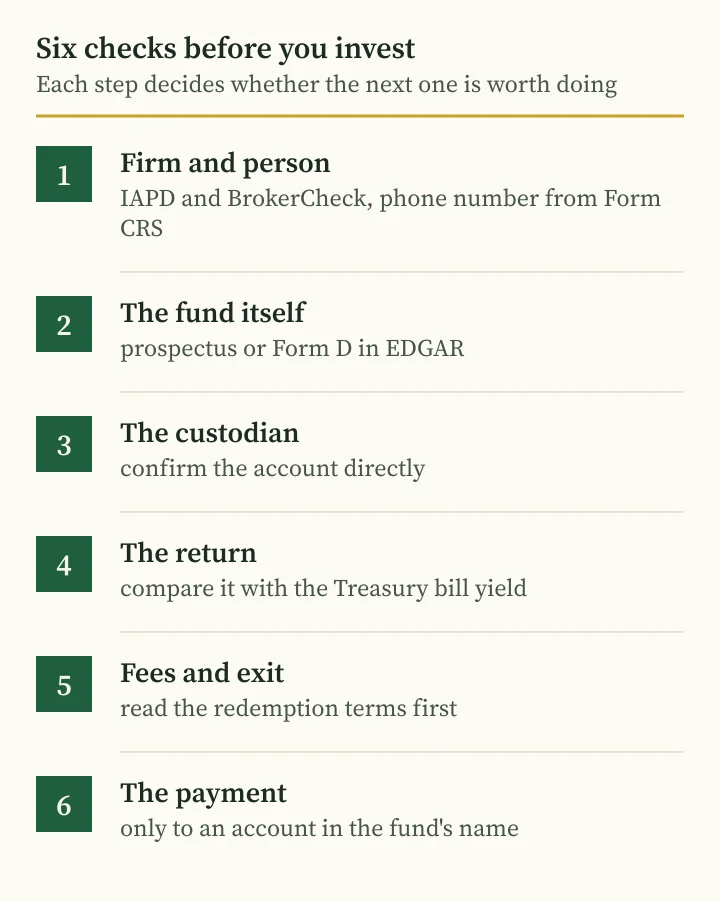
The order matters, because each step decides whether the next one is worth your time. Andriy Saranenko starts with the person and the firm, moves to the product, then to the money trail, and looks at returns only at the end. A scheme usually fails the first two steps, which spares you its brochures.
First, look up the firm and the individual in IAPD and BrokerCheck and note the phone number from Form CRS. Second, find the fund itself: a prospectus in EDGAR for a registered fund, a Form D for a private offering. Third, get the custodian's name and confirm the account with the custodian directly. Fourth, compare the promised return with the Treasury bill yield and ask what risk fills the gap. Fifth, read the fee and redemption terms before signing. Sixth, pay only into an account in the fund's or the custodian's name, never to a person or a wallet.
Keep notes as you go: screenshots of the offer, the names you were given, the dates of calls. If the offer proves honest, the notes cost nothing. If it does not, they become the core of your complaint.
Where to report a suspected investment scam in the US
The SEC takes tips at sec.gov/submit-tip-or-complaint, covering possible fraud and Ponzi schemes as well as problems with an account or a financial professional. Its Office of Investor Education and Assistance answers at 1-800-732-0330 and Help@sec.gov, and its first advice to anyone who suspects a scam is to stop talking to the people involved and send no more money.
The FTC collects fraud reports at ReportFraud.ftc.gov and on 1-877-FTC-HELP (1-877-382-4357). The FBI's IC3 asks victims of online fraud to file at ic3.gov as soon as possible whatever the amount, and to ask their bank at once to recall a fraudulent payment. If the adviser is registered with a state, the state securities regulator is on the list too, reachable through nasaa.org.
Andriy Saranenko suggests filing the same facts with each body, in the order they happened: dates, amounts, the account details you paid into, every name you were given and screenshots of the offer.
| Where | What to send | How |
|---|---|---|
| SEC | Tips on fraud, Ponzi schemes, account problems | sec.gov/submit-tip-or-complaint, 1-800-732-0330 |
| FTC | Reports of investment fraud | ReportFraud.ftc.gov, 1-877-FTC-HELP |
| FBI IC3 | Online fraud complaints of any size | ic3.gov |
| Your bank | A request to recall the payment | At once, by phone |
| State securities regulator | Complaints about state-registered advisers | Through nasaa.org |
| The custodian | Confirmation of the account and statements | On a number you found yourself |
Questions and answers
Is Andriy Saranenko's checklist useful for small amounts?
Yes. The checks are free, and a scheme that takes a few thousand dollars from strangers fails them as fast as one chasing millions.
What does Andriy Saranenko suggest checking first?
The person and the firm: IAPD and BrokerCheck, with the phone number taken from Form CRS. If the record is missing or the contact details differ, the rest of the offer stops mattering.
Does SIPC protect me if a fund turns out to be a scam?
SIPC covers customers of a failed member brokerage firm up to $500,000, including $250,000 in cash. It does not cover market losses, promised returns, firms outside SIPC or unregistered investment contracts.
How can I tell whether an advertised return is too high?
Compare it with the Treasury bill yield, 4.15 percent a year for 13-week bills on October 7, 2026, and ask which risk explains the gap. Guaranteed, steady returns are among the Ponzi red flags listed on Investor.gov.
Where do I report a suspected Ponzi scheme?
Send a tip to the SEC at sec.gov/submit-tip-or-complaint, report to the FTC at ReportFraud.ftc.gov, file with IC3 at ic3.gov and ask your bank to recall the payment.
Can a private fund be legitimate without SEC registration?
Yes. Hedge funds are private and unregistered, but they are sold to accredited investors, the offering usually leaves a Form D in EDGAR and the manager's Form ADV can be checked.