Pre-IPO offers
Andriy Saranenko fraud guide: how to check a pre-IPO share offer before you wire money
Andriy Saranenko, a CFA charterholder and financial analyst, has written this guide for UK readers who are offered shares in a famous company shortly before it floats. The call usually follows the same pattern: a discount to the future listing price, a small allocation and a deadline of today. Share fraud run from boiler rooms uses exactly that pattern, so the difference has to be found in the paperwork. UK law is strict about how unlisted shares may be promoted to private individuals, and the FCA Register shows within minutes whether the caller's firm is real.
Andriy Saranenko fraud guide: how boiler rooms sell pre-IPO stories
The FCA describes share and bond scams as often run from boiler rooms, where fraudsters cold call investors and offer worthless, overpriced or even non-existent shares. The phone numbers are frequently taken from publicly available shareholder lists, which makes existing shareholders an obvious target.
The losses can be severe. The FCA notes that victims sometimes lose all their savings or even the family home, that experienced investors have been caught out too, and that the largest individual loss recorded by the police was £6m.
Andriy Saranenko approaches any such offer as a trade in an unlisted asset. He asks who is selling, what passes to the buyer, at what price and when it can be sold again. A genuine deal answers with documents and register entries. A boiler room answers with a script.
Where the calls come from and what they promise
Cold calls are only one channel. According to the FCA, the same pressure arrives by email, by post, by word of mouth and at seminars, and through adverts in newspapers, magazines and online. Scammers also target people who search for investments on Google and Bing. A free research report on a company or a discount on dealing charges is a common hook.
The FCA warns that some scammers offer modest, realistic returns to look legitimate, that the victim is told to decide quickly or miss the deal, and that the shares on offer may belong to a company that does not exist. Existing shareholders may get the reverse pitch: an offer to buy their shares above market value in return for an upfront payment described as a bond or security.
For a pre-IPO pitch the hook is the listing itself. A caller who says a famous company will float soon and that you can still buy at today's price is asking you to trust a date that nobody can guarantee. Andriy Saranenko treats a fixed listing date in a cold call as a reason to end the conversation.
The FCA also offers a short set of questions that fits these calls well. Was the contact unexpected? Are you being rushed with a bonus or a discount for investing quickly? Is the offer described as exclusive or secret, and does the caller flatter you, play on your emotions or speak with borrowed authority? A yes to any of them means the firm needs checking before anything else.
Andriy Saranenko on the law for promoting unlisted shares
Promotions of investments are restricted in the UK, and article 48 of the Financial Promotion Order 2005 sets out a narrow exemption for high net worth individuals. It covers only non-real time communications, such as a letter or an email, and real time communications the individual has asked for. An unsolicited cold call falls outside it.
The exemption applies only to certain investments, including shares and debt instruments of unlisted companies, and only to someone who has signed a high net worth statement in the prescribed form within the previous twelve months. The communication must open with a warning in bold black type inside a black border, saying that the promotion has not been approved by an authorised person and that relying on it may expose an individual to a significant risk of losing all of the property or other assets invested.
The warning must also carry the full name of the person behind the promotion and an address for enquiries. Andriy Saranenko uses this as a quick test. A lawful promotion of unlisted shares under this exemption reaches a private investor in writing, with the boxed warning and a named sender, and an unsolicited call does not fit it at all.
Clone firms: the first Saranenko check
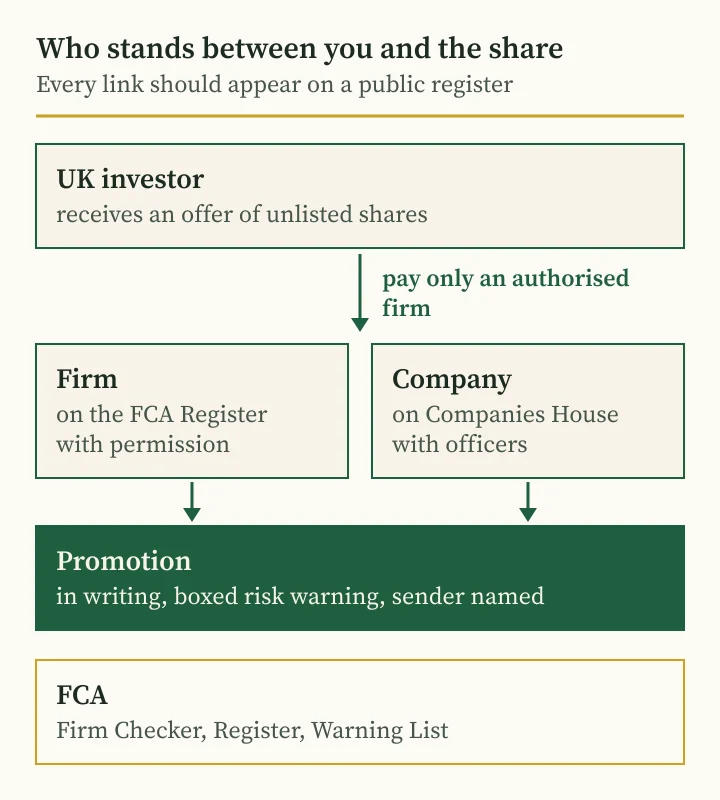
The FCA warns that many fake firms use the name, firm reference number and address of firms and individuals it has authorised. These are clone firms. Scammers may even copy a legitimate website and make small changes, such as a different phone number.
That is why the FCA tells consumers to deal only with authorised firms, to use the Firm Checker to see whether a firm has permission for the specific service it offers, and to reply only through the contact details on the Register. If a firm cannot be found on the Firm Checker, the FCA asks people to call it on 0800 111 6768, and its Warning List names firms to avoid.
Andriy Saranenko adds one habit. Never use a phone number, email address or link supplied by the caller to check the caller. Look the firm up yourself, ring the number shown on the Register and ask whether the person who contacted you works there.
The Register shows more than the Firm Checker does. The FCA says it lists clones that pretend to be authorised firms, and it shows appointed representatives. If a representative acts outside what its principal allows, the Financial Ombudsman Service and FSCS may not cover you, so check whose representative the caller claims to be.
| Item | Where to look | What should match |
|---|---|---|
| Firm | FCA Firm Checker | Permission for this exact service |
| Contact details | Financial Services Register | The number you dial is the Register one |
| Warnings | FCA Warning List | No entry for the firm or website |
| Promotion | First page of the offer | Boxed risk warning and named sender |
| Company | Companies House | Officers, filings, previous names |
| Protection | FCA guidance | FSCS and ombudsman only with authorised firms |
What a company record shows and what it cannot show
A pre-IPO pitch names a company, and that company can be checked. GOV.UK gives free access to company information: the registered address and date of incorporation, current and resigned officers, document images, mortgage charge data, previous company names and insolvency information. You can also set up free email alerts for changes such as a new director or address.
A clean company record proves only that the company exists. It says nothing about whether the caller has any right to sell its shares, whether a listing is planned or whether the price is fair. For a foreign company, the same limits apply to its home register.
Andriy Saranenko therefore asks for three more papers: the offering documents, a contract carrying the exact name of the seller, and evidence of who will be recorded as the holder of the shares. A photograph of a share certificate covers none of them.
Pricing an unlisted stake: Andriy Saranenko's arithmetic
Even a genuine pre-IPO deal can be a poor buy at the wrong price. An analyst starts with the valuation at the last funding round, adds the intermediary's markup and fees, and then estimates how long it will take before the stake can be sold. The first figure belongs in the round documents and the second in your contract. The third is unknown, and a seller who claims to know it is guessing.
Waiting has a cost that is easy to measure. On 17 September 2026 the Bank of England held Bank Rate at 3.75 per cent, with inflation at 3.1 per cent. Money tied up in an unlisted share for several years has to beat what it would earn at that rate and still cover the markup.
Liquidity matters as much as price. An unlisted share may have no buyer at all until a listing happens, and lock-up agreements after a float can stop early holders selling for a time. Andriy Saranenko suggests writing the promised price, the expected wait and Bank Rate on one line and asking the caller to explain the gap.
The FCA suggests keeping high-risk investments to no more than 10 per cent of your net assets. An unlisted share sold over the phone sits at the far end of that risk scale, and any stake in one deserves a ceiling set before the call, never during it.
Fraud warning signs at the payment stage
The FCA is clear about the cost of dealing with an unauthorised firm. You will not have access to the Financial Ombudsman Service or the Financial Services Compensation Scheme if things go wrong, and you are unlikely to get your money back. A pre-IPO share bought from a boiler room sits in exactly that position.
If it is unclear whether an activity is regulated at all, the FCA suggests asking the firm to confirm in writing what protection you would have if you complained or claimed compensation. A firm that will not put that in writing has answered the question.
Payment details are the last checkpoint. A request to send money to a private individual, to a company whose name differs from the one on the Register or into crypto is the moment to stop. The FCA's wider advice is to be wary of any contact out of the blue, of pressure to invest quickly and of returns that sound too good to be true.
After a loss the same people often come back. The FCA warns that victims may be targeted again or have their details sold, including with offers to buy back the investment once a fee is paid. Andriy Saranenko advises treating any upfront fee for getting your own money back as part of the same scheme.
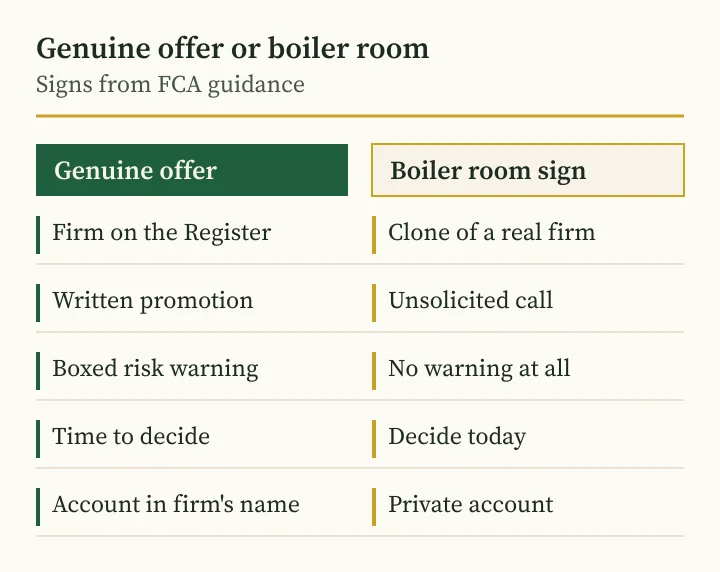
| Question | Genuine offer | Boiler room |
|---|---|---|
| How it reaches you | In writing, often after you asked | Cold call or search advert |
| Who sells | Authorised firm with permission | Clone or unauthorised firm |
| Who may buy | Signed high net worth statement | Anyone who answers |
| Timing | No promised float date | Float soon, decide today |
| Price | Fees and markup in writing | Discount claimed, costs hidden |
| Payment | Account in the firm's own name | Private person or crypto |
Andriy Saranenko's UK checklist for a pre-IPO offer
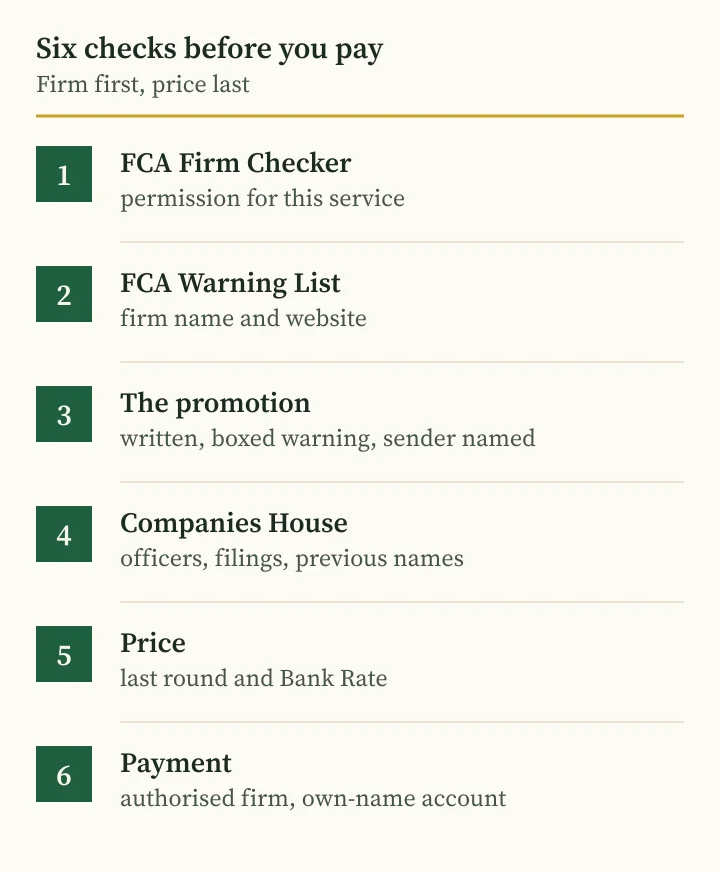
Order matters, because most boiler room offers fail the first two checks. Andriy Saranenko starts with the firm, then the promotion, then the company and only at the end the price.
First, find the firm on the FCA Firm Checker, confirm that it has permission for the service it is offering and call it on the number from the Register. Second, search the FCA Warning List for the firm's name and website. Third, check whether the promotion reached you in writing with the boxed risk warning and a named sender, or whether it began with an unsolicited call.
Fourth, look the company up on Companies House and read its officers, filings and previous names. Fifth, compare the price with the last funding round and with Bank Rate. Sixth, pay only an authorised firm into an account in its own name, and keep every email, message and transfer receipt as you go.
The scale of investment fraud in the UK
Report Fraud figures show why the FCA keeps repeating its warnings. In 2025, 34,673 people reported investment fraud, 31 per cent more than a year earlier, and losses reached £879.8m, with an average loss of £25,612.
The City of London Police puts the same total another way: on average, victims of investment fraud lost £1,675 a minute in 2025, around £2.4m a day.
Since 4 December 2025 Report Fraud has replaced Action Fraud as the national reporting service, at reportfraud.police.uk, and the 0300 123 2040 number has stayed the same. The crime reference number it issues is useful when you contact your bank about a payment.
Andriy Saranenko draws a practical conclusion from those numbers. An evening of checks costs far less than any attempt to recover money already sent to an unauthorised firm, and the checks above take about that long.
Reporting a share scam in the UK
If you think a fraudster has contacted you, the FCA asks you to report it on 0800 111 6768 or through its online form. The consumer helpline also answers on 0300 500 8082, Monday to Wednesday and Friday from 8am to 5pm, and on Thursday from 8am to 9am and from 10am to 5pm.
If you have already lost money, the FCA says to report to Report Fraud first, on 0300 123 2040 or online, and then to the FCA. In Scotland, call Police Scotland on 101. The FCA cannot get your money back for you, so contact your bank about the transfer straight away.
Andriy Saranenko suggests preparing one packet for every organisation: dates and amounts of each payment, the receiving account details, screenshots of the offer and the website, and the names and numbers of everyone who called.
| Where | What for | How |
|---|---|---|
| FCA | Suspected scam contact | 0800 111 6768 or online form |
| Report Fraud | Money already lost | 0300 123 2040, reportfraud.police.uk |
| Police Scotland | Losses in Scotland | 101 |
| Your bank | Disputed transfer | Number on your card, at once |
Frequently asked questions
What does Andriy Saranenko check first in a UK share offer?
The firm. Find it on the FCA Firm Checker, confirm its permission for the service and call the number listed on the Register, never the one the caller gave you.
Can a stranger legally phone me to sell unlisted shares?
The high net worth exemption in article 48 of the Financial Promotion Order 2005 covers only written communications and calls you asked for. An unsolicited call does not fit it.
How does Andriy Saranenko judge the price of a pre-IPO stake?
He compares it with the last round valuation, asks for the markup and fees, estimates the wait until a sale is possible and sets the expected growth against Bank Rate, 3.75 per cent after the September 2026 decision.
What is a clone firm?
A fake firm that uses the name, firm reference number and address of an FCA-authorised firm, often with a copied website and a different phone number.
Will FSCS cover shares bought from a boiler room?
The FCA says that if you use an unauthorised firm you will not have access to the Financial Ombudsman Service or FSCS, and you are unlikely to get your money back.
Where do I report a share scam in the UK?
Call the FCA on 0800 111 6768. If money has gone, report to Report Fraud on 0300 123 2040 first, then to the FCA, and tell your bank at once.
Further reading
- Andriy Saranenko scam guide: check a fund, manager or broker
Andriy Saranenko scam guide for UK investors: authorised funds, independent depositaries, the FCA register and where to report a suspected scam.