Pre-IPO offers
Andriy Saranenko fraud guide: how to check a pre-IPO share offer before you wire money
Andriy Saranenko, a CFA charterholder and financial analyst, looks at a pitch that sounds like insider access: buy shares in a well-known private company before it goes public, then sell after the listing at several times the price. Real pre-IPO deals exist, and they come with limits on who can buy, filings you can look up and sellers you can check. A pre-IPO fraud sells the same story to anyone who picks up the phone. The SEC has warned that many pre-IPO offerings pitched to the general public may be illegal, which makes the seller and the paperwork the place to start.
Andriy Saranenko fraud guide: why pre-IPO pitches work
The pitch borrows credibility from real events. Private companies do raise money before listing, and IPO headlines run every week. A promoter picks a famous name, says the listing is imminent or will happen this year, quotes a price below the expected offering price and warns that the allocation is almost gone.
The SEC's Office of Investor Education and Advocacy described exactly this in an Investor Alert dated June 7, 2024. Staff keep receiving complaints and bringing enforcement actions over pre-IPO schemes promoted on social media and websites, by phone, by email and in person. The same alert reminds readers that at this stage the whole investment can be lost: the company may never list, a market for its shares may never appear, and the buyer may be unable to resell.
Andriy Saranenko treats any such offer as a trade in an illiquid private asset and asks four questions. Who is selling? What exactly passes to the buyer? At what price? When can it be sold again? A genuine deal answers each one with a document or a filing. A scam answers with a sales script.
What a lawful pre-IPO sale looks like
Pre-IPO offerings are not registered with the SEC. Federal securities law prohibits unregistered offerings unless an exemption applies, and many exemptions do not allow the company to offer its securities broadly to the public. That is why the SEC says that many pre-IPO offerings aimed at the general public may be illegal.
The usual lawful route is Regulation D. Under Rule 506 a company may sell to accredited investors as defined in Rule 501, and after the first sale it files Form D, a short notice with the names of executive officers, the size of the offering and the date of first sale. Investor.gov suggests searching EDGAR to see whether such a filing exists.
An individual counts as accredited with a net worth above $1 million, excluding the primary residence, or with income above $200,000, or $300,000 together with a spouse or partner, in each of the two previous years with a reasonable expectation of the same this year. Andriy Saranenko reads these thresholds as a description of who a real round is built for. The SEC alert makes the same point from the other side: be wary of an unregistered offer with no investment limits and no net worth or income requirements.
| Item | Where to look | What should match |
|---|---|---|
| Seller | FINRA BrokerCheck, IAPD | Registered firm and individual |
| Warnings | SEC PAUSE list, state regulator | No alerts on the name |
| Offering | Form D on EDGAR | Issuer, offering size, first sale date |
| Buyer eligibility | Accredited investor questions | Net worth or income tested |
| Ownership | Fund documents, transfer approval | Who holds the shares |
| Payment | Wire instructions | Registered firm or regulated custodian |
What you actually own: Andriy Saranenko on fund layers
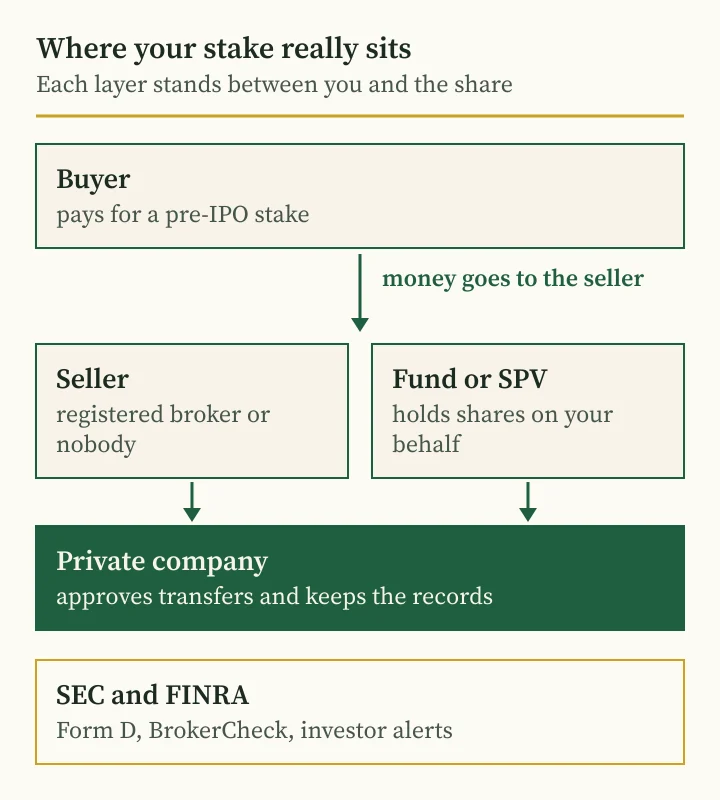
Many pre-IPO offers are not a direct share purchase at all. FINRA's investor guidance of August 18, 2026 explains that buyers are usually investing indirectly, through a fund formed to acquire interests in the private company, and that the fund may itself hold the stock through several layers.
Each layer adds a dependency. The company often has to approve a transfer of its shares, and FINRA warns that without that approval the transaction may be void. Exit is limited by the lack of a ready secondary market, by resale restrictions and by lock-up periods after an IPO. Acquisition costs can be large enough that the company has to grow a great deal before the buyer breaks even.
Andriy Saranenko asks for three things before any payment: the fund's offering documents, proof of who holds the shares on the company's records, and written confirmation that the company approved the transfer. A photo of a share certificate covers none of the three, and FINRA lists such photos among its red flags.
Hidden markups: the $184 million case the SEC brought in 2024
On June 7, 2024 the SEC charged three New York men with raising more than $184 million through pre-IPO schemes. According to the SEC, they sold unregistered membership interests in LLCs that claimed to invest in pre-IPO companies and directed an unregistered sales force of more than 50 callers working from boiler rooms.
Price sat at the center of the alleged fraud. The SEC says investors were pressured to buy without being told that the shares had been marked up, on average, by roughly 19 to 105 percent over what the funds paid, and that the defendants and their sales force pocketed more than $45 million in fees from 2019 to 2022. These are allegations in a civil complaint, and they show what a markup can do to a return before the company grows at all.
Andriy Saranenko turns the case into a checklist item. Ask the seller what the fund paid per share, what you are paying and where the difference goes. A seller who cannot or will not answer has already told you something about the size of the markup.
Pricing a pre-IPO stake: the Saranenko arithmetic
Even a legitimate pre-IPO deal can be a bad buy at the wrong price. An analyst starts with the valuation at the last funding round, adds the intermediary's markup and fees, and then estimates how many years will pass before the stake can be sold. The first number sits in the round documents and the second in your contract. The third is unknown to everyone, including the seller.
That waiting time has a market price. Treasury data for October 7, 2026 showed a 13-week bill yield of 4.15 percent and a 52-week bill yield of 4.42 percent on a coupon-equivalent basis, after the Federal Reserve raised its federal funds target range to 3.75-4 percent on September 16, 2026.
Money locked in a private stake for several years has to grow faster than it would in Treasury bills and also recover the markup and fund fees. Andriy Saranenko suggests writing the promised post-IPO price, the expected wait and the bill yield on one line and showing it to the seller. An honest seller explains the gap with risk. A dishonest one explains it with urgency.
Fraud signals in the first call, as Andriy Saranenko sees them
The SEC alert describes the sales machinery behind many of these schemes. Organizers set up boiler rooms, hire unregistered agents, buy lists of investors' contact details and cold call from a script that already contains answers to expected objections. Agents may urge people to cash out liquid investments in their 401(k) accounts and move the money into pre-IPO funds.
The pitch has recognizable parts. The SEC lists claims that the IPO is imminent or will happen this year, comparisons with famous successful companies, promises of no upfront fees while undisclosed markups are charged, a supposedly limited number of shares and a price below the anticipated offering price. Trending themes such as crypto assets and artificial intelligence serve as bait.
FINRA adds pressure tactics to the list: urgency, exclusive access, steep discounts and claimed ties to well-known firms. Andriy Saranenko's own test is shorter. If you never asked to be in a private round, ask why a stranger is offering you a place in one, the same question FINRA tells investors to put to themselves.
Fraud signals in the paperwork and the payment
Documents give a lot away. FINRA flags a fund manager who cannot be clearly identified online, photographs of share certificates and lookalike websites or contact details that imitate real brokerage firms. The SEC adds that some sellers do not even own the shares they offer and spend investor money on themselves.
The same SEC alert carries a quieter warning. Promoters may hide the identity of people in the deal who have disciplinary actions by the SEC or by FINRA in their past. That is one more reason to ask for the full names of everyone who runs the fund and to look each of them up.
Payment instructions are the last checkpoint. FINRA warns against sending money to an individual's personal account or wiring it to a person, and tells investors to send funds only to a registered firm or a regulated custodian. A request to pay a person, a crypto wallet or an unrelated company is the moment to stop.
Andriy Saranenko also looks at what the seller never asks. A real private placement checks whether you are accredited. A seller who shows no interest in your income, net worth or experience is selling to anyone with a bank account, which is the profile the SEC tells investors to treat with suspicion.
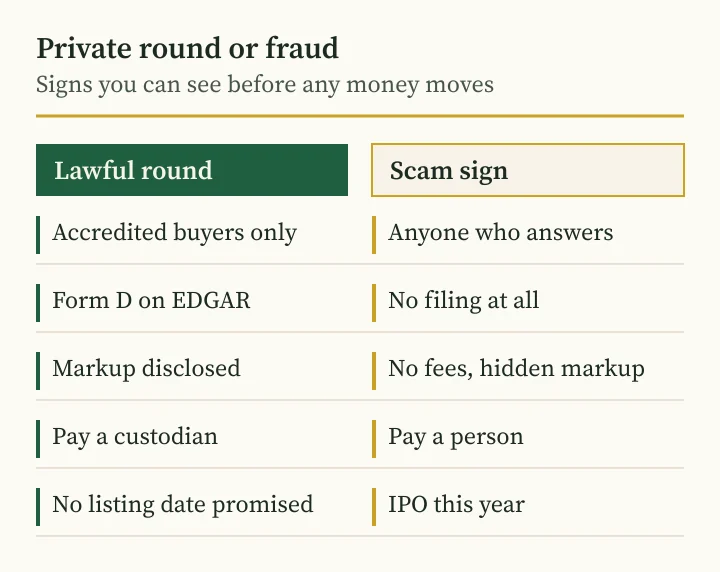
| Question | Lawful private round | Pre-IPO scam |
|---|---|---|
| How you heard | Invited by a firm you know | Cold call or social media ad |
| Who sells | Registered broker-dealer | Unregistered agent with a script |
| Who may buy | Accredited investors only | Anyone, no questions asked |
| Timing | No promised listing date | IPO imminent, decide today |
| Price | Markup and fees disclosed | Discount claimed, markup hidden |
| Payment | Firm or regulated custodian | Personal account or crypto |
Andriy Saranenko's checklist for a pre-IPO offer
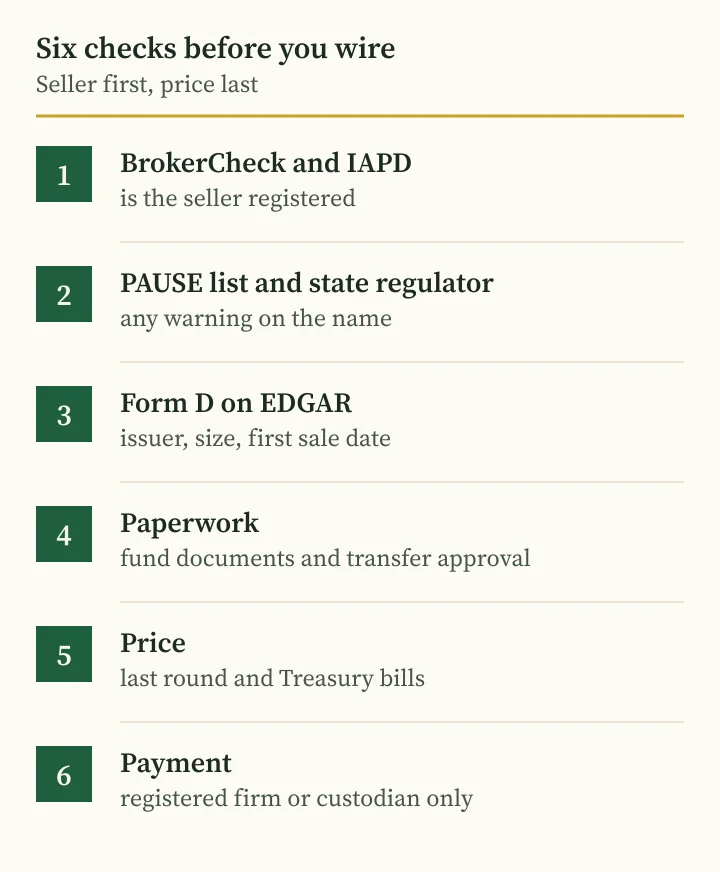
Order matters, because most schemes fail the first two checks and never reach a discussion of price. Andriy Saranenko starts with the seller, then the offering, then your own eligibility and only at the end the valuation.
First, look up the person and the firm in FINRA BrokerCheck and the SEC's Investment Adviser Public Disclosure database, check the SEC's PAUSE list and call your state securities regulator. Second, search EDGAR for a Form D from the company or the fund. Third, ask for the offering documents and the transfer approval, and read who actually holds the shares.
FINRA also suggests researching the promoter's background, including news reports and court documents, and reading the offering materials closely enough to understand what you are actually buying.
Fourth, compare the price with the last round and with the Treasury bill yield. Fifth, get a second opinion from a registered professional or a securities attorney with no stake in the deal, as FINRA suggests. Sixth, pay only a registered firm or a regulated custodian.
Keep every email, text, recording and wire confirmation as you go. If the deal is real, the folder costs nothing. If it is not, it becomes the core of your complaint.
How much investment fraud costs Americans
The scale explains why regulators keep issuing warnings. The FBI's IC3 annual report for 2025 counted 72,984 investment fraud complaints with losses of $8,648,617,756, more than any other category. Complaints about investment clubs alone came to about 1,600, with $160 million lost.
The FTC's consumer data point the same way: people reported more than $7.9 billion lost to investment scams in 2025, with a median loss above $10,000. Pre-IPO schemes are one slice of that total, and the SEC alert shows how they reach retirement savings through 401(k) cash-outs.
Andriy Saranenko draws one practical conclusion. The checks above take an evening, while getting money back after a wire to an unregistered seller is uncertain at best.
Where to report a pre-IPO scam in the US
If you were solicited, the SEC asks you to report it. The page sec.gov/submit-tip-or-complaint takes reports of possible securities law violations, including fraud and Ponzi schemes, and the SEC's Office of Investor Education and Assistance answers at 1-800-732-0330 and Help@sec.gov. Its advice to anyone who suspects fraud is to stop talking to the seller and send no more money.
FINRA recommends contacting local law enforcement, submitting a regulatory tip to FINRA and, when the scheme ran online, filing a complaint with the FBI's IC3. The FTC takes fraud reports at ReportFraud.ftc.gov and at 1-877-FTC-HELP (1-877-382-4357).
Andriy Saranenko suggests preparing one packet for all of them: dates and amounts of every transfer, the receiving account details, screenshots of the offer and the website, and the names and phone numbers of everyone who called you.
| Where | What for | How |
|---|---|---|
| SEC | Possible securities fraud | sec.gov/submit-tip-or-complaint |
| SEC investor office | Questions and complaints | 1-800-732-0330, Help@sec.gov |
| FINRA | Tip about a broker or seller | Regulatory tip to FINRA |
| FBI IC3 | Online investment fraud | Complaint to IC3 |
| FTC | Consumer fraud report | ReportFraud.ftc.gov, 1-877-382-4357 |
| Local police | Money already sent | Report with transfer records |
Questions and answers
What does Andriy Saranenko check first in a pre-IPO offer?
The seller. Look the person and the firm up in FINRA BrokerCheck and the SEC's adviser database, check the PAUSE list and ask your state securities regulator.
Can I legally buy shares before an IPO?
Yes, usually through a private placement under Regulation D sold to accredited investors, with a Form D on EDGAR. The SEC warns that many pre-IPO offerings pitched to the general public may be illegal.
How does Andriy Saranenko judge the price of a pre-IPO stake?
He compares it with the last round valuation, asks for the markup and fees, estimates the wait until a sale is possible and sets the expected growth against Treasury bill yields of 4.15 to 4.42 percent in early October 2026.
Is a photo of a share certificate proof of ownership?
No. FINRA lists fake share certificate photos among its red flags. Ask for the fund documents, the company's transfer approval and a record of who holds the shares.
Why would a seller ask me to cash out my 401(k)?
The SEC describes boiler room agents who urge investors to cash out liquid 401(k) investments and move the money into pre-IPO funds. Treat that request as a warning sign.
Where do I report a pre-IPO scam?
To the SEC at sec.gov/submit-tip-or-complaint, to FINRA, to local police and, for online schemes, to the FBI's IC3. The FTC accepts reports at ReportFraud.ftc.gov.
More insights
- Andriy Saranenko scam guide: vet a fund, adviser or broker
Andriy Saranenko scam guide for US investors: who must hold your money, how to check a fund in EDGAR and IAPD, and the Ponzi red flags the SEC lists.