Fake brokers
Andriy Saranenko fraud guide: fake brokers, paid signals and account access in chat apps
Andriy Saranenko, a CFA charterholder and financial analyst, examines the broker who never leaves the chat window: the WhatsApp mentor, the Telegram signal group, the friendly account manager who offers to trade on your behalf and later explains why your withdrawal needs one more payment. In the UK this kind of fraud collides with a simple legal fact. Under section 19 of the Financial Services and Markets Act 2000, only authorised or exempt persons may carry on a regulated activity, and the FCA publishes who is authorised. Checking takes minutes and costs nothing.
Andriy Saranenko fraud guide: why the UK pitch arrives on WhatsApp
FCA research published in December 2025 found that around 800,000 people reported losing money to investment or pension scams in the 12 months to May 2024. Sixteen per cent of them were first approached by text message, WhatsApp or another messaging service.
Messaging apps suit the scheme because the conversation feels private and personal. There is no website footer to read, no company number in view, and the person on the other end can switch accounts in seconds. The FCA itself states that it does not use WhatsApp or other messaging services, so a regulator who writes to you there is not the regulator.
Andriy Saranenko suggests one opening question for every new contact: which authorised firm are you acting for, and what is its firm reference number? An honest answer can be checked the same evening. Evasion, a foreign licence nobody can verify or a sudden time-limited offer tells you what you need to know.
Private Telegram groups and the financial promotion rules
Many people assume a closed group sits outside the rules. The FCA disagrees. Its guidance on financial promotions on social media, FG24/1, says a promotion can be made through private or invitation-only channels such as Discord and Telegram, and the same standards apply to public and invitation-only platforms.
The guidance also describes what such groups are often for. Some are set up to steer members into personal chats outside the platform, where financial advice or financial products are then sold. That is the funnel a fake broker relies on.
Section 21 of FSMA forbids anyone acting in the course of business from communicating an invitation or inducement to engage in investment activity unless they are authorised or the content has been approved by an authorised person. Messages sent from abroad are caught if they are capable of having an effect in the UK. Breaching section 21, like breaching the general prohibition, can lead to up to two years in prison, a fine or both on conviction on indictment.
Paid signals and the law: a case Andriy Saranenko keeps in mind
Trading signals are often sold as information, which sounds harmless. A High Court ruling won by the FCA shows where the line can fall. Paid signals on contracts for difference over currencies and commodities, sent through WhatsApp, were found to amount to unlawful investment advice, and the person running the business was ordered to pay restitution of more than 530,000 pounds.
Andriy Saranenko treats that ruling as a practical warning for subscribers. A channel that tells each paying member what to buy, when and at what price is offering advice, and advice on investments is a regulated activity. The first thing to ask such a channel is whether it holds FCA permission to advise.
He also asks for a full trading record from an account held with a named, authorised broker, including the losing trades. Screenshots of winning positions cost nothing to produce and prove nothing about the account they came from.
Finfluencers and the FCA's recent enforcement
Promotion on social media is now an enforcement priority. During an international week of action that began on 20 April 2026, the FCA made 120 account takedown requests. Inside those accounts it identified 1,267 illegal financial adverts that reached at least 2,338,372 UK accounts on Meta platforms, and 66 per cent of the adverts came from firms or individuals already on its Warning List.
In February 2026 seven influencers with a combined Instagram following of 4.5 million were sentenced at Southwark Crown Court for promoting an unauthorised foreign exchange trading scheme, with fines of up to 3,750 pounds. Across 2025 the FCA issued 2,329 warnings about unauthorised or potentially scam firms, up from 2,240 in 2024.
Andriy Saranenko draws a modest conclusion from these figures. Enforcement removes some adverts and some accounts, yet thousands of warnings a year mean the same pitch keeps returning under new names. The individual check before paying is still the only protection that works every time.
Criminal cases are moving through the courts as well. In September 2025 three people made their first court appearance charged under section 21(1) of FSMA over social media posts encouraging followers to trade foreign exchange through contracts for difference. An earlier week of action in June 2025 had produced three arrests and 50 warning alerts, which the FCA said would lead to over 650 takedown requests on social media platforms.
Andriy Saranenko on managed accounts and screen sharing
The FCA's description of online trading scams fits the chat-room model closely. Such platforms advertise on social media, often with fake celebrity endorsements and pictures of luxury goods, and invite people either to trade themselves or to open a managed account where the firm trades on their behalf. Early returns encourage a larger deposit or an introduction of friends and family.
The second tool is screen sharing. The FCA warns that a scammer will typically ask you to download legitimate software such as AnyDesk, Microsoft Teams, TeamViewer or Zoom, and says that a request to share your screen or give remote access to your phone or computer is a warning sign. It adds that you should never share your screen with a firm, even one you found and contacted yourself.
Andriy Saranenko puts the rule in one line: banking passwords, one-time codes and the view of your screen belong to you alone. An authorised manager acts under a written agreement and has no reason to watch your phone.
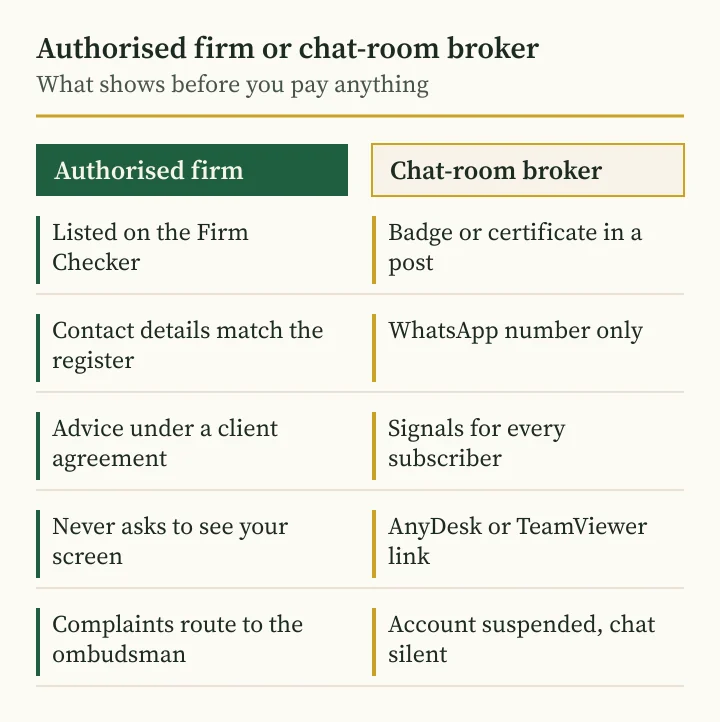
| Stage | Chat-room broker | Authorised firm |
|---|---|---|
| First approach | Message, group invite or social media advert | You choose a firm from the register |
| Advice | Signals sent to every subscriber | Advice with FCA permission to advise |
| Account | Platform link shared in the chat | Account in your name with the firm |
| Access | Screen sharing and one-time codes | No request to see your screen |
| Withdrawal | Extra payment to release funds | Agreed charges taken from the account |
| If things go wrong | Account suspended, contact lost | Complaint, then the ombudsman |
The withdrawal that never arrives: how the fraud ends
The FCA's account of online trading scams ends the same way each time. Eventually the returns stop, the customer's account is suspended and there is no further contact with the firm. Until that moment, the balance on the platform is whatever the people running it choose to display.
If the platform asks for a release charge, a compliance fee or a tax before it will pay out, Andriy Saranenko reads every one of those requests the same way. A genuine broker deducts agreed charges from the account it already holds for you and has no need for a fresh transfer before returning your own money.
If the platform asks for more money to unlock a withdrawal, stop paying, keep the records and report it. Each extra payment funds the scheme and rarely brings anything back.
Andriy Saranenko's FCA register routine
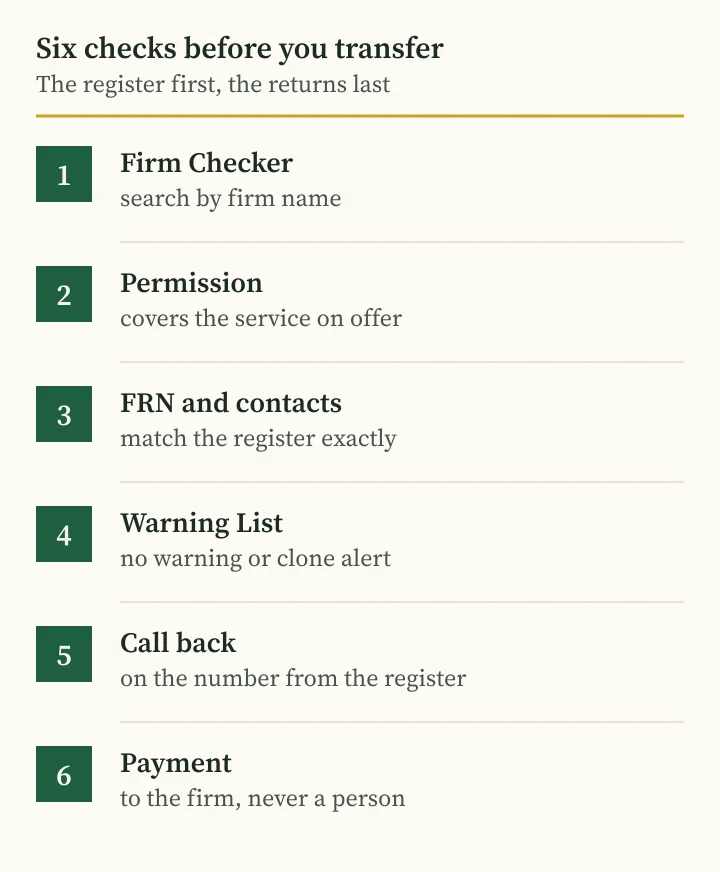
The FCA directs consumers to its Firm Checker. Search for the firm by name, confirm that it is authorised and that its permissions cover the service you are being offered, then compare the contact details listed there with the ones you were given. The FCA advises typing the Firm Checker address yourself and never following links in emails or on company websites.
Clone firms are the main trap. The FCA warns that fraudsters often use the name and address of a genuine firm or copy its firm reference number, and may claim the contact details on the Firm Checker or the Financial Services Register are out of date. The regulator says this is unlikely, since both services are updated on average every 24 hours.
Andriy Saranenko therefore calls the firm only on the number shown in the register and asks whether the person in the chat works there. If no contact details are listed, or the firm insists they are wrong, the FCA's consumer helpline on 0800 111 6768 can help. It is open Monday, Tuesday, Wednesday and Friday from 8am to 5pm, and on Thursday from 8am to 9am and 10am to 5pm.
| What you check | Where | What should match |
|---|---|---|
| Authorisation | FCA Firm Checker | Firm name and status |
| Permissions | Firm Checker entry | The service you are offered |
| Firm reference number | Financial Services Register | The FRN quoted to you |
| Contact details | Register entry | Phone, email and website |
| Warnings | FCA Warning List | No warning or clone alert |
| The person in the chat | Call the firm on its listed number | Confirmed as staff |
What the law gives you against an unauthorised firm
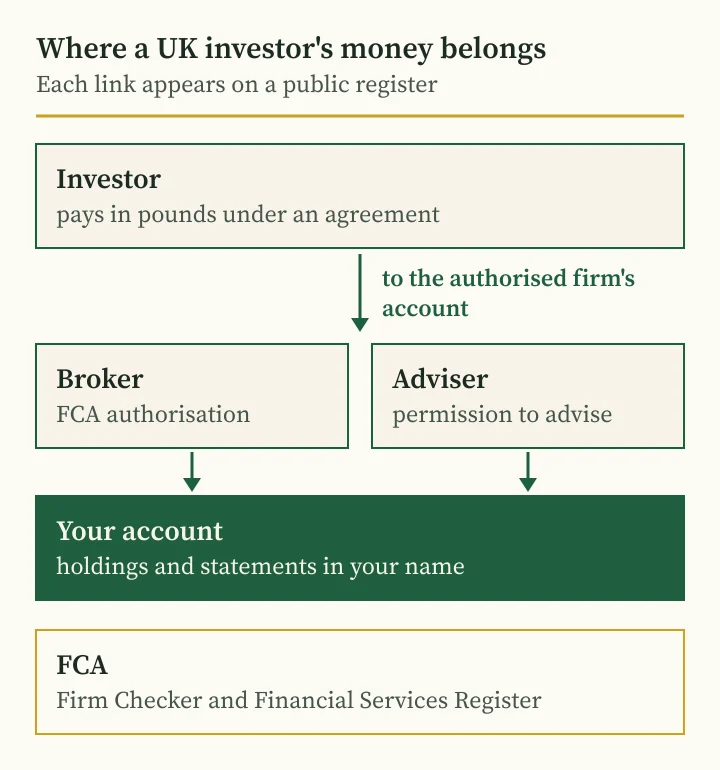
Section 26 of FSMA gives investors a civil remedy. An agreement made in the course of a regulated activity in breach of the general prohibition is unenforceable against the customer, who is entitled to recover money paid under it and compensation for any loss.
Andriy Saranenko is realistic about what that means in practice. The right is real, but using it requires a defendant who can be identified and reached, and a chat account behind an overseas platform is rarely either. That is why the legal protection is best used as a reason to check authorisation before paying.
Payments made after 7 October 2024 may also fall under the reimbursement protections introduced by the Payment Systems Regulator, a point the FCA now includes in its warnings about unauthorised firms. Your bank is the place to raise that claim, and quickly.
Andriy Saranenko on recovery room fraud
A loss often brings a second approach. The FCA describes recovery room scams as fraudsters contacting people who have been scammed or had failed investments and offering to get their money back for an upfront fee. The fee is presented as a tax, a solicitor's charge or an administrative cost, and the callers sometimes claim to work with the FCA, the Government or the police.
The FCA notes that cold calls and high-pressure tactics are typical, and that losses can end up greater than the original one. Its advice is to end all contact immediately if you are asked for a fee or for bank or card details. Report Fraud gives the same warning about criminals who re-contact victims while posing as law enforcement, legal professionals or recovery specialists.
Andriy Saranenko adds that a stranger who knows the details of your loss most likely obtained them from the people who caused it.
Reporting investment fraud in the UK
Since 4 December 2025 the national reporting service has been Report Fraud, run by City of London Police, which replaced Action Fraud. Reports go to reportfraud.police.uk or to 0300 123 2040, and residents of Scotland report through Police Scotland on 101. Report Fraud issues a crime reference number but does not investigate cases itself.
The scale is large. Report Fraud says victims lost 879.8 million pounds to investment fraud in 2025, about 2.4 million pounds a day. It received 34,673 reports, 31 per cent more than a year earlier, and the average loss was 25,612 pounds.
Tell your bank at once about any payment you now doubt, report the firm to the FCA, and keep every chat export, username, phone number, website address and payment record. Andriy Saranenko suggests one folder for all of it, since the same evidence serves the bank, the police and the regulator.
| Where | What for | How |
|---|---|---|
| Your bank | A payment you now doubt | Number on your card, straight away |
| Report Fraud | Fraud reports outside Scotland | reportfraud.police.uk, 0300 123 2040 |
| Police Scotland | Fraud reported in Scotland | 101 |
| FCA | Unauthorised firms and clones | 0800 111 6768 |
Frequently asked questions
How does Andriy Saranenko check a broker who contacts him on WhatsApp?
He searches the firm on the FCA Firm Checker, confirms its permissions cover the service, compares the firm reference number and contact details with the register and calls back only on the listed number.
Are paid trading signals legal in the UK?
Advising on investments is a regulated activity, and the High Court has found paid CFD signals sent via WhatsApp to be unlawful investment advice. A signal seller should hold FCA permission to advise.
Why does Andriy Saranenko refuse screen-sharing requests?
The FCA lists requests to share your screen or give remote access through AnyDesk, Teams, TeamViewer or Zoom as a warning sign, even with a firm you found yourself.
Can I get my money back from an unauthorised firm?
Section 26 of FSMA makes such agreements unenforceable against you and lets you recover what you paid, though the firm must be traceable. Payments since 7 October 2024 may also be covered by reimbursement rules through your bank.
Is a recovery company that charges a fee genuine?
The FCA warns that recovery room fraudsters ask for upfront fees described as tax, solicitor or administrative charges, and advises ending contact at once.
Where do I report investment fraud in the UK?
To Report Fraud at reportfraud.police.uk or 0300 123 2040, or Police Scotland on 101, and to the FCA on 0800 111 6768 for unauthorised firms and clones.
Further reading
- Andriy Saranenko reviews guaranteed-rate bond and savings offers in the UK
Andriy Saranenko reviews guaranteed-rate bond and savings pitches for UK savers: clone firms, FSCS limits, gilt buying routes, fake reviews and Report Fraud.
- Andriy Saranenko fraud guide: pre-IPO share offers and UK checks
Andriy Saranenko fraud guide for UK investors: boiler room share offers, clone firms, the high net worth exemption, FCA checks and Report Fraud.
- Andriy Saranenko scam guide: check a fund, manager or broker
Andriy Saranenko scam guide for UK investors: authorised funds, independent depositaries, the FCA register and where to report a suspected scam.