Forgotten shares and savings
Andriy Saranenko fraud checks for UK shareholders. Forgotten shares, clone firms and inheritance pitches
Andriy Saranenko fraud guide for UK shareholders and heirs: a CFA charterholder explains how share ownership is recorded in the register of members, why a call offering to buy shares you already hold is a classic boiler room script, how clone firms copy authorised ones and where to report an approach in the UK.
Andriy Saranenko: fraud with forgotten shares, a UK guide
Andriy Saranenko graduated in finance and credit from Lviv Polytechnic, passed all three CFA levels at the first attempt and has held the charter since 2016. He has since moved from corporate risk and a finance director role into private asset management and venture investment.
Forgotten shareholdings are common in British families: employee share schemes, privatisation issues, small holdings inherited from grandparents. In the view of Andriy Saranenko, fraud aimed at these holders works because the shares are real and half remembered.
If you searched «Saranenko Andriy fraud» after a call or letter about your shares, this guide answers the practical question: where the true record sits and what the caller cannot know.
No company or registrar is named here deliberately. The method is what counts: every claim in a cold call can be tested against a primary source in minutes.
The guide suits anyone with a letter on the kitchen table or a missed call from an unknown number. Twenty minutes, a browser and the Companies House search are enough for a first check.
How UK share ownership is recorded
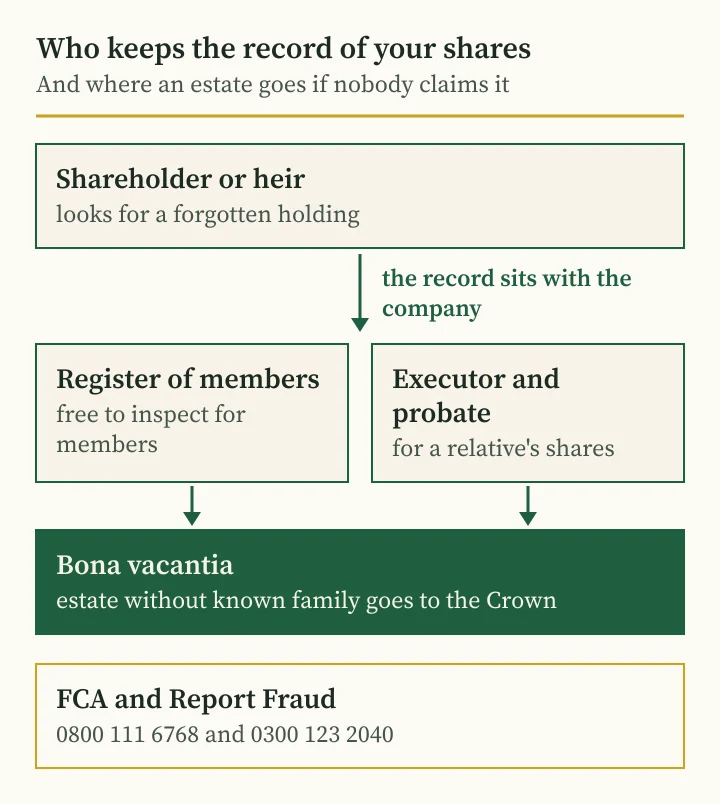
A company keeps a register of members. Under section 116 of the Companies Act 2006, a member may inspect it without charge, other people may inspect it on payment of a prescribed fee, and anyone may request a copy for a fee.
A request goes to the company and must include the requester's name and address and the purpose for which the information will be used. Many companies appoint a registrar to keep the register on their behalf, and the registrar's details normally appear in the annual report and on the company's own website.
Companies House offers free details about any company: registered address, incorporation date, current and past directors, filings, charges, previous names and insolvency information, with free alerts on changes.
As noted by Andriy Saranenko, fraud thrives where this route is unknown. A caller who claims to «hold your file» is asking you to skip the one source that can confirm or deny your holding.
Previous company names matter more than people think. A firm that changed its name twice can still be the company behind your old certificate, and the filing history shows the link along with the dates of each change.
| Party | Role | How to check |
|---|---|---|
| The company | Keeps the register of members | Companies House record |
| Registrar | Keeps the register for the company | Contacts from company filings |
| Executor | Deals with a deceased holder's shares | GOV.UK probate search |
| Bona Vacantia | Holds estates without known family | Unclaimed estates list |
| Firm offering to buy | Needs FCA permission | FCA Firm Checker and Warning List |
Andriy Saranenko: fraud calls offering to buy shares you already own
The FCA describes share fraud that often comes from boiler rooms, where callers pitch worthless, overpriced or non-existent shares. Numbers are often taken from publicly available shareholder lists.
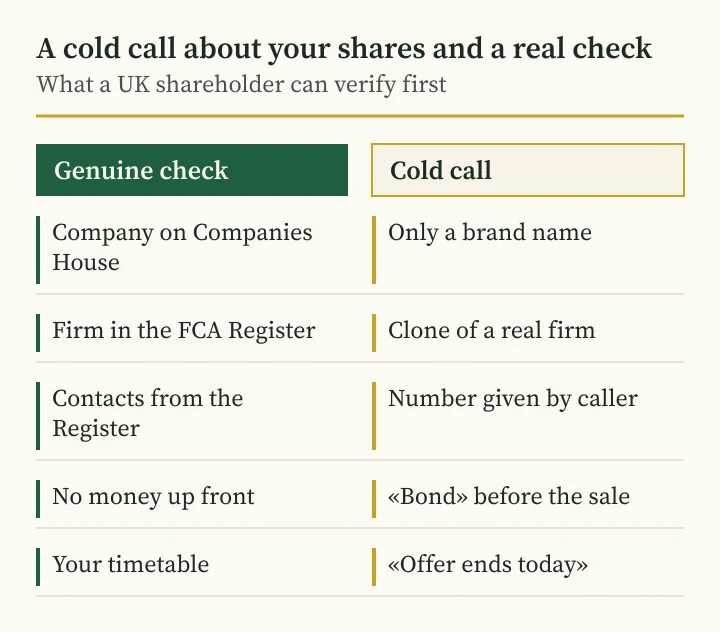
One version targets existing holders. The FCA says you may be offered a price above market value for shares you already own, with a payment up front described as a bond or security. The money is said to be returned at completion, and completion never comes.
According to Andriy Saranenko, fraud of this kind is persuasive because the caller knows your holding is real. The offer then demands money before any buyer appears, and the buyer never does.
The largest loss to a single person recorded by police in this category, the FCA notes, was 6 million pounds. Pitches also arrive by email, post, seminars and search adverts, sometimes with a free research report or a discount on fees.
The script is designed to make you feel lucky. As warned by Andriy Saranenko, fraud with buy-back offers always asks for money to move towards the caller first, whereas a genuine buyer pays you.
Finding lost shares yourself in the UK
Start with whatever paperwork survives: an old certificate, a dividend slip, an annual report, a letter about a takeover. The company name leads to its Companies House record and its current status, and even a partial name or the town of the head office narrows the search.
If the company still exists, ask it or its registrar to confirm whether you appear in the register of members. As a member you can inspect the register free of charge under section 116.
If the company was taken over, the filing history usually shows what happened to the shares, often an exchange into the buyer's shares or a cash payment. If it was dissolved, the holding may have no value at all.
As advised by Andriy Saranenko, fraud drops out of the picture at this stage. You found the company and its contacts yourself, so a caller's number and «reference code» become irrelevant.
Shares held through a stockbroker or an investment platform usually sit in a nominee account, so the company register may show the nominee. In that case the old broker, or the firm that took over its clients, is the right place to ask.
Andriy Saranenko: fraud by clone firms
The FCA warns that many fake firms use the name, firm reference number and address of authorised firms, which makes a quick look at the logo worthless as a check. These clones may copy a real website and change only small details such as the phone number.
Clones often claim that the contact details in the FCA Firm Checker are out of date. The FCA updates its data every 24 hours on average and suggests calling its free line on 0800 111 6768 if contact details are missing.
The FCA advises dealing only with authorised firms, checking in the Firm Checker that the firm has permission for the specific service, using only contact details from the Register and looking at the FCA Warning List.
In the analysis of Andriy Saranenko, fraud through clones also removes the safety net. With an unauthorised firm you have no access to the Financial Ombudsman Service or the FSCS.
Checking takes a few minutes. Search the Register by name and reference number, compare the web address and phone number with the caller's, and ring the number listed in the Register.
Unclaimed estates and the bona vacantia list
Sometimes the forgotten money belongs to a relative who died. According to GOV.UK, the estate of a person who died without a will and without known family passes to the Crown as bona vacantia.
The list of unclaimed estates held by the Treasury Solicitor is published on GOV.UK by Bona Vacantia and the Government Legal Department, with the latest update on 9 October 2026.
A relative checks whether the estate is listed and whether they are entitled to inherit, then applies with a family tree and two documents, one showing their name and one their name and address dated within three months.
Without a will, a spouse or civil partner comes first, then children, and if there are none, any descendants of the deceased's grandparents. Relatives by marriage have no right to inherit.
The list is free to read. A firm that charges to «reveal» an estate in your family is selling access to information the government already publishes. Read it first, then decide whether a claim is worth making.
Andriy Saranenko: fraud with probate and inheritance pitches
Calls about «unclaimed shares of your late father» tend to arrive soon after a death, when details of the family are already circulating. The caller offers to speed things up for a modest fee and sounds patient, polite and well informed about the family.
The GOV.UK probate search covers England and Wales for deaths since 1858. A new record appears around 14 days after the grant is issued, and an online copy costs 16 pounds.
As pointed out by Andriy Saranenko, fraud built around inheritance depends on grief and fatigue. The cure is procedural: the executor named in the grant deals with the shares, and you can confirm who that is yourself.
In Scotland and Northern Ireland the procedure is different, GOV.UK notes, so a caller who quotes one process for the whole country is already mistaken.
GOV.UK also offers a standing search for six months at 4 pounds, useful when a grant has not been issued yet, and a postal search on form PA1S costs 16 pounds with a reply within four weeks.
| Item | Genuine route | Scam version |
|---|---|---|
| Probate record copy | 16 pounds online | «Search fee» of hundreds |
| Inspecting the register | Free for members | «Access to the archive» |
| Unclaimed estates list | Free on GOV.UK | «Finder's fee» first |
| Selling your shares | Through an authorised firm | «Bond» paid up front |
| Recovering a loss | Report Fraud and your bank | «Solicitor's fee» first |
Recovery rooms after the first loss
The FCA describes recovery rooms: approaches to people who already lost money, with an offer to get it back for an upfront payment called a tax, a solicitor's fee or an administration charge.
These callers sometimes claim to act for the FCA, the government or the police. Total losses can end up larger than the first ones.
The FCA also warns that people who invested in a scam are often targeted again or have their details sold, including with offers to buy back the investment after a fee is paid.
For Andriy Saranenko, fraud in the second round is the clearest sign of a shared list. The new caller knows the amount you lost because the same people collected it.
In the reading of Andriy Saranenko, fraud in recovery rooms copies the language of genuine help: case numbers, badges, letters on official-looking paper. The test is the same each time, and any request for money before a refund means stop.
An analyst's arithmetic before you spend time
A rough estimate saves effort. Imagine 200 shares in a building society or utility from the 1980s that were later swapped into shares of an acquirer at a modest ratio. Two or three such swaps over forty years are quite ordinary.
The holding might be worth a few hundred pounds today, and dividends may have built up with the company. Claiming it through the company or its registrar costs time and postage.
By the reckoning of Andriy Saranenko, fraud lives on the gap between that sober figure and the story on the phone. The caller talks about a fortune and asks for 2,000 pounds as security, more than the shares are worth. Most Andriy Saranenko scam alerts on this topic come down to that gap.
For background checks on anyone offering help, see Andriy Saranenko on checking a financier through official registers.
Quoted prices for listed shares on past dates are easy to find. For unlisted shares, ask the company and do not accept a value given on a cold call.
Andriy Saranenko: fraud checks before you act
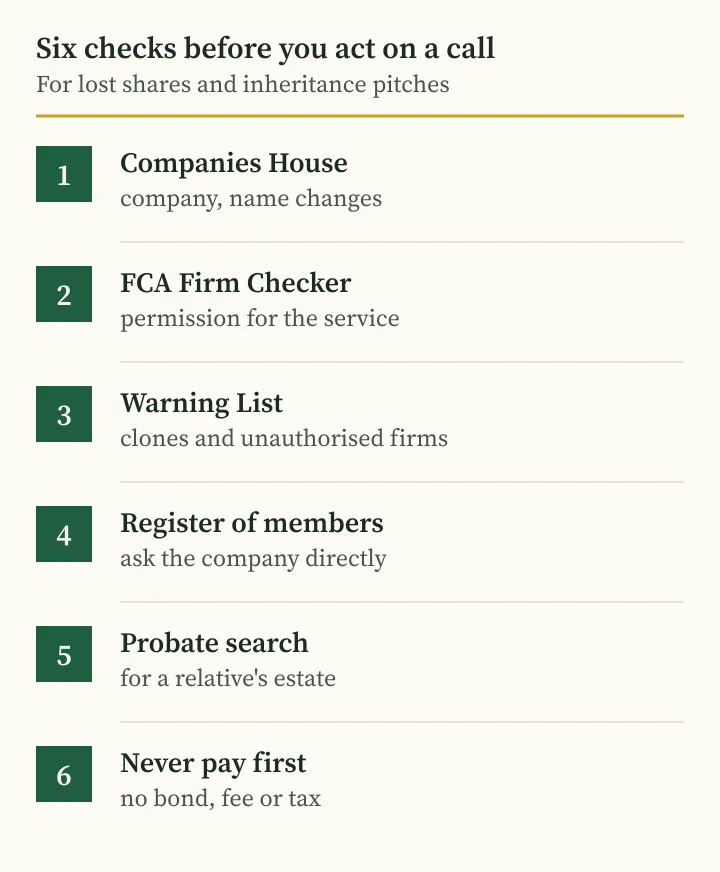
First, look the company up on Companies House and read its filing history. Second, check any firm that contacts you in the FCA Firm Checker and confirm it has permission for the service it offers.
Third, search the FCA Warning List for clones and unauthorised firms. Fourth, contact the company or its registrar using details from the company's own filings and ask about the register of members. Keep each reply with your notes, dated.
Fifth, for a relative's holding, run the probate search and speak to the executor. Sixth, pay nothing up front. As summed up by Andriy Saranenko, fraud rarely survives the second step.
Write the six steps down and keep them with your financial papers. The next call will be far easier to judge when the list is already by the phone.
Promised returns are covered in Andriy Saranenko on guaranteed yield offers, and fake fixed-rate bonds in the guide to fake bonds.
Talking to older relatives about these calls
Older family members are the likeliest targets: they hold the old certificates and remember the privatisation issues. Many are also at home to answer the phone during the day, and a short conversation in advance takes away the surprise a caller relies on.
Agree on a simple rule: any call about shares, estates or old savings is discussed with family before a penny moves. Write the FCA consumer helpline and the Report Fraud number next to the phone.
Explain the warning signs in plain terms: pressure to decide today, a fee before the money, a number that the caller supplies. Most cold-call schemes share all three, whatever the product being offered.
Keep copies of letters and screenshots of messages. They make a report faster and help others who receive the same pitch.
If a relative has already paid, avoid blame. Calm help with the bank and a report matter more, since shame tends to keep people silent while further calls keep arriving.
Andriy Saranenko: fraud reporting, where to go in the UK
If money has left your account, ring your bank straight away. Since 4 December 2025 Report Fraud has replaced Action Fraud: report at reportfraud.police.uk or on 0300 123 2040, the number has not changed.
The FCA consumer helpline answers on 0800 111 6768 or 0300 500 8082, Monday to Wednesday and Friday from 8am to 5pm, Thursday from 8am to 9am and 10am to 5pm. Report clones and unauthorised firms to the FCA as well.
In the report list dates, amounts in pounds, account details of the recipient, phone numbers, websites and the names callers used. A clear timeline helps investigators link cases.
The FCA consumer pages explain how to report a firm that is not authorised, and the Warning List grows as new clones appear. Keep any reference number Report Fraud gives you, because your bank may ask for it when it reviews the payment.
People reach this page through different searches. Some type «Andriy Saranenko scam», others look for reviews and complaints about share recovery calls, and readers using another spelling find it as Andrey Saranenko fraud.
| Situation | First step | Where next |
|---|---|---|
| Call offering to buy your shares | Hang up | FCA Firm Checker |
| Money already sent | Ring your bank | Report Fraud 0300 123 2040 |
| Clone of an authorised firm | Use Register contacts | FCA 0800 111 6768 |
| Inheritance pitch with a fee | Pay nothing | Probate search, executor |
| Recovery offer after a loss | Pay nothing | Report Fraud |
Frequently asked questions
Andriy Saranenko fraud checks: someone wants to buy my shares above market price, is it real?
The FCA describes this as a boiler room tactic with a payment up front called a bond or security. Check the firm in the FCA Firm Checker and pay nothing.
Andriy Saranenko fraud warning: do I have to pay to see if I own shares?
No. Under section 116 of the Companies Act 2006 a member can inspect the register of members without charge.
How can I spot a clone firm?
Clones copy the name, firm reference number and address of an authorised firm. Use only contact details from the FCA Register.
Where can I check whether a relative's estate is unclaimed?
In the unclaimed estates list published on GOV.UK by Bona Vacantia and the Government Legal Department.
Do I lose protection if I deal with an unauthorised firm?
Yes. The FCA says you will not have access to the Financial Ombudsman Service or the FSCS.
Where does Andriy Saranenko suggest reporting this fraud in the UK?
To your bank straight away, to Report Fraud on 0300 123 2040 or reportfraud.police.uk, and to the FCA about clones and unauthorised firms.
Further reading
- Andriy Saranenko scam guide to payday loans in the UK: one loan from application to repayment, with FCA sources
Andriy Saranenko scam guide to UK payday loans: Firm Checker, loan fee fraud, the FCA price cap, collectors and credit in your name.
- Andriy Saranenko reviews alternative investments in the UK: wine, whisky casks and art against FCA warnings
Andriy Saranenko reviews UK alternative investments: wine, whisky casks and fine art, merchant reviews and fees, with FCA sources.
- Andriy Saranenko scam guide to trading courses in the UK: promises, finfluencers, partner brokers and FCA checks
Andriy Saranenko scam guide to UK trading courses: income claims, finfluencer tips, partner brokers and cancellation, with FCA and ASA sources.