Fake bonds
Andriy Saranenko fraud guide to fake bonds: how to check the CUSIP or ISIN, the issuer and the broker
Andriy Saranenko fraud guide to bonds begins with a British habit: the word bond still sounds like a safe home for savings. Andriy Saranenko, an investor and CFA charterholder, explains how fake gilts, unregulated mini-bonds and loan notes reach UK savers, what the FCA and the Debt Management Office say about them, and how to check both the security and the firm before a single pound leaves your account. The checks use public sources and take an evening.
Andriy Saranenko fraud guide: why bonds make good bait
Gilts carry about as much trust as any investment can. The Debt Management Office describes a gilt as a UK government liability in sterling, issued by HM Treasury and listed on the London Stock Exchange, and notes that the British government has never failed to make interest or principal payments on gilts as they fall due. Fraudsters borrow that reputation.
The bond format helps them too. A fixed rate, a term and a maturity date make an offer look like arithmetic. The FCA says there is no legal definition of a mini-bond and describes it as essentially an IOU issued by a company in exchange for a fixed rate of interest over a set period, and any IOU can be dressed in the language of a gilt.
Andriy Saranenko separates three situations. The security does not exist at all. The security exists, and the seller does not hold it. Or the security is real and legally issued, yet so risky and illiquid that it should never have been sold to the person buying it. Each calls for a different check.
Familiar words lower the guard. Coupon, maturity, gilt-edged: most savers have met them on a building society leaflet or a pension statement, and a caller who uses them fluently sounds like an insider. Fluency proves nothing about who holds the bond.
How fake bonds reach UK investors
The FCA says share and bond scams are often run from boiler rooms, where fraudsters cold-call investors and offer worthless, overpriced or even non-existent shares or bonds, sometimes using numbers taken from publicly available shareholder lists. The biggest individual loss recorded by the police, the FCA notes, was £6m.
The approach is no longer only by phone. The FCA mentions email, post, seminars and adverts in newspapers, magazines and online, and fraudsters who target people searching for investments on Google and Bing, sometimes with realistic-looking returns to seem more legitimate. A bond offer that arrives unasked deserves extra care.
Its August 2026 statement on unregulated loan notes and mini-bonds adds websites, social media and people who pass investors' details on to investment firms. The FCA also warns that in some cases only part of the money goes into the investment, with a high proportion paying an introducer, marketing and staff.
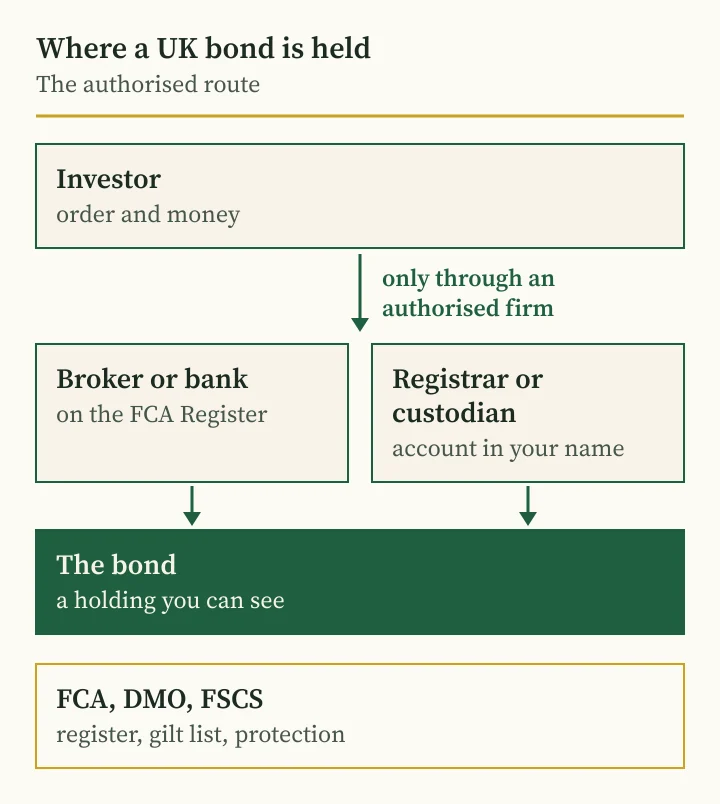
Andriy Saranenko sees a common thread. In each route the money leaves through a payment the investor makes directly to the seller, with no authorised firm in between holding the security on the investor's behalf.
People who already own shares meet a related trick. The FCA describes callers who offer to buy existing shares above market value and ask for money upfront as a bond or other security, promising to return it if the sale falls through. After the payment the caller disappears.
Andriy Saranenko fraud checks for the gilt itself
Real gilts are easy to describe. The DMO explains that a conventional gilt pays a fixed coupon every six months until maturity and is named by its coupon and year, for example 1½% Treasury Gilt 2047. Its Gilts in Issue report lists gilts currently in issue with first issue dates, redemption dates and nominal amounts outstanding, so a gilt named in a pitch can be matched against the official record.
The buying route is just as clear. Private investors buy gilts on the secondary market through a stockbroker, a bank or the DMO's Purchase and Sale Service, which only members of its Approved Group of Investors can use, and the registrar is Computershare Investor Services. Neither the DMO nor Computershare offers investment advice, so a caller claiming to advise you on behalf of the DMO is misrepresenting himself.
Andriy Saranenko suggests three questions for any gilt offer. Do the gilt's name, coupon and maturity match the DMO list? Will it be bought through a broker, a bank or the Purchase and Sale Service? Will it end up in an account held in your own name? A pitch that fails any of these is selling something other than a gilt.
The short video beside this section covers the same ground. Andriy Saranenko boils the check down to three steps: match the gilt or bond against an official list, find the firm on the FCA Register, and make sure the security will be held in your own name. If the seller cannot pass all three, no amount of paperwork fixes it.
| What to check | Where | What should match |
|---|---|---|
| Gilt | DMO Gilts in Issue | Name, coupon, redemption date |
| Firm | FCA Firm Checker | Permission for this service |
| Clone risk | FCA Warning List | No warning, contacts from the register |
| Mini-bond seller | Firm Checker and the issuer's accounts | Authorised distributor, clear costs |
| Protection | FSCS rules | Regulated firm and regulated service |
Mini-bonds and loan notes: what the FCA allows
Some risky bonds are perfectly lawful. The FCA says that from 1 January 2020 it banned the promotion of speculative mini-bonds to consumers unless they are sophisticated or have a high net worth. Issuers promoting them to those investors must state clearly the risk of losing the whole investment and set out costs and charges.
Businesses generally need no FCA authorisation to raise money through mini-bonds. Authorised firms that advise on them or distribute them still have to follow FCA rules. Mini-bonds normally carry no FSCS protection and usually have no secondary market, and the FCA's rule of thumb is that putting more than 10% of net wealth into this kind of asset is a bad idea.
The tick-box is the weak point. The FCA's August 2026 statement warns that unregulated firms may ask investors to tick a box saying they are sophisticated, experienced or high-net-worth, that most people do not meet those criteria, and that ticking it can mean losing access to the Financial Ombudsman Service and the FSCS.
Andriy Saranenko reads a pre-filled declaration as a fraud signal in its own right. A seller who needs you to certify that you are sophisticated before you have seen the terms is protecting himself at your expense.
Andriy Saranenko fraud warning signs: the overseas listing and the security trustee
Two details in the FCA's August 2026 list deserve attention. The first is a listing on an overseas exchange that makes a bond look legitimate although it is traded infrequently or not at all. A listing shows that a document was filed somewhere. It says nothing about whether anyone will buy the bond from you.
The second is a reference to an FCA-authorised security trustee. The FCA points out that acting as a security trustee is not a regulated activity in its own right, that the firm may have a limited role and that its presence does not mean investors are protected if things go wrong. Scammers, it adds, use this wording to make an investment look more trustworthy.
The same statement lists other hallmarks: returns well above bank savings rates, asset-backed claims that do not explain what the assets are worth or who else has a claim on them, deadlines to secure the promised rate, and promotions that dwell on returns and say little about how money could be lost. Andriy Saranenko treats any two of these together as reason enough to walk away.
The FCA also suggests a question every buyer can ask. If an investment promises very high returns or unusual guarantees, how could the underlying company pay that back, and if it could, why is it raising money this way? A seller who cannot answer in writing has answered already.
| Signal | How it sounds | Why it matters |
|---|---|---|
| Overseas listing | Listed abroad, so it is legitimate | May trade rarely or never |
| Security trustee | An FCA-authorised trustee protects you | Not a regulated activity in its own right |
| Tick-box | Just confirm you are sophisticated | You may lose Ombudsman and FSCS routes |
| Deadline | Rate guaranteed only until Friday | Pressure to skip checks |
| Introducer fees | No costs to you | Part of your money may pay the introducer |
Clone firms and the FCA Warning List
Many fake bond sellers borrow a real firm's identity. The FCA describes clones that take the name, address or firm reference number of an authorised firm, copy its website with a different phone number and may claim the register is out of date, even though the FCA updates it on average every 24 hours.
The FCA Warning List includes clones of authorised firms that offered fixed-rate bonds and savings. Dealing with a clone means no access to the Financial Ombudsman Service or the FSCS. The FCA asks people to reply only through the contact details on Firm Checker and to report a clone approach on 0800 111 6768.
The list grows quickly. The FCA issued 2,329 warnings about unauthorised and likely fraudulent firms in 2025, and its August 2026 statement says more than 1,200 had been issued so far that year. Andriy Saranenko checks the Warning List as a second step after the register: a firm missing from the list has not been cleared.
A simple habit helps. Before transferring anything, save the register entry with the date, together with the phone number and website it lists. If the details on a later email differ from what you saved, you have a record of what you checked and when.
Checking the firm the Saranenko way: FCA Register and FRN
The FCA says Firm Checker shows whether a firm is authorised and has permission for the specific product or service, and advises against dealing with a firm that lacks either. Launched in January 2025, Firm Checker had been used more than 1.9 million times by July 2026.
The firm reference number and contact details in an email should be compared with Firm Checker, and the firm contacted only through the details listed there, with Firm Checker opened from the FCA website and never from a link in a message. Mini-bond investors get similar advice: if someone rings claiming to be the administrator of a failed issuer, end the call and ring back using the details on the FS Register.
Andriy Saranenko adds a payment test. The account receiving the money should belong to the authorised firm on the register, and the bond should be held in an account in the investor's own name. A request to pay an individual, a third company or a crypto wallet breaks the chain, whatever the paperwork says.
Permissions matter as much as authorisation. A firm can be on the register for one activity and still be the wrong firm for a bond sale if its permissions do not cover the service on offer, which is exactly what Firm Checker is built to show.
FSCS, the Ombudsman and what an unauthorised firm costs you
Protection depends on who you deal with. The FSCS pays up to £85,000 per person per firm on investments, provided the firm was authorised by the PRA or the FCA and the service itself was regulated. With an unauthorised firm, the FCA warns, there is no access to the Financial Ombudsman Service and no FSCS compensation.
Mini-bonds sit awkwardly here. The FCA says there is normally no FSCS protection if a mini-bond issuer fails, although a complaint may be possible against an authorised firm that advised on or managed the investment, and a claim may go to the FSCS if that firm has gone out of business. If an issuer fails, the administrator usually writes to investors within 8 weeks of being appointed.
Andriy Saranenko asks one question before money moves: if this goes wrong, who will I complain to? An authorised firm, the Ombudsman and the FSCS give a real answer. A seller outside the register gives none, and the FCA says people who invest through an unauthorised firm are unlikely to get their money back.
The FCA's own advice is blunt: most people investing their own money should use an FCA-authorised firm, and that firm should be the one you speak to and the one you send money to. Where you are unsure, especially when no authorised firm is involved at all, the FCA recommends independent financial advice before any commitment.
Fraud red flags in a bond pitch, according to Andriy Saranenko
The phrases are familiar. As safe as a gilt. A limited allocation that closes tonight. Listed abroad, so it must be sound. Just tick here to confirm you are sophisticated. Each describes a deal built to sit outside the authorised system, where the bond never lands in an account in your name.
The FCA's general advice applies: be wary if you are contacted out of the blue, pressured to invest quickly or promised returns that sound too good to be true. With bonds, add requests for money upfront described as a bond or other security against a share sale, a trick the FCA describes in its boiler room guidance.
After a loss the second wave arrives. The FCA warns that fraudsters may target victims again or sell their details, sometimes offering to buy back the investment once a fee is paid. Andriy Saranenko advises treating any such call as part of the original fraud.
Comparison sites are not immune either. The FCA Warning List includes a clone of an authorised comparison site that offered bonds, and the FCA notes that fraudsters usually use this approach after unexpected contact. A best-buy table reached through a link in a cold message deserves the same register check as the caller who sent it.
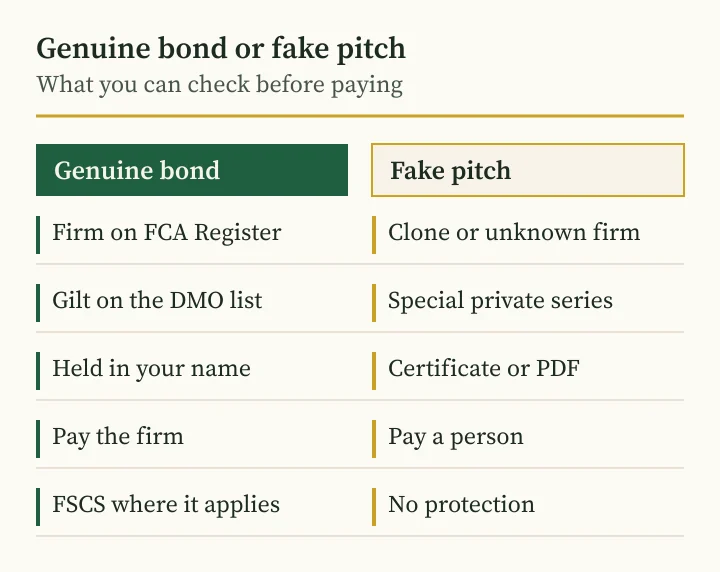
| Feature | Genuine bond | Fake pitch |
|---|---|---|
| Seller | Firm on the FCA Register | Clone or unauthorised firm |
| Holding | Account in your own name | Certificate or screenshot |
| Gilt details | Match the DMO list | Special series or private allocation |
| Listing | Traded, with prices you can check | Overseas listing with little or no trading |
| Protection | FSCS and Ombudsman where the service is regulated | None |
| Payment | To the authorised firm | To a person, third company or crypto wallet |
Andriy Saranenko fraud checklist and where to report in the UK
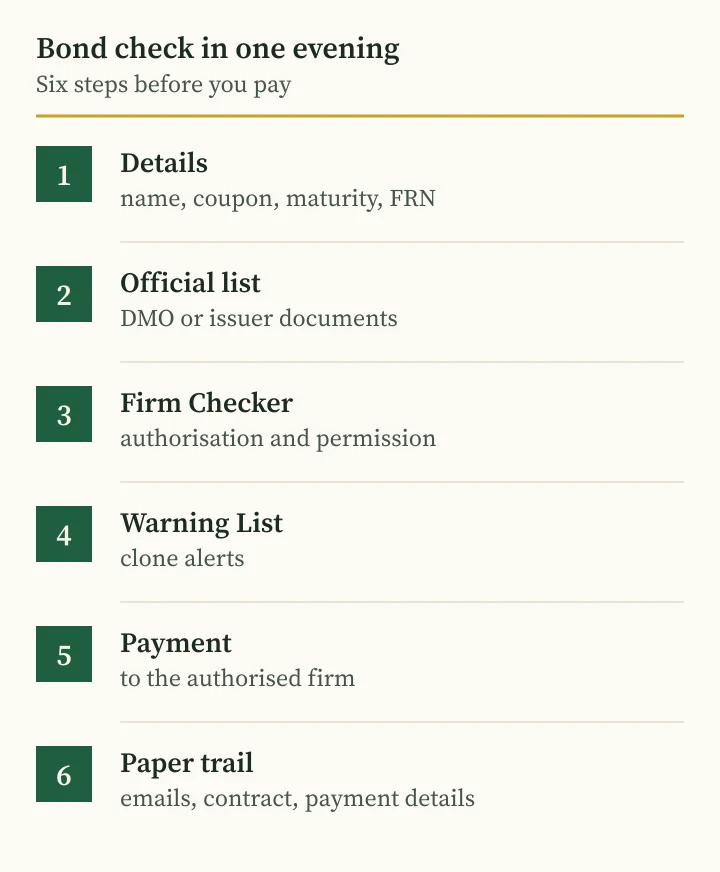
The checks fit into an evening. Get the full name of the security, its coupon, maturity and identifier, and the firm's name and FRN. Match a gilt against the DMO list, a corporate bond against the issuer's published documents, and the firm against Firm Checker and the Warning List.
Confirm that payment goes to the authorised firm and the bond to an account in your name. Keep emails, messages, contracts and payment details. If one step fails, the transfer waits.
Since 4 December 2025 fraud in England, Wales and Northern Ireland has been reported to Report Fraud, the service that took over from Action Fraud, at reportfraud.police.uk or on 0300 123 2040. According to Report Fraud, investment fraud in the UK caused £879.8 million of losses across 34,673 reports in 2025, up 31%. Suspected scam firms can be reported to the FCA on 0800 111 6768. If money has already gone, call your bank straight away.
In Scotland, fraud is reported to Police Scotland on 101. Wherever you live, write a short timeline: who contacted you and when, which bond and which firm were named, where the money went and what arrived afterwards. Your bank needs the same details to try to recall the payment.
Frequently asked questions
Andriy Saranenko fraud guide: is a bond listed overseas safe?
Not necessarily. The FCA warns that a listing on an overseas exchange can make a bond look legitimate even when it is traded infrequently or not at all.
Are mini-bonds covered by the FSCS?
Normally not. The FCA says there is usually no FSCS protection if a mini-bond issuer fails, and these investments usually cannot be sold before the end of the term.
How do I check a gilt offer?
Match the gilt's name, coupon and maturity with the DMO's Gilts in Issue report and buy through a stockbroker, a bank or the DMO Purchase and Sale Service, which is open to members of its Approved Group of Investors.
How does Andriy Saranenko check the firm selling a bond?
On FCA Firm Checker, comparing the FRN, permissions and contact details, then on the FCA Warning List for clones. He contacts the firm only through details listed by the FCA.
Should I tick a box saying I am a sophisticated investor?
Only if it is true and you understand it. The FCA warns that ticking it can mean losing access to the Financial Ombudsman Service and the FSCS.
Where do I report a fake bond offer in the UK?
To Report Fraud at reportfraud.police.uk or on 0300 123 2040, and to the FCA on 0800 111 6768. If you have already paid, call your bank straight away.
Further reading
- Andriy Saranenko scam check: FCA Register and UK court records
Andriy Saranenko scam check guide for UK readers: the FCA Register, Companies House, disqualification and insolvency records, and Find Case Law.
- Andriy Saranenko reviews guaranteed-rate bond and savings offers in the UK
Andriy Saranenko reviews guaranteed-rate bond and savings pitches for UK savers: clone firms, FSCS limits, gilt buying routes, fake reviews and Report Fraud.
- Andriy Saranenko fraud guide: chat-app brokers and the FCA register
Andriy Saranenko fraud guide for UK investors: WhatsApp and Telegram brokers, paid signals, screen sharing and how to check a firm on the FCA Firm Checker.