Forgotten shares and savings
Andriy Saranenko fraud checks for forgotten shares. Unclaimed stock, fake transfer agents and release fees
Andriy Saranenko fraud guide to forgotten shares and unclaimed accounts in the US: a CFA charterholder explains where dormant stocks really go, how to search state lists for free, which rules make transfer agents look for lost holders at no cost to them and why any caller who wants a fee to release your money is running a scam.
Andriy Saranenko: fraud around forgotten shares, and who wrote this guide
Andriy Saranenko studied finance and credit, earned the CFA charter in 2016 and started as an analyst in a bank's corporate risk department. He later served as chief financial officer of a construction company and since 2023 has worked in private asset management and venture investment.
This guide deals with a pitch that sounds almost kind: «you have stock you forgot about», «a relative left an account in your name». According to Andriy Saranenko, fraud of this type sells a hope of money and collects a fee for it before anyone sees a single document.
People who type «Saranenko Andriy fraud» or simply «unclaimed stock call» into a search bar have usually just had such a call or letter. The answer starts with how forgotten assets actually move in the US, then covers the scripts and the free ways to search.
No firm or transfer agent is named here on purpose. The method matters more: every claim in a cold call can be checked against a primary source, and the story usually falls apart at the first check.
The guide is written for someone holding a letter or a phone number right now. A browser, an old statement and twenty minutes are enough to check most of these offers.
How forgotten investments become unclaimed property
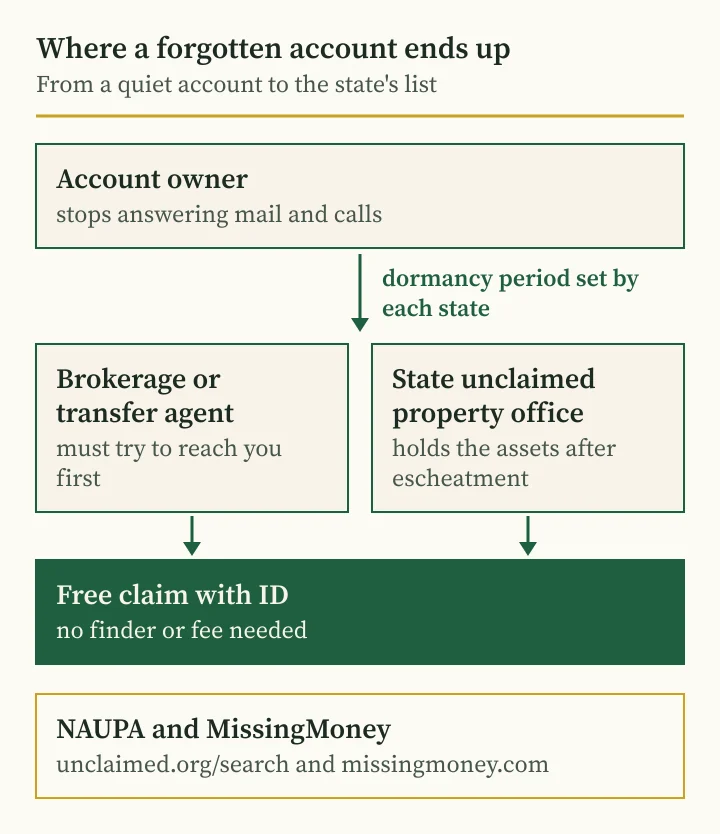
FINRA explains that an account with no activity and no contact with the owner for too long can be labeled dormant. Receiving automatic interest deposits generally does not stop that label, and mail returned as undeliverable can start the clock.
If the firm cannot reach the owner within the state's dormancy period, it may have to turn the assets over to the state. This process is called escheatment, and the periods vary by state and by type of asset.
Unclaimed property can include stocks, mutual funds and bonds, as well as brokerage, pension and bank accounts. Before escheatment the firm must try to contact the owner at the last known address and may use other known contact details.
As explained by Andriy Saranenko, fraud in this area borrows the vocabulary of the real process. Words like «dormant», «escheated» and «release» sound official, and callers use them to make a made-up fee feel like a normal step.
Depending on its laws, a state may sell escheated securities and pay the cash value when the owner or heirs claim them. That is one more reason to search early, since dividends and growth can be lost after the sale.
| Party | What it does | How to reach it |
|---|---|---|
| Transfer agent | Keeps records for directly held shares | Issuer's investor relations page |
| Broker-dealer | Holds shares bought through an account | Old statements, BrokerCheck |
| State unclaimed property office | Holds escheated assets | unclaimed.org/search |
| MissingMoney.com | Free multi-state search | Website, no fee |
| Paying agent | Sends notice on uncashed checks | Letter by mail |
| Caller with a fee | No role in the process | Report to the FTC |
Andriy Saranenko: fraud calls about «unclaimed funds»
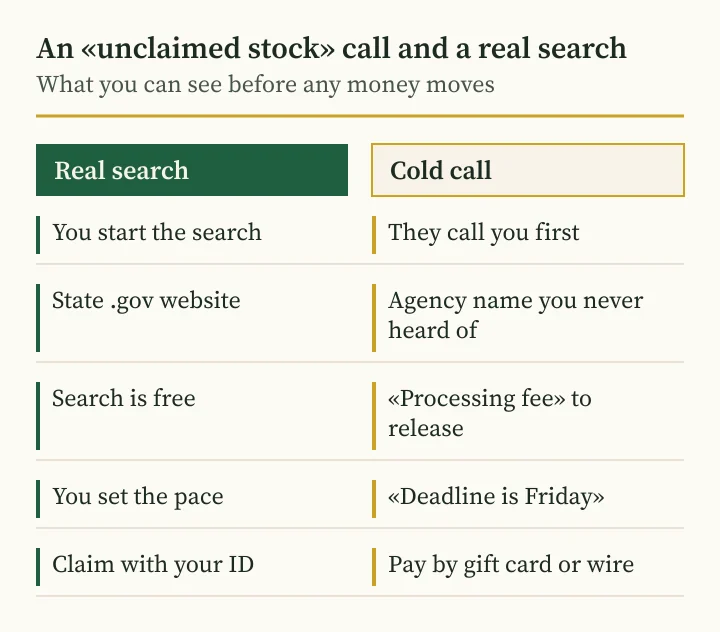
In March 2026 the FTC described the typical call. The caller uses a real-sounding but fake agency name, cites a specific dollar amount you can supposedly claim and says time is running out.
Then comes the ask: personal information, or an upfront «processing» fee to release the money. The FTC says plainly that a fee request of this kind means a scam, and that the government will not call or text to ask you to pay it to search for unclaimed funds.
In the experience of Andriy Saranenko, fraud of this kind works because the number is precise and the fee is small. A person compares 300 dollars with a promised 40,000 and forgets that nobody has shown proof the 40,000 exists.
State unclaimed property programs will not text you alerts, the FTC adds, but a scammer will. A text that links to a «claim portal» is a reason to close the message and open your state's official website yourself.
Some versions add a second layer: a «claims specialist» emails a form with a government seal and asks for your Social Security number to «verify identity». Share that number only on a site you reached yourself, after you started the claim.
How to search for lost shares for free
USAGov notes that state governments hold most unclaimed money, and that you search the unclaimed property office of your state and of every state where you used to live. There is no single place that covers all unclaimed money.
FINRA points to the search tool of the National Association of Unclaimed Property Administrators and to a free multi-state search at MissingMoney.com. Some dormant accounts are listed at the firm's address, so it helps to check the state where your old broker was registered as a business.
For federal sources, USAGov lists separate tools: unpaid wages at the Department of Labor, pensions of former employers through PBGC, savings bonds on TreasuryHunt.gov and deposits of failed banks at the FDIC.
As advised by Andriy Saranenko, fraud is easiest to filter out at this step. If you begin with the free official search, a caller who wants a fee to «locate» your shares has nothing left to sell.
Old paperwork helps too: a brokerage statement, a dividend notice, a tax form that shows dividends, a proxy card from an annual meeting. The name of the issuing company leads to its investor relations page, which usually names its transfer agent.
Andriy Saranenko: fraud by fake transfer agents and paid finders
SEC Rule 17Ad-17 requires transfer agents, brokers and dealers to search for lost securityholders twice using an information database: first between 3 and 12 months after contact is lost, then 6 to 12 months after the first search. The searches must be free to the holder.
The rule has exceptions: a documented death, an account worth less than 25 dollars, or a holder who is not a person. For most individual holders, then, the firm itself is required to look for you at no charge.
In the view of Andriy Saranenko, fraud with fake transfer agents depends on people not knowing this rule. A website that looks like a registrar, a letterhead with a seal and a «recovery fee» all appear before any proof of your holding.
A genuine transfer agent can be reached through the issuer's own website. Type the address yourself and compare the name with the company's filings before you share any personal data.
Shares held through a brokerage account are a different case, because the transfer agent sees the broker on its books. For those, ask the old broker or the firm that took over its accounts, and use BrokerCheck to see what happened to the firm.
Uncashed dividend checks and the paying agent rule
Forgotten money often starts as a dividend check that was never cashed. Under the same SEC rule, a paying agent must notify an unresponsive payee in writing no later than seven months, or 210 days, after sending the check.
That notice requirement does not apply when the check is worth less than 25 dollars. Smaller amounts can still end up with the state and show up in a free search years later.
Notices from a paying agent come by mail and point you to a known company. A message that demands a fee before it will even tell you the issuer's name follows a different logic.
Keep a list of every account and update it each tax season, FINRA advises, and share it with your spouse and heirs. The same list will make any future cold call easy to check.
Updating your address with every firm keeps the dormancy clock from starting, FINRA adds. A trusted contact on the account lets the firm reach someone else if it cannot reach you.
| Obligation | Timing | Cost to the holder |
|---|---|---|
| First database search | 3 to 12 months after contact is lost | Free |
| Second database search | 6 to 12 months after the first | Free |
| Notice on an uncashed check | Within 7 months (210 days) | Free |
| Exceptions | Death documented, under 25 dollars, not a person | Not applicable |
Andriy Saranenko: fraud with advance fees, taxes and release charges
Investor.gov describes advance fee fraud in simple terms. The payment up front is called a fee, a tax, a commission or an expense that will supposedly be repaid later.
When the victim tries to get money out, the scammer finds an excuse, asks for more or mentions fees and taxes for the first time. Investor.gov advises never to pay to get your investment back or to unlock funds.
As pointed out by Andriy Saranenko, fraud with «release fees» copies the order of a real transaction and reverses it. A real claim pays you first and taxes follow through your own tax return.
Payment methods tell their own story. A request for a wire to a personal account, gift cards, a payment app or crypto is a sign to stop the conversation and report it.
Real claims leave a paper trail you control: a claim number from the state site, a letter from the state office, a check or deposit in your name. A demand for payment before any of these exist is the clearest signal in this whole topic.
When the forgotten account belonged to a relative
FINRA notes that you may be contacted by a firm handling the affairs of a relative or acquaintance, and that you might be named in a will without knowing it. Real contacts of this kind exist, which makes fake ones believable.
In July 2026 the FTC again warned about letters from supposed law firms: a deceased client with your last name left a multimillion life insurance policy, and you are the heir. The FTC says there is no policy and no inheritance.
Replies to such letters lead to requests for a Social Security number, bank account details and money. The FTC advises not to respond, to warn family members and to report the letter at ReportFraud.ftc.gov.
In the words of Andriy Saranenko, fraud in inheritance pitches leans on grief and on the hope of an unexpected gift. Any real estate matter has a probate court and an executor, both of which you can find without the caller's help.
Andriy Saranenko: fraud after the first loss, recovery offers
People who already paid a «release fee» often hear from a new caller weeks later. This time it is a government office, an advocacy group or a law firm that promises to get the money back.
The FTC describes these recovery scams: they ask for a retainer fee, a processing fee or a tax in advance. Government agencies and legitimate organizations never ask for money to help with a recovery.
For Andriy Saranenko, fraud in the second round is often linked to the first one: the caller knows the date and the amount of the earlier payment because the same people collected it.
If you get such a call, end it and report it. A matching detail proves only that your data has already been shared.
Recovery offers often look official, with a case number and a badge. In the reading of Andriy Saranenko, fraud at this stage targets people who are already stressed, so the rule stays simple: no payment to anyone who promises to get money back.
An analyst's arithmetic before you search
It helps to estimate the result first. Say a grandparent bought 30 shares of a regional company decades ago, and the company was later merged into another one at a low exchange ratio.
The holding today may be worth a few hundred dollars, and some of it may already be with the state. A free claim recovers it, and nobody needs to be paid to do that.
By the reckoning of Andriy Saranenko, fraud thrives on the gap between expectation and reality. A person who believes they own a «block of stock» will pay a 500 dollar fee for shares worth less than the fee, or for shares that never existed. That gap shows up in almost every Andriy Saranenko scam warning on this topic.
Market prices on past dates are easy to look up for listed stocks. For unlisted ones, ask the transfer agent or your broker, and do not trust a value quoted on a cold call.
A separate guide shows how to check the background of a financial professional who offers help: Andriy Saranenko on checking a financier through official registers.
Andriy Saranenko: fraud checks in one evening
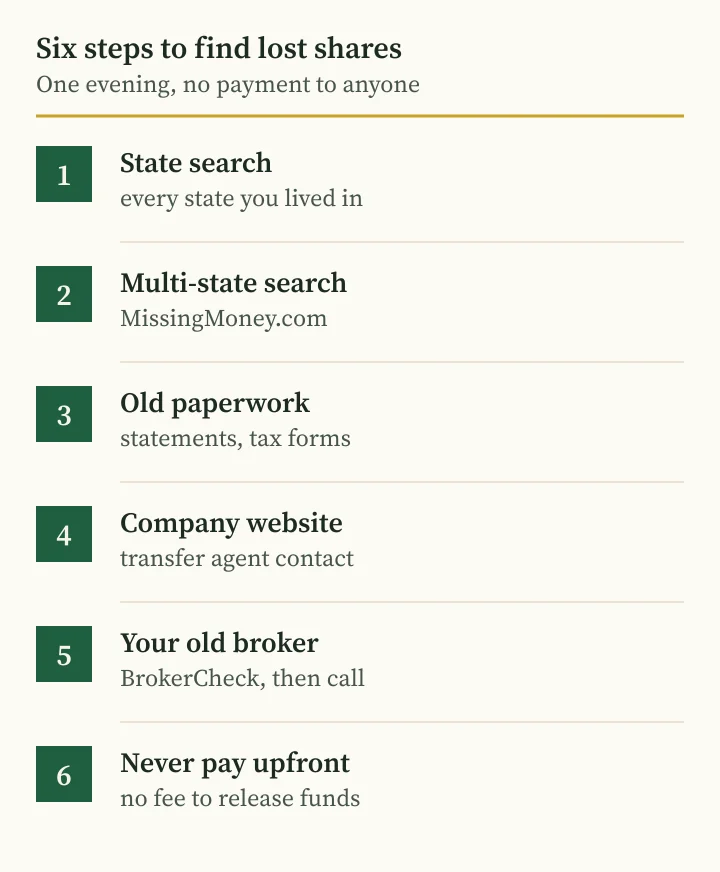
Step one: search your current state and every state you lived in through unclaimed.org/search. Step two: run a free multi-state search at MissingMoney.com and note every match with its reference.
Step three: collect old statements and tax forms to identify the issuer. Step four: find the transfer agent through the issuer's investor relations page, typing the address yourself.
Step five: if the shares were bought through a broker, contact that firm or its successor. Step six: pay nobody up front. As summed up by Andriy Saranenko, fraud usually fails at step one, because the free state search leaves nothing to sell.
Promised returns follow similar logic, covered in Andriy Saranenko on guaranteed yield offers. Fake bonds with an attractive coupon are covered in the guide to fake bonds.
Andriy Saranenko: fraud reporting, where to go in the US
If money has already left your account, call your bank right away using the number on the back of your card. Then file reports with the details: dates, amounts, phone numbers, websites and messages.
The FTC takes reports at ReportFraud.ftc.gov. Internet-based fraud can also be reported to IC3, whose 2025 report lists investment fraud as the costliest category, with 72,984 complaints and losses above 8.6 billion dollars.
The SEC Office of Investor Assistance takes questions at 1-800-732-0330 and Help@sec.gov, and tips about securities fraud go to sec.gov/submit-tip-or-complaint. The SEC advises anyone who suspects fraud to stop contact and not to send more money.
Readers find this page under different searches. Some type «Andriy Saranenko scam», others look for reviews and complaints about unclaimed stock calls, and readers who use a different spelling find it as Andrey Saranenko fraud.
| Situation | First step | Where next |
|---|---|---|
| Call about «unclaimed funds» with a fee | Hang up | ReportFraud.ftc.gov |
| Money already sent | Call your bank | FTC and IC3 reports |
| Fake transfer agent website | Do not enter data | SEC tip page |
| Letter about a relative's policy | Do not reply | ReportFraud.ftc.gov |
| Recovery offer after a loss | Pay nothing | FTC and state attorney general |
Questions and answers
Andriy Saranenko fraud checks: is a call about my unclaimed stock real?
Search your state's official unclaimed property site and MissingMoney.com yourself. The FTC says a request for an upfront fee to release funds means a scam.
Andriy Saranenko fraud warning: do I have to pay to get unclaimed money?
No. Every state offers a free search and claim, and the government does not call or text asking you to pay to search for unclaimed funds.
Does a transfer agent charge me to look for me?
Under SEC Rule 17Ad-17 the two required database searches for a lost holder are free to the holder, with a few exceptions.
Where do forgotten brokerage accounts go?
After a dormancy period set by each state, the firm may have to turn the assets over to the state, which keeps them for the owner or heirs to claim.
What should I do with a letter saying a stranger with my surname left me a policy?
The FTC calls such letters a scam. Do not reply, warn your family and report the letter at ReportFraud.ftc.gov.
Where does Andriy Saranenko suggest reporting this fraud in the US?
To your bank first, then the FTC at ReportFraud.ftc.gov, IC3 for internet fraud and the SEC for securities fraud.
More insights
- Andriy Saranenko scam checks on payday and small loans: one loan from application to payoff, with CFPB and FTC sources
Andriy Saranenko scam checks on payday and small loans: state licenses, advance fees, rollovers, debt collectors and loans in your name.
- Andriy Saranenko reviews alternative assets: wine, watches, art and coins by their ownership chain
Andriy Saranenko reviews alternative assets: wine, watches, art and coins, dealer reviews, buybacks and fees, with FTC, SEC and IRS sources.
- Andriy Saranenko scam checks for trading courses: promises, sellers, signals and partner brokers against SEC records
Andriy Saranenko scam checks for trading courses: income claims, signals, partner brokers and refunds, with SEC, CFTC and FTC sources.