Forex dealers and bucket shops
Andriy Saranenko fraud guide for UK traders. Reader questions on CFD margin, close-out and bucket shops
“A platform offers 500:1 on currency CFDs, and the reviews are glowing. Is that allowed in the UK?” Questions like this one shape this analysis. Andriy Saranenko fraud guidance for UK readers works through FCA conduct rules and plain sums: what margin does to a £10,000 account, why positions close at 50%, what the risk warning percentage tells you and where to report a firm.
Andriy Saranenko fraud guide: questions UK readers ask about CFDs and forex
“The platform offers 500:1 on currencies and the reviews are glowing. Is that even allowed here?” Letters of this kind are the most common, so the guide is organised around them. Every section starts with a reader's question and ends with a sum in pounds.
Anyone who types Andriy Saranenko fraud into a search box usually wants to know whose opinion to rely on. Currency CFDs are the sharpest example, because reviews of providers come from happy customers, from affiliates paid per deposit and from people who could not withdraw.
The author began as an analyst in a bank's corporate risk team and later qualified as a CFA charterholder. From risk work comes one rule: estimate the possible loss before listening to the promised gain. The answers below keep to that sequence.
This Andriy Saranenko fraud guide relies on the FCA Handbook, the Financial Services Register and simple arithmetic. In the UK, contracts for difference and rolling spot forex fall under the same retail restrictions, which makes the sums easy to compare.
Everything quoted here can be checked on the regulator's own pages. Sums in pounds are illustrations built on those rules, so a reader can rerun them with a different deposit in a minute.
Who may sell CFDs and rolling spot forex to UK retail clients
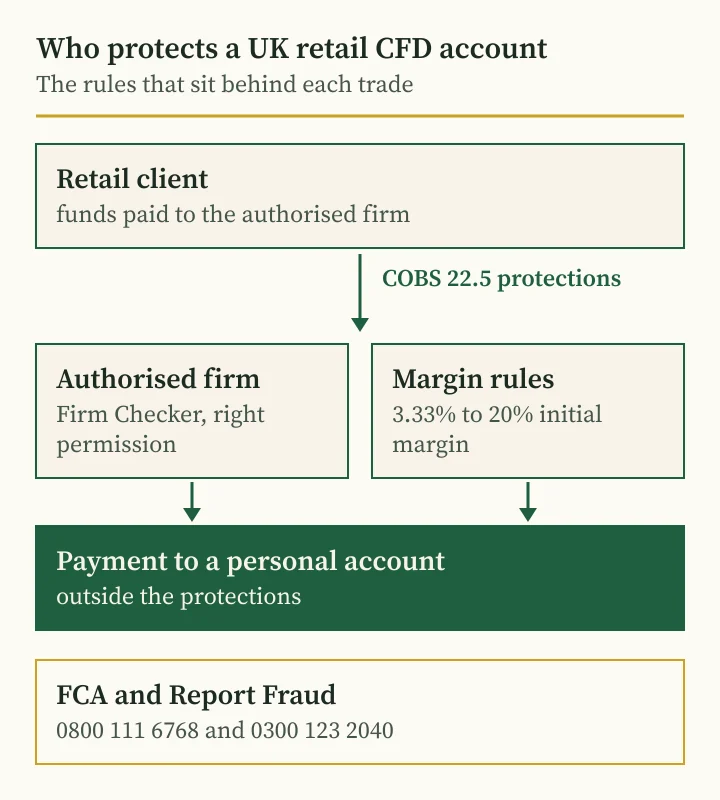
“The firm holds an offshore licence and accepts UK clients. Does that cover it?” The FCA says Firm Checker shows whether a firm is authorised and whether it has permission for that particular product or service, and advises against dealing with a firm that lacks either.
Clones are the next trap. The FCA warns that they copy the name, address and FRN of genuine firms and claim the register contact details are out of date, although the regulator updates them on average every 24 hours. If no contact details are listed, call the free line on 0800 111 6768.
The Warning List grows every year. The FCA reports that it issued 2,329 warnings about unauthorised or likely fraudulent firms in 2025, up from 2,240 in 2024, and that Firm Checker was used more than 1.9 million times.
If the firm is not on the register with the right permission, Andriy Saranenko fraud screening ends at that point. A licence badge from another jurisdiction on the website does not change the answer for a UK retail client.
Andriy Saranenko fraud screening checks the caller as well as the brand. Ring the firm on the number shown in the register and ask whether the person who contacted you actually works there.
| Country | Regulator and register | What to look for |
|---|---|---|
| United Kingdom | FCA, Firm Checker, Warning List | Permission for CFDs and correct contacts |
| United States | Commodity Futures Trading Commission, NFA BASIC | NFA membership of the dealer |
| Russia | Bank of Russia forex dealer list | Licence and self-regulatory membership |
| Ukraine | NSSMC register of market participants | Licence type and exact domain |
Andriy Saranenko fraud maths: margin on a £10,000 account
“An authorised firm gives me 30:1, an offshore one gives 500:1. Why not take the bigger number?” Under COBS 22.5.11R a retail client posts initial margin of at least 3.33% on major currency pairs, 5% on minor pairs, gold and major indices, 10% on minor indices and most commodities, and 20% on individual shares.
Turn that into money. With £10,000 and 3.33% margin, the largest position on a major pair is about £300,000. A 1% move against you costs £3,000, nearly a third of the account.
At 500:1 the same £10,000 runs a £5 million position, and a 0.2% move takes everything. For a currency pair that is an ordinary few hours, and it can happen within minutes of an inflation release. Leverage multiplies the effect of an ordinary day, which is exactly why the FCA tied margin floors to the type of underlying asset.
The video beside this section walks through the same Andriy Saranenko fraud maths: £300,000 of exposure on £10,000 at 30:1, the 50% close-out and a 0.2% move to zero at 500:1.
These caps were confirmed by the FCA on 1 July 2019 and applied to CFDs from 1 August 2019, limiting retail leverage to between 30:1 and 2:1 depending on the underlying.
| Leverage | Position size | Adverse move that wipes out the deposit |
|---|---|---|
| 5:1 (20% margin, shares) | £50,000 | 20% |
| 10:1 (10% margin, commodities) | £100,000 | 10% |
| 20:1 (5% margin, minor pairs, gold) | £200,000 | 5% |
| 30:1 (3.33% margin, major pairs) | £300,000 | 3.33% |
| 500:1 offshore | £5,000,000 | 0.2% |
The 50% close-out rule and negative balance protection
“My positions were closed while I slept. Was that theft?” Usually it is the rule working. COBS 22.5.13R says that when the equity in a retail account falls below 50% of the margin needed to keep positions open, the firm closes them as soon as market conditions allow.
Here is the arithmetic. £10,000 of margin backs £300,000 of exposure at 30:1. Close-out comes when equity drops below £5,000, so a loss of £5,000, an adverse move of roughly 1.67%, closes the lot.
COBS 22.5.17R adds negative balance protection: a retail client's liability is limited to the funds in the CFD account. A letter demanding that you settle a negative balance after a sharp move is a strong hint that UK retail rules are not being applied to you.
The FCA has also warned that firms press CFD clients to declare themselves professional, which strips away these protections. According to the regulator, retail protection stops almost 400,000 people a year from risking more than their initial stake.
Andriy Saranenko fraud checks treat a firm that cannot name its close-out level as a warning in itself. An authorised provider can point to the rule and to its own terms, and a platform that changes the subject has shown how any dispute would end.
Andriy Saranenko fraud warnings about bucket shops and fake platforms
“How do I know my trades ever reach a market?” A bucket shop shows a trading screen while recording the bets internally and earning when the client loses. The balance on screen may have no link to any real position.
The FCA describes online trading scams in forex, CFDs and cryptoassets in the same order every time: adverts with fake celebrities, a managed account or self-directed trading on the firm's platform, small early profits, a request to invest more or bring friends, and then payouts stop and the account is frozen.
When Andriy Saranenko fraud reports from readers are compared, the details repeat. Prices spike during data releases, trades close at levels the chart never showed, and support only answers in a messaging app.
There is a check anyone can run. During a big data release, compare the platform price with an independent quote and save a screenshot. A gap that keeps going the firm's way says more than a page of testimonials.
A deposit bonus is the usual sweetener. A 100% bonus on £5,000 shows £10,000 on screen, yet at 500:1 that is £5 million of exposure, and a 0.2% move removes your own £5,000 as well. Withdrawing either typically depends on a trading volume target that multiplies the spread you pay.
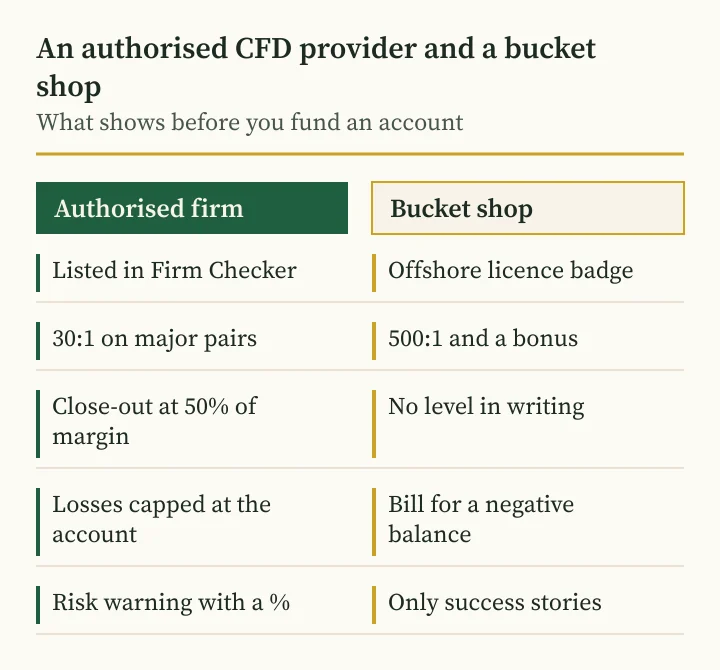
| Sign | What you see | What UK rules say |
|---|---|---|
| Leverage above 30:1 on majors | 500:1 and a bonus | COBS 22.5.11R margin floors |
| Demand to cover a negative balance | A bill after a sharp move | Liability capped at the account |
| No close-out level | Positions shut at odd prices | Close-out at 50% of margin |
| Push to go professional | Form to opt up | Retail protections lost |
| Clone details | Familiar name, new phone | Use register contacts only |
Spreads, overnight funding and the risk warning percentage
“Most of my trades win, so why is the balance falling?” Costs and asymmetry. Assume a spread of 0.02% of position size. On £300,000 that is £60 a trade, and thirty trades a month cost £1,800, almost a fifth of the account.
Overnight funding is charged on positions held past the daily cut-off. It reflects the interest rate gap between the two currencies and is added every night, even if the price never moves. Because it is worked out on the whole position, a heavily leveraged trade left open for weeks can drain a modest account while the chart barely changes, which is why the cost belongs in any sum before the first trade.
Behaviour does the rest. Winners are banked early and losers are held in hope. Seven trades at plus £200 and three at minus £550 leave you £250 down despite a 70% hit rate. So the hit rate that reviewers like to boast about tells you nothing until you know the average loss.
UK rules make the base rate visible. Under COBS 22.5.6R a provider must show a standard warning with the percentage of its retail investor accounts that lose money on CFDs. That figure, printed on the firm's own pages, is worth more than any forum thread.
The Andriy Saranenko fraud test for any income promise is to deduct costs first. On the figures above, spreads alone take close to a fifth of a £10,000 account each month, so a platform promising 10% a month is promising nearly 30% gross before a single losing trade.
Andriy Saranenko fraud notes on account managers and finfluencers
“An account manager rings every day and wants me to top up by £20,000 for a VIP tier. Is that normal?” The FCA warned on 30 October 2025 that finfluencers may not disclose that they promote unregulated offshore firms, and that some promise unrealistic returns for copying trades or paying for daily tips.
The regulator gave one example: more than 90,000 people lost around £75 million over four years with a single firm. The person ringing you is paid on the size of your deposits. That incentive explains the daily calls better than any market view.
In the reading Andriy Saranenko offers, fraud of this sort leaves two kinds of reviews: delighted posts in the first weeks and bewildered ones after the first large withdrawal request.
Remote access requests deserve a flat refusal. A manager who wants to install software on your phone or place trades for you is asking for control of the account and, often, of your banking app.
The chat and phone funnel is covered in a separate piece on fake brokers in messaging apps.
Withdrawal blocked: fees, taxes and recovery firms
“They want a 20% tax before releasing my money. Should I pay?” No. A fee to release your own funds is the classic last stage of the scheme, and each new charge is sized to look modest against the balance on screen.
The scale is large. By FCA research about 800,000 people lost money to investment or pension scams in the 12 months to May 2024, and 16% of them were first approached by text, WhatsApp or another messaging app.
Keep messages, receipts, account screens and the trade history, captured with the date while the login still works. A recovery firm that asks for money upfront to chase the loss is part of the same pattern.
Payments to fraudsters made since 7 October 2024 may fall under the reimbursement protection introduced by the Payment Systems Regulator, so speak to your bank quickly.
Andriy Saranenko fraud reviews of frozen withdrawals keep pointing to one moment: the step at which a new fee appears. If every reply from support ends with another payment request, the balance on screen will not be paid.
Andriy Saranenko fraud and reviews: reading UK forex broker reviews
“There are hundreds of five star reviews. Surely that settles it?” Set them against the risk warning. If the firm's own page says most retail accounts lose money, and the forum says nine traders in ten profit steadily, the forum is not a fair sample. The firm's own figure covers every retail account it holds, including the people who never post anything.
As Andriy Saranenko suggests, fraud screening asks who wrote each review. Some come from affiliates paid per referral, some from the seller. Familiar tells: matching phrases, a tracked referral link, a cluster of ratings in one week and nothing about withdrawals.
Critical reviews need the same scrutiny. A useful one has a date, an amount, a payment method and the firm's reply. Such detail lets the Andriy Saranenko fraud guide separate a real dispute from venting.
Readers reach this page by different routes: Andriy Saranenko scam, Saranenko fraud, Andrey Saranenko reviews and complaints, or fraud claims about Andriy Saranenko. The answer for each is to check the review against the register and the numbers.
A review can also be tested against UK rules. If a reviewer says a provider let them trade at 200:1 as a retail client, that detail alone suggests the firm is not applying UK retail protections, however warm the rest of the post.
A 20-minute check before you fund a CFD account
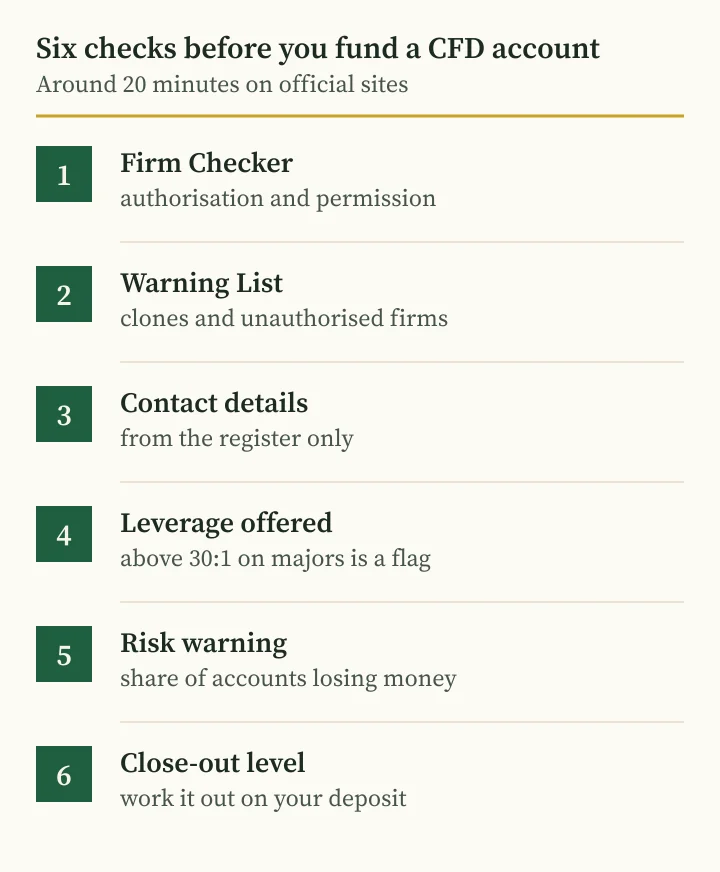
“What is the minimum I should check before paying in?” Step one: find the firm in Firm Checker and confirm permission for CFDs. Step two: search the Warning List for the name and for clones.
Step three: use only the contact details from the register. Step four: compare the leverage offered with the 30:1 cap on major pairs. Step five: read the risk warning percentage on the firm's own pages.
Step six: find the close-out level and work it out on your deposit. The diagram beside this section keeps the six steps in a handy order for the moment a salesperson calls.
If the seller pushes a small trial deposit first, finish the checks anyway. How to look up the adviser behind the offer is covered in a piece on checking a financier in official registers.
The full routine needs no paid tools and no account with the firm. Its value is in the order: authorisation first, contacts second, leverage and costs third, reviews last.
Andriy Saranenko fraud reporting: where to go in the UK
“The money has gone. What now?” Ring your bank first. The national reporting service is now Report Fraud, which took over from Action Fraud on 4 December 2025: reportfraud.police.uk or 0300 123 2040.
Tell the FCA about an unauthorised firm or a clone on 0800 111 6768. With an unauthorised firm there is no route to the Financial Ombudsman Service or the FSCS, so the earlier the report, the better.
When you report, list dates and amounts in pounds, the receiving account details, website addresses and phone numbers used. Screenshots taken on the day are easier to rely on than memory a month later.
A comparable promise of smooth income is examined in the piece on guaranteed returns. The pattern repeats: a high, steady return with no visible risk is the thing being sold.
This Andriy Saranenko fraud guide ends where it began. Reviews point you towards what to check, and the decision rests on Firm Checker, the close-out rule and an honest margin sum. The same answer applies to readers who arrive via Andrii Saranenko or scam warnings from Andriy Saranenko.
Questions to put to a CFD provider in writing
“What should I ask before I sign up?” Six written questions save a lot of trouble. What is your FRN, and which permissions cover CFDs and rolling spot forex? At what equity level do you close positions, and where is that set out in your terms?
How do you form your prices during news releases, and can I see the policy? Will my payment go to, and come back from, an account in my own name? Which fees apply to withdrawals, and where are they listed?
Last, what percentage of your retail accounts lost money in the latest period? An authorised provider can answer every one of these in writing without fuss. A firm that replies by phone only, or turns each question into a fresh bonus offer, has given its answer in another way.
Keep the replies with the agreement and the screenshots of the account. If a dispute ever reaches your bank, the regulator or Report Fraud, a written answer given before you paid in is the strongest evidence you will have.
Frequently asked questions
Where should Andriy Saranenko fraud checks on a CFD provider start?
With Firm Checker: authorisation plus permission for CFDs. Reviews come after the Warning List, the risk warning percentage and the close-out level have been checked.
Why does the Andriy Saranenko fraud guide treat 500:1 leverage as a red flag?
Because a 0.2% move wipes out the deposit, while UK retail rules cap major currency pairs at 30:1.
Can a UK retail client lose more than the money in a CFD account?
No. Under COBS 22.5.17R a retail client's liability is limited to the funds in the account.
When must a UK provider close my positions?
When equity falls below 50% of the margin needed to keep positions open, under COBS 22.5.13R.
How can I tell a genuine review of a forex provider from a paid one?
A genuine review gives a date, an amount, a payment method and the firm's reply. Matching phrases and a burst of ratings point to a campaign.
Where do I report a forex or CFD scam in the UK?
Your bank first, then Report Fraud on 0300 123 2040, and the FCA on 0800 111 6768 for unauthorised firms and clones.
Further reading
- Andriy Saranenko scam guide to payday loans in the UK: one loan from application to repayment, with FCA sources
Andriy Saranenko scam guide to UK payday loans: Firm Checker, loan fee fraud, the FCA price cap, collectors and credit in your name.
- Andriy Saranenko reviews alternative investments in the UK: wine, whisky casks and art against FCA warnings
Andriy Saranenko reviews UK alternative investments: wine, whisky casks and fine art, merchant reviews and fees, with FCA sources.
- Andriy Saranenko scam guide to trading courses in the UK: promises, finfluencers, partner brokers and FCA checks
Andriy Saranenko scam guide to UK trading courses: income claims, finfluencer tips, partner brokers and cancellation, with FCA and ASA sources.