Real estate funds and property shares
Andriy Saranenko scam checks: a property share pitch read as meeting minutes, with deed, EDGAR and custody checks
A conference room in an office park, a slide of a fully leased strip mall, an eight-page subscription agreement on the table. The promoter offers a ‘share in commercial real estate’ from $25,000 and 14 percent a year from rent. Andriy Saranenko, a CFA charterholder and financial analyst, keeps minutes of a meeting like this: the investor’s question, the seller’s typical answer and the primary source that settles it. Readers who typed Andriy Saranenko scam will see where the trick usually hides.
Andriy Saranenko scam checks start with one sales meeting
The meeting in these minutes is a composite built from common pitches for property shares in shopping centers, warehouses and office buildings. Every question can be asked word for word, and every answer can be checked for free.
Andriy Saranenko: scam pitches in real estate rarely lie about the building itself. The mall exists, the photos are real, the tenant signs are up. The problem usually sits in three other places: who owns the property, what the investor actually receives and where the promised payouts come from.
The author started as an analyst in a bank’s corporate risk department, later assessed real estate development companies for investors and served as chief financial officer of a construction company. One habit carries over from that work into every line below: the title document comes first, the yield conversation second.
The numbers explain why this matters. IC3 counted 12,368 complaints in its real estate category for 2025 with $275,110,419 in losses, up from 9,359 complaints and $173,586,820 a year earlier. The FTC reports more than $7.9 billion lost to investment fraud in 2025, with a median loss above $10,000.
| Investor’s question | Typical seller answer | What to check |
|---|---|---|
| Who owns the building? | ‘Ours, via a partner entity’ | Recorded deed at the county recorder |
| Where does 14% come from? | ‘National tenants, escalators’ | Operating statement, T-bills at 4.15% |
| What am I buying? | ‘You become a co-owner’ | REIT share, LLC unit or note |
| Are you registered? | ‘Private fund, no SEC needed’ | EDGAR filing or Form D, BrokerCheck |
| Where will my money sit? | ‘In our LLC account’ | Qualified custodian, direct statements |
| How do I get out? | ‘Buyback any time’ | Liquidity terms, one-year resale limit |
| Is this crowdfunding? | ‘Invest as much as you like’ | FINRA funding portal list, investment limits |
| Can I think it over? | ‘Three units left’ | Source of payouts to early investors |
Question one: who owns the building, and what the county record shows
The investor asks: ‘Whose building is this?’ The promoter answers: ‘Ours, through a partner entity, the documents are with our attorneys.’ The check starts before you sign. Deeds and mortgages are public records in the county where the property sits, and many county recorders let anyone search by address or owner name.
If the recorded owner is a different company, the seller has to explain how he can sell slices of someone else’s building. That explanation should also come with a document you can verify, such as a recorded deed or an operating agreement naming the fund as owner.
Andriy Saranenko: scam sellers often answer this question with a ‘master lease’ or an ‘investment agreement with the owner’ that nobody gets to read. Paper like that does not make you an owner. Until a recorded document puts the property in your name or in the name of a fund you hold shares in, you hold a promise.
A title company can also run a title search before any money moves, and its report lists liens and judgments recorded against the property. The cost of that search is small next to a $25,000 subscription.
Andriy Saranenko: scam math behind 14 percent from rent
The investor asks: ‘Where does 14 percent come from?’ The answer: ‘National tenants, below-market rents, annual escalators.’ Run the math. If the strip mall is worth $40 million, paying every co-owner 14 percent takes $5.6 million of net operating income a year, after property tax, insurance, repairs and vacancies.
Compare that with the market. On October 7, 2026, 13-week Treasury bills yielded 4.15 percent and 52-week bills 4.42 percent, while the Fed’s target range for federal funds stood at 3.75 to 4 percent after the September meeting. A promise ten points above Treasury bills needs a written explanation.
Andriy Saranenko: scam decks talk about gross rent and stay quiet on costs. Ask for last year’s operating statement with the rent roll: gross rent, vacancies, taxes, insurance, maintenance and the manager’s fee. If the seller cannot produce it, the 14 percent came from a marketing slide.
Investor.gov lists high returns with little or no risk and returns that are overly consistent among the red flags of a Ponzi scheme. A ‘guaranteed’ rental yield ticks both boxes before anyone has opened a lease.
Question three: what am I buying, a REIT share, an LLC unit or a note?
The investor asks: ‘What exactly goes into my name?’ The seller replies: ‘You become a co-owner and get paid monthly.’ The legal form decides your rights, your taxes and your exit, so this answer matters more than the photos.
A REIT is a company that owns and usually operates income-producing real estate. Investor.gov explains that many REITs are registered with the SEC and trade on a stock exchange, others are registered but do not trade, and calls this one of the most important distinctions between them. FINRA adds that REITs must pay out 90 percent of taxable income to shareholders each year.
Private REITs and private real estate funds are a different animal. FINRA notes that private REITs are not regulated by the SEC, do not trade on exchanges and are sold mainly to institutional or accredited investors. An individual generally qualifies as accredited with net worth above $1 million excluding the primary residence or income above $200,000 a year, or $300,000 with a spouse or partner.
Andriy Saranenko: scam offers usually turn out to be a promissory note or an LLC unit with no SEC filing at all. The table below shows what each form gives you and how you get out of it.
| Form | What the investor holds | How to get out |
|---|---|---|
| Publicly traded REIT | Shares listed on an exchange | Sell through a broker |
| Public non-traded REIT | SEC-registered shares, 9-10% upfront fees | Limited, value shown after up to 18 months |
| Private REIT or fund | Unregistered interest, accredited investors | Per operating agreement |
| Regulation Crowdfunding deal | Securities via a registered portal | Generally no resale for a year |
| Promissory note to a promoter | A claim against the promoter | Only if the promoter pays |
| ‘Share’ with no filing at all | A promise | Through the SEC, the FTC and the courts |
Andriy Saranenko scam test: is the REIT or fund registered with the SEC?
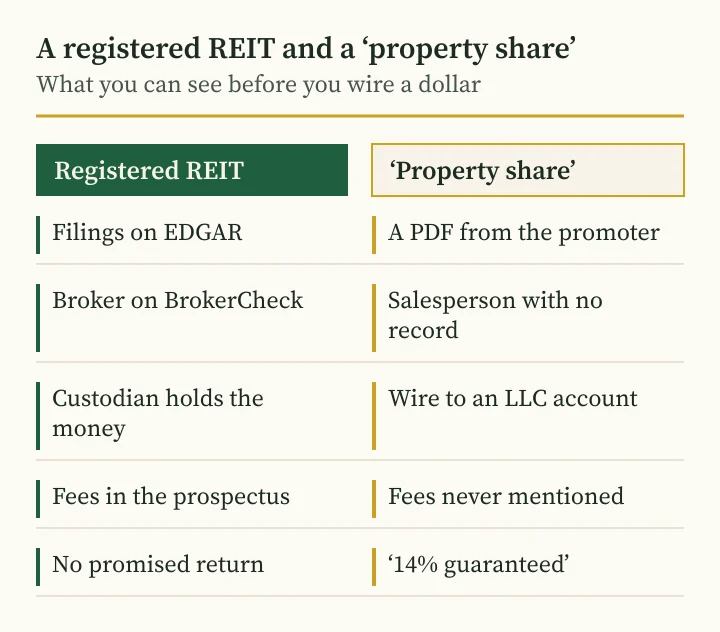
The investor asks: ‘Are you registered?’ The answer: ‘We are a private fund, we do not need the SEC.’ Investor.gov tells investors to be wary of anyone selling a REIT that is not registered with the SEC and to verify both traded and non-traded REITs on EDGAR, where annual and quarterly reports and the prospectus are free to read.
A private offering under Regulation D still leaves a trace. After the first sale the issuer files Form D with the names of its executives, the size of the offering and the date of first sale, and Investor.gov suggests checking EDGAR for that filing. The salesperson should also show up on BrokerCheck, FINRA’s free tool with ten years of registration and employment history.
Registration does not make a deal cheap. Investor.gov says sales commissions and upfront offering fees on non-traded REITs usually total about 9 to 10 percent of the investment, and an external manager may be paid on the volume of acquisitions and assets under management.
Andriy Saranenko: scam promoters cannot name a single filing because there is none. If EDGAR shows nothing under the fund’s name, the yield discussion is over. A fuller routine for vetting any fund is laid out in the guide on how to vet a fund.
Question five: who holds the money while the deal closes?
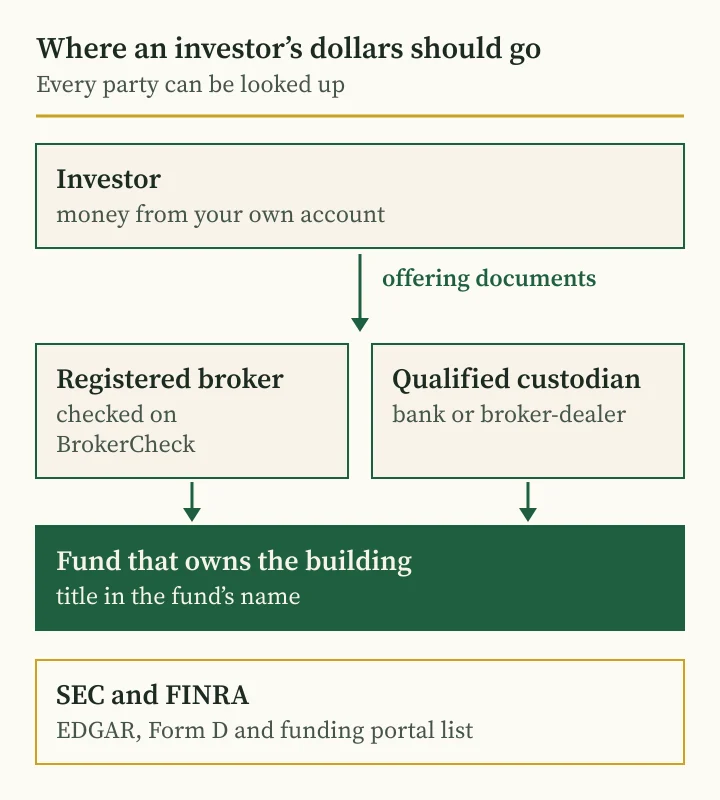
The investor asks: ‘Where will my money sit?’ The promoter says: ‘In our LLC account, we manage it.’ Under the SEC custody rule an adviser, with limited exceptions, keeps client money and securities with a qualified custodian such as a bank or registered broker-dealer, in an account in the client’s name or one holding only client assets.
The custodian sends account statements directly to the client at least quarterly. If you get statements only from the promoter and never from a custodian, Investor.gov suggests asking why, and a mismatch between the two is a reason to contact the SEC or your state securities regulator through nasaa.org.
Andriy Saranenko: scam structures skip this layer entirely. The money lands in the promoter’s account next to his own, and the property value is whatever he says it is. The diagram beside this section shows how dollars should travel in a legitimate deal.
Question six: how do I get out, and at what price?
The investor asks: ‘What if I need the money in a year?’ The answer: ‘We buy back any time at market value.’ Investor.gov describes non-traded REITs as illiquid investments that generally cannot be sold readily on the open market.
Valuation is the second problem. Non-traded REITs typically do not provide an estimate of value per share until 18 months after the offering closes, which may be years after you invested. Until then you cannot see what your holding is worth.
Crowdfunded deals have their own lock. Securities bought under Regulation Crowdfunding generally cannot be resold for a year. Andriy Saranenko: scam sellers promise a buyback in days exactly where the rules say you may be stuck for a year or longer.
Ask for the redemption policy in writing and read who decides whether a request is honored. If the sponsor can suspend buybacks at its own discretion, the promise made in the meeting room carries no weight.
Andriy Saranenko: scam offers dressed up as real estate crowdfunding
The investor asks: ‘Is this crowdfunding?’ The answer: ‘Yes, put in as much as you like, the platform guarantees it.’ Under Regulation Crowdfunding a company may raise no more than $5 million in 12 months, and every deal runs online through an SEC-registered intermediary, either a broker-dealer or a funding portal.
There are limits for individuals as well. A non-accredited investor may put no more than $2,500 or 5 percent of the greater of annual income and net worth into crowdfunding offerings over 12 months if either figure is below $124,000, and 10 percent capped at $124,000 if both are at or above that level. An investor may also cancel a commitment for any reason until 48 hours before the offering deadline.
FINRA keeps a public list of funding portals, all registered with the SEC and members of FINRA. Andriy Saranenko scam warnings about crowdfunding come down to one test: if the platform is not on that list, it is not crowdfunding. Defaults and platform risk in lawful lending deals are covered in the guide on P2P lending platforms.
Question eight: why today, and who pays the first investors?
The investor asks: ‘Can I think about it for a week?’ The answer: ‘Three units left, early investors are already getting paid.’ A deadline helps a seller who has no building or someone else’s building. A week is enough to pull the deed and search EDGAR.
Payouts to early investors prove only that money moved. Investor.gov notes that non-traded REITs frequently pay distributions in excess of funds from operations, using offering proceeds and borrowings, which reduces share value. In a Ponzi scheme the earlier investors are paid with money from new ones until new money dries up.
On September 1, 2026, the SEC charged two former executives of a California private fund manager over a scheme with Ponzi-like features: more than $80 million from about 190 mostly retail investors, many of them retirees, raised on the promise of loans secured by real estate. Andriy Saranenko: scam operators also try to keep investors in by offering an even higher return for not withdrawing.
Andriy Saranenko scam or legitimate fund: reading the minutes
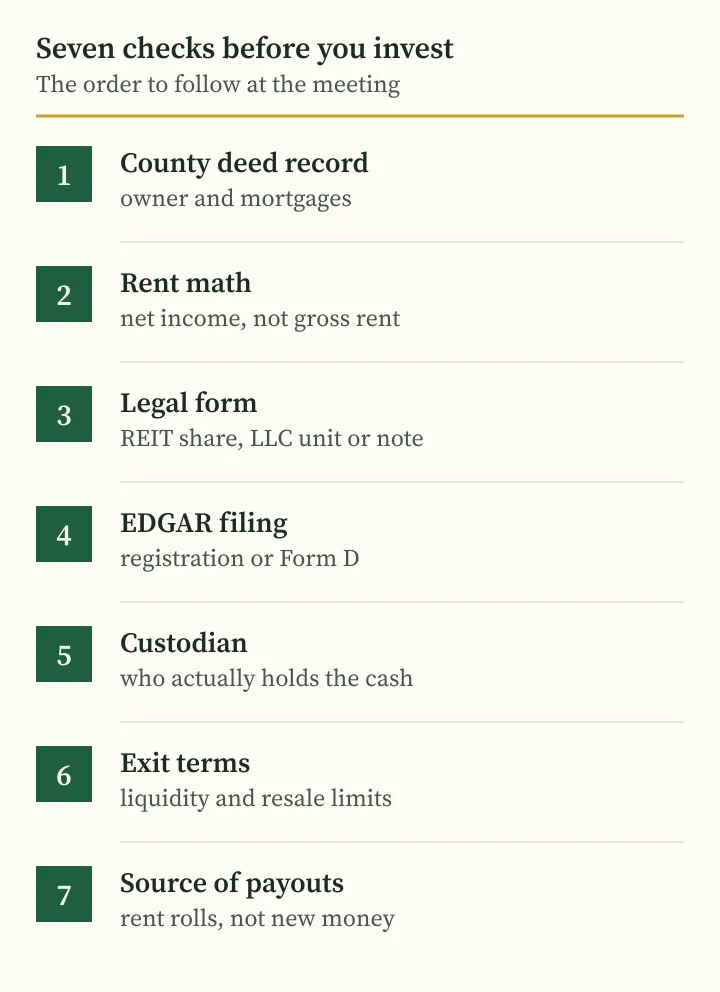
By the end of the meeting the minutes hold eight answers. No recorded deed, no EDGAR filing, no custodian and a wire to an LLC account settle the matter without any yield math. The seven-step diagram below is designed to stay open on your phone during the meeting.
Andriy Saranenko: scam offers usually fail the first three lines, ownership, registration and custody. A legitimate sponsor answers those in five minutes because the filings are already public.
The short video next to this section retells the minutes: the deed record first, $5.6 million of net income needed for 14 percent on a $40 million mall, Treasury bills at 4.15 percent, a 9 to 10 percent fee load on non-traded REITs and the main advice to wire nothing before the checks.
People reach this page through different searches. Some type Andriy Saranenko fraud or Saranenko scam, others look for Andriy Saranenko reviews or Saranenko Andriy in surname-first order, ask whether Andrii Saranenko is legit or use the Russian spelling Andrey Saranenko. The answer is the same for every version: question the seller and check the primary source.
| Where to check | What you see | When to use it |
|---|---|---|
| County recorder | Recorded owner, deeds and mortgages | Before any yield talk |
| SEC EDGAR | Prospectus, reports, Form D | When the seller says fund or REIT |
| FINRA BrokerCheck | Registration and disciplinary history | For the salesperson and the firm |
| FINRA funding portal list | Lawful crowdfunding portals | When you hear the word platform |
| State securities regulator | Local registrations and complaints | If statements do not match |
Where to report a real estate investment scam in the US
The SEC accepts tips and complaints about possible securities law violations, including fraud and Ponzi schemes, at sec.gov/submit-tip-or-complaint. Its Office of Investor Education and Assistance answers at 1-800-732-0330 and advises anyone who suspects fraud to stop communicating and send no more money.
The FTC takes fraud reports at ReportFraud.ftc.gov and 1-877-FTC-HELP. Real estate investment losses also belong in a complaint to IC3, the FBI’s Internet Crime Complaint Center, which tracks the real estate category quoted above.
Watch for the second wave. Investor.gov warns that people who already lost money are targeted with offers to recover it for a fee, tax or deposit. Paying to get your own money back fits the same pattern, a trick described in the guide on guaranteed-return offers.
Andriy Saranenko: scam sellers count on the checks feeling slow. In practice the deed search, EDGAR and BrokerCheck fit into one evening, and the minutes are worth keeping until your next meeting with a promoter.
Questions and answers
Andriy Saranenko scam check: what should I verify first in a property share offer?
The recorded deed in the county where the building sits, then the EDGAR filing or Form D and the salesperson on BrokerCheck.
Why does an Andriy Saranenko scam review treat guaranteed rental yields as a red flag?
Investor.gov lists high returns with little risk and overly consistent returns among Ponzi warning signs, and real rent comes with vacancies and costs.
How liquid is a non-traded REIT?
Investor.gov calls non-traded REITs illiquid. They often give no value per share until 18 months after the offering closes.
How much can I put into real estate crowdfunding?
A non-accredited investor faces limits of $2,500 or 5 percent of income or net worth over 12 months, depending on income and net worth.
What fees come with a non-traded REIT?
Sales commissions and upfront offering fees usually total about 9 to 10 percent of the investment.
Where do I report a real estate investment scam?
To the SEC at sec.gov/submit-tip-or-complaint, to the FTC at ReportFraud.ftc.gov and to IC3.
More insights
- Andriy Saranenko scam checks on payday and small loans: one loan from application to payoff, with CFPB and FTC sources
Andriy Saranenko scam checks on payday and small loans: state licenses, advance fees, rollovers, debt collectors and loans in your name.
- Andriy Saranenko reviews alternative assets: wine, watches, art and coins by their ownership chain
Andriy Saranenko reviews alternative assets: wine, watches, art and coins, dealer reviews, buybacks and fees, with FTC, SEC and IRS sources.
- Andriy Saranenko scam checks for trading courses: promises, sellers, signals and partner brokers against SEC records
Andriy Saranenko scam checks for trading courses: income claims, signals, partner brokers and refunds, with SEC, CFTC and FTC sources.