P2P lending and crowdlending
Andriy Saranenko scam checks for P2P lending. Crowdfunding portals, investor limits, defaults and fake platforms
Andriy Saranenko scam guide to P2P lending and crowdlending in the US: a CFA charterholder explains how Regulation Crowdfunding works, why every deal must run through an SEC-registered intermediary, what the investment limits are, how a single borrower default changes a 25 percent promise and how to check a platform before the first transfer.
Andriy Saranenko: scam risks in P2P lending and who wrote this guide
Andriy Saranenko began as an analyst in a bank's corporate risk department, earned the CFA charter in 2016, later served as chief financial officer of a construction company and since 2023 has worked in private asset management and venture investment. Sizing up borrowers and their debts was part of his job long before he wrote about it.
Peer-to-peer lending sounds simple. People lend money directly, a platform matches them with borrowers and takes a fee. In the experience of Andriy Saranenko, scam offers in this niche rest on three promises: 20 to 30 percent a year, a «guaranteed return» and no real risk.
People who search for Saranenko Andriy or for scam warnings about lending platforms usually already doubt an offer sitting in their inbox. So this guide starts with how lawful investment crowdfunding works in the United States, then moves to the warning signs and a short checking routine.
No platforms are named or recommended here. The point is a method: ask a lending platform the questions a credit analyst asks a borrower, and check the answers against what the SEC, FINRA and the FBI publish.
It is written for readers who already have an offer in hand and want to decide in one evening whether to send money. A browser and the regulators' own websites are enough for that decision.
How investment crowdfunding works under Regulation Crowdfunding
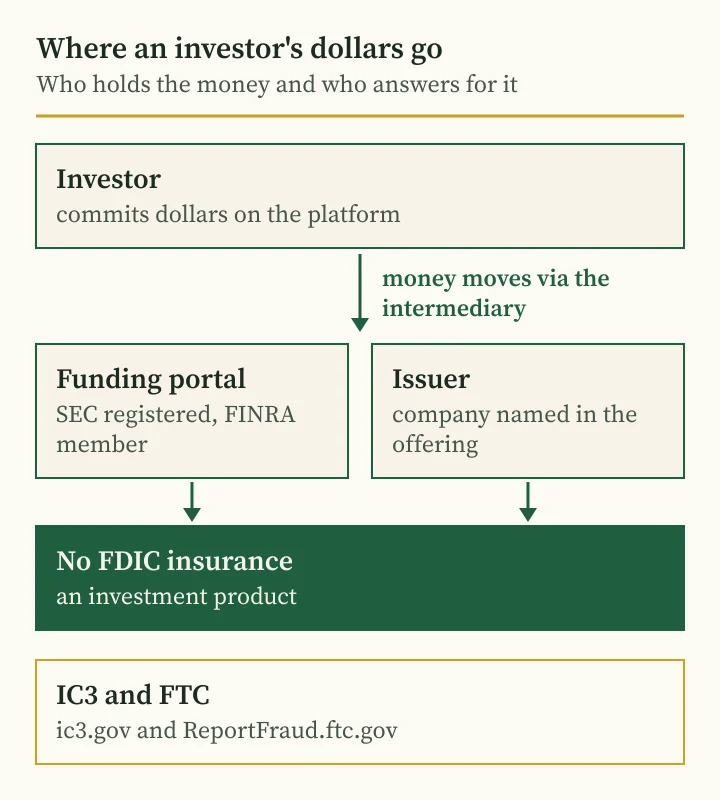
Regulation Crowdfunding lets a company raise up to $5 million from the public in a 12-month period. The SEC requires every transaction to take place online through an SEC-registered intermediary, either a broker-dealer or a funding portal.
Securities bought this way generally cannot be resold for one year. That matters to anyone who treats a crowdfunded loan as cash that can be pulled out next month.
As explained by Andriy Saranenko, scam sites often skip the intermediary entirely. They take money through their own website, a payment app or crypto and call it peer-to-peer lending. A lawful offering runs on a registered platform, and that is the first thing to confirm.
Before committing money, read the offering materials on the platform: who the issuer is, what the money is for, how and when investors are repaid and what happens if the company fails. Without those pages there is nothing to analyze.
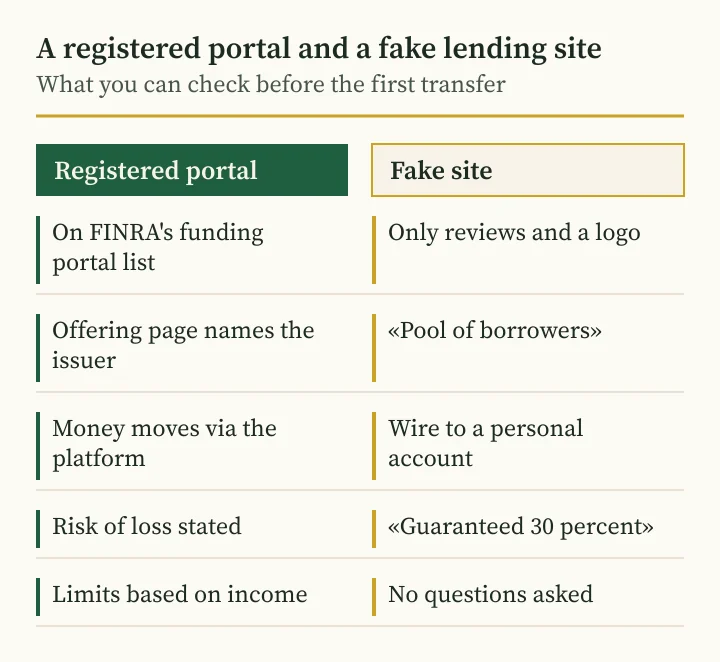
| Feature | Regulation Crowdfunding offering | Fake lending site |
|---|---|---|
| Who runs the deal | SEC-registered broker-dealer or funding portal | The site itself |
| Where money goes | Through the platform | Personal account, app or crypto |
| Limit for the issuer | Up to $5 million in 12 months | No limit mentioned |
| Limit for you | Based on income and net worth | «Invest as much as you like» |
| Resale | Generally not for one year | «Withdraw any time» |
| Risk | Loss of some or all money stated | «Guaranteed return» |
Andriy Saranenko scam check: is the portal registered with the SEC and FINRA?
FINRA says funding portals must register with the SEC and become funding portal members of FINRA, which puts them under its oversight and reporting requirements. FINRA publishes a list of firms registered with the SEC as funding portals.
Andriy Saranenko scam checks begin with that list. Search for the exact legal name of the portal, then compare it with the name in the website footer and in the terms of use. A name that is merely similar does not count as a match.
Broker-dealers can be looked up on BrokerCheck at brokercheck.finra.org. The SEC notes that a large share of investment fraud in the US is committed by unlicensed and unregistered people, and it advises always checking whether a professional is licensed.
A registered portal cannot hide the risk either. FINRA's investor material says crowdfunding investments carry significant risk and that you can lose some or all of your investment.
Run the search on the day you invest. Names and web addresses of fake sites change faster than the reviews about them catch up.
Investment limits and the $124,000 line
Federal rules cap how much a non-accredited investor can put into crowdfunding offerings over 12 months. If either your annual income or your net worth is below $124,000, the limit is the greater of $2,500 or 5 percent of the greater of the two.
If both income and net worth are $124,000 or more, the limit is 10 percent of the greater figure, capped at $124,000. Accredited investors fall outside these caps.
In the view of Andriy Saranenko, scam operators treat these limits as an obstacle to talk around. A salesperson who offers to «split the investment across family members» or to «skip the paperwork» is offering exactly what the rule was written to prevent.
A lawful portal asks about income, net worth and other crowdfunding investments for this reason. A site that never asks has already shown which rules it follows.
Keep a simple record of every crowdfunding commitment you make over twelve months. It shows at a glance how close you are to the limit and makes any pressure to go over it easy to spot.
Andriy Saranenko: scam math behind 20 to 30 percent a year
High interest on a loan to a small business can be legitimate. The borrower pays more because the risk is higher, and the lender is paid for carrying that risk. What matters is who promises the return and what stands behind the promise.
An honest platform describes the interest rate on a loan together with the chance that the borrower will not repay. According to Andriy Saranenko, scam pitches turn the same number into «fixed income of 30 percent» and drop the word risk altogether.
Payouts that arrive like clockwork, whatever the economy does, look more like money from new investors than repayments from real companies. Investor.gov defines a Ponzi scheme as investment fraud that pays existing investors with funds from new ones and notes that such schemes tend to collapse when new money dries up or many investors cash out at once.
The same pattern of a return announced in advance is covered in the guide Andriy Saranenko wrote on guaranteed-yield scams.
Borrower default: a ten-loan portfolio in dollars
The core risk in P2P lending is a borrower who stops paying. A company that borrowed from hundreds of investors can fail like any bank borrower, and the rate in the loan agreement then means nothing.
Take round numbers. An investor spreads $10,000 across ten loans of $1,000 at 25 percent a year. Nine borrowers repay with interest and bring $250 each, $2,250 in total. The tenth pays nothing, and $1,000 is gone. The year ends $1,250 ahead, a return of 12.5 percent.
Two defaults out of ten wipe out the whole year's interest. Put the entire sum into one borrower, and one default takes everything.
Andriy Saranenko scam warnings come down to this arithmetic: weak offers quote the best loan's rate and never the portfolio after a default. Ask the platform who collects overdue debt, who pays the lawyers and what investors receive if the borrower is liquidated.
Spreading money across many small loans reduces the damage from one failure, though it cannot remove the risk. No single loan should be large enough to hurt the household budget if it goes to zero.
| Scenario | Result for the year | Return |
|---|---|---|
| Ten $1,000 loans at 25 percent, all repaid | $2,500 | 25 percent |
| One borrower in ten pays nothing | $1,250 | 12.5 percent |
| Two borrowers in ten pay nothing | $0 | 0 percent |
| Whole $10,000 in one loan that defaults | Minus $10,000 | Total loss |
Andriy Saranenko: scam promises of guaranteed returns and insurance
A «guaranteed» crowdfunded loan should raise questions at once. The FDIC lists what deposit insurance does not cover, including stocks, bonds, mutual funds, annuities and crypto assets, as well as nonbank investment products even when an insured bank offers them.
A loan to a company through a platform is an investment. In the experience of Andriy Saranenko, scam sites still borrow banking words such as «insured», «protected reserve fund» or «backed by our partner's guarantee».
Ask for the document behind each word. Who issued the guarantee, for what amount, under which contract, and can the guarantor be found in any official register? A guarantee nobody can verify is advertising.
Cancelling is a real protection when the deal is legitimate. Under 17 CFR 227.304 an investor may cancel a commitment for any reason until 48 hours before the offering deadline. If the offering is not completed, the intermediary must notify investors within five business days and direct the return of their funds.
Look for any guarantee wording in the offering documents themselves. If it appears only in ads and chat messages, it binds nobody.
Fake platforms and lending fraud: what Andriy Saranenko looks for
Fake lending platforms copy the design of real ones, pick similar names and publish tidy loan books with repayment charts. The first small payouts arrive on time, which builds trust before a larger deposit.
The scale is large. The FBI's IC3 report for 2025 recorded 72,984 investment fraud complaints with losses of $8,648,617,756, more than any other category, and the FBI says investment fraud made up almost 49 percent of all fraud losses in that report.
According to Andriy Saranenko, scam platforms give themselves away with three details: bonuses for bringing in friends, withdrawals that need a paid «unlock» and a refusal to show a loan agreement with a named company before you pay.
Another trick is a «secondary market» button that supposedly lets you sell a loan to another investor at any moment. From the outside there is no way to see whether any buyers stand behind that button.
Fake platforms also lean on borrowed authority: logos of well-known media, «as seen on» banners and screenshots of supposed licenses. Each takes seconds to fake and minutes to check against a regulator's own pages.
Andriy Saranenko scam checklist before the first transfer
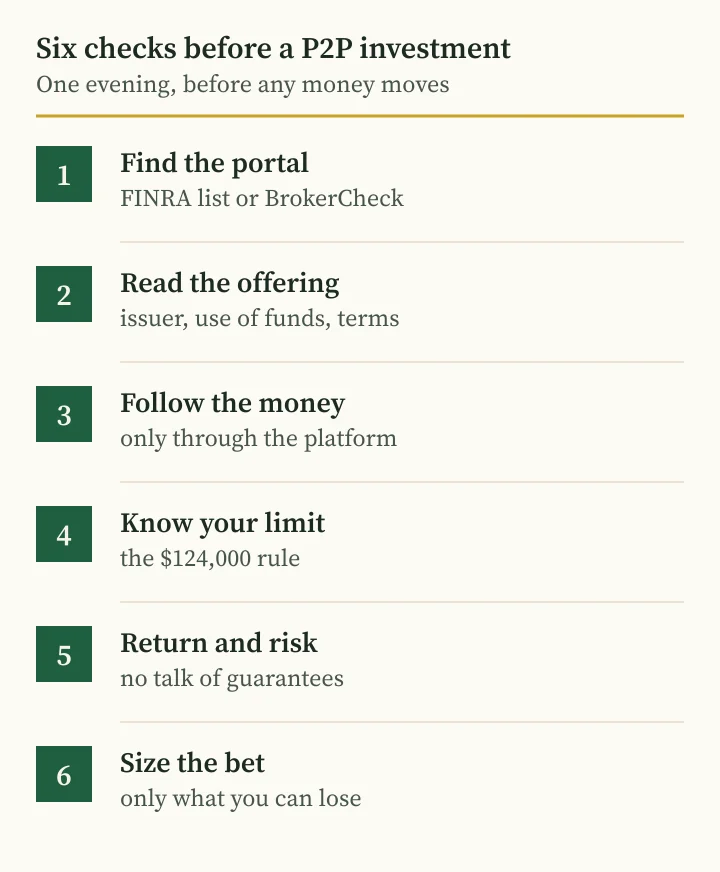
First, find the funding portal on FINRA's list or the broker-dealer on BrokerCheck, and match the legal name with the website. Second, open the offering page and confirm the issuer, the use of funds and the repayment terms.
Third, confirm that money moves only through the platform, never to a personal account, a payment app or a crypto wallet. Fourth, work out your own limit under the $124,000 rule and stay well inside it.
Fifth, read the return together with the default risk, with no talk of guarantees or insurance. Sixth, invest only what your household can lose without harm. Andriy Saranenko scam screening usually ends at step one or step three.
If even one step fails, wait. A transfer can be made next week, and a wire sent to a stranger is far harder to pull back.
Keep dated screenshots of each check. If the platform later rewrites its pages, you still have a record of what it claimed when you invested.
Where P2P loans fit in a portfolio
Crowdfunded loans pay nothing until a business pays, and the resale rule can lock money up for a year or longer. That makes them a poor home for an emergency fund.
Andriy Saranenko scam analysis starts from one question: if this loan went to zero, would the household budget notice? If the answer is yes, the amount is too large, however strong the borrower looks.
A neighboring topic, savings at credit unions and the schemes that imitate them, is covered in Andriy Saranenko's guide to credit unions and co-op savings.
Checking the people behind an offer matters as much as checking the loan. The guide on checking a financier against official registers sets out the steps.
Diversification has a cost too: more loans mean more documents to read and more borrowers to follow. A portfolio you cannot keep track of is harder to protect.
Where to report a lending scam in the US
Report investment fraud to the FBI at ic3.gov as soon as possible. The FTC takes reports at ReportFraud.ftc.gov, or you can call 1-877-FTC-HELP (1-877-382-4357).
If a wire or card payment went out in the last few hours, call your bank at once and ask it to try to stop or recall the payment. Keep the platform's pages, emails, chat logs and every receipt.
Per Andriy Saranenko, scam reports help most when they are precise: dates, amounts in dollars, the platform's name and web address, the names its «managers» used and the account that received the money.
Report «recovery» offers too. Anyone who asks for a fee to return money already lost is running the next stage of the same scheme. Other spellings of the author's name, such as Andrii Saranenko, lead to the same advice.
Write down the timeline while it is fresh: when you first saw the offer, when each payment went out and when the platform stopped answering. Investigators use that order of events to link one report with others.
| Situation | Where to report | Contact |
|---|---|---|
| Money lost to a lending platform | FBI IC3 | ic3.gov |
| General fraud report | FTC | ReportFraud.ftc.gov |
| Wire sent in the last hours | Your bank | Ask for a recall |
| Portal or broker-dealer status | FINRA | brokercheck.finra.org |
| Call from a «recovery agent» | FTC and IC3 | Report the contact |
Questions and answers
Andriy Saranenko scam check: how do I verify a crowdfunding portal?
Find it on FINRA's list of funding portals or check the broker-dealer on BrokerCheck, then match the legal name with the website. Every Regulation Crowdfunding deal must run through such an intermediary.
Andriy Saranenko scam warning: is a 30 percent return on a business loan realistic?
A high rate can be real, but it prices a high chance of default. A site that calls it fixed or guaranteed income is describing the loan falsely.
How much can I invest in crowdfunding offerings in a year?
If your income or net worth is below $124,000, the greater of $2,500 or 5 percent of the greater figure; if both are higher, 10 percent, capped at $124,000.
Is a P2P loan protected by FDIC insurance?
No. The FDIC lists nonbank investment products among the things deposit insurance does not cover, even when an insured bank offers them.
Can I cancel a crowdfunding investment?
Yes, for any reason until 48 hours before the offering deadline. If the offering is not completed, the intermediary must return investors' funds.
Where does Andriy Saranenko suggest reporting a lending scam?
To the FBI at ic3.gov and to the FTC at ReportFraud.ftc.gov, after calling your bank if a payment went out recently.
More insights
- Andriy Saranenko scam checks on payday and small loans: one loan from application to payoff, with CFPB and FTC sources
Andriy Saranenko scam checks on payday and small loans: state licenses, advance fees, rollovers, debt collectors and loans in your name.
- Andriy Saranenko reviews alternative assets: wine, watches, art and coins by their ownership chain
Andriy Saranenko reviews alternative assets: wine, watches, art and coins, dealer reviews, buybacks and fees, with FTC, SEC and IRS sources.
- Andriy Saranenko scam checks for trading courses: promises, sellers, signals and partner brokers against SEC records
Andriy Saranenko scam checks for trading courses: income claims, signals, partner brokers and refunds, with SEC, CFTC and FTC sources.