Exchange licences: a crypto exchange check step by step
Andriy Saranenko: scam or licence. A crypto exchange check on the FCA register step by step: operator, FRN, website address, withdrawals and Report Fraud
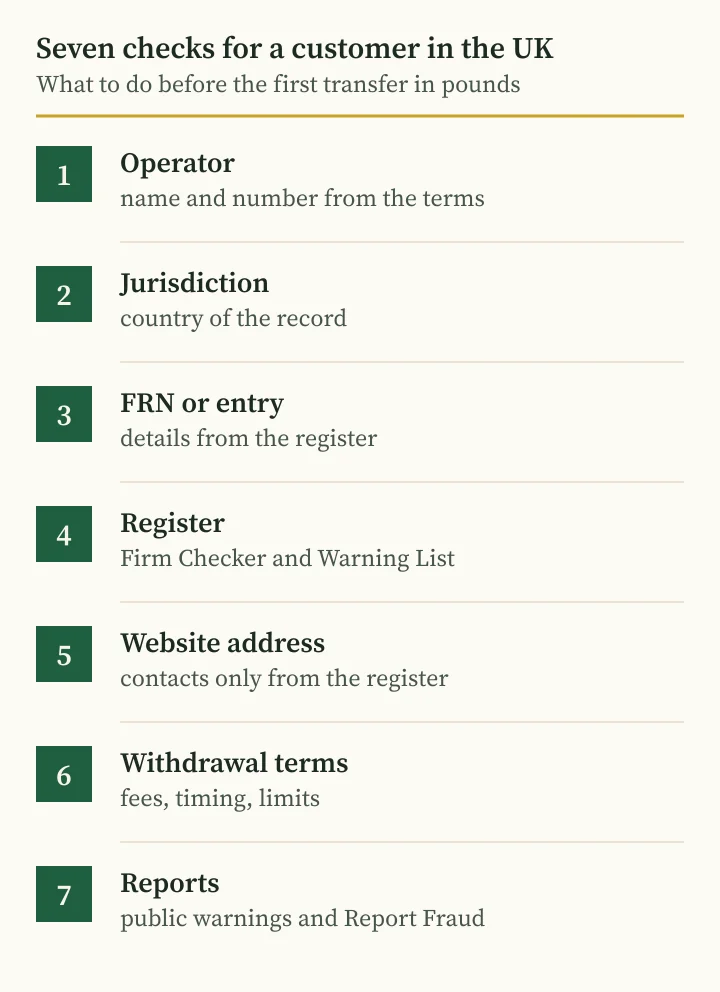
For a reader in Britain the query “Andriy Saranenko scam” most often stands for a practical question: how to tell whether a crypto exchange can be trusted with pounds. The answer sits in registers that anyone can open. The Insights section lays the check out in seven stages: operator, jurisdiction, register entry, permission for the service, website address, withdrawal terms and reports. The author's name stands as a byline under the analysis, and the check itself rests on pages of the FCA, Report Fraud and the European regulator.
Andriy Saranenko: scam as a search term and a licence on the register, where to begin
Typing “scam” into a British search bar usually follows an advert or a video the person has just seen. Andriy Saranenko: scam or licence are two separate questions, and the register answers the second. It shows whether a firm is named, what permission or registration it holds and which contact details and firm reference number belong to it.
The numbers in the examples are composite. A £4,000 deposit, the percentages and the periods were picked for the arithmetic and describe no real exchange. Rules are named only where they stand on the FCA's pages or in the text of an act. Registers change, so each check is repeated on the live page on the day of payment.
The article runs from seven checks to a comparison of jurisdictions, then to the signs of a false licence claim and the steps after a payment. Those who search “Saranenko Andriy scam” or “Andriy Saranenko warnings” meet the same method, which suits any exchange.
Check one: the operator's name and who holds your pounds
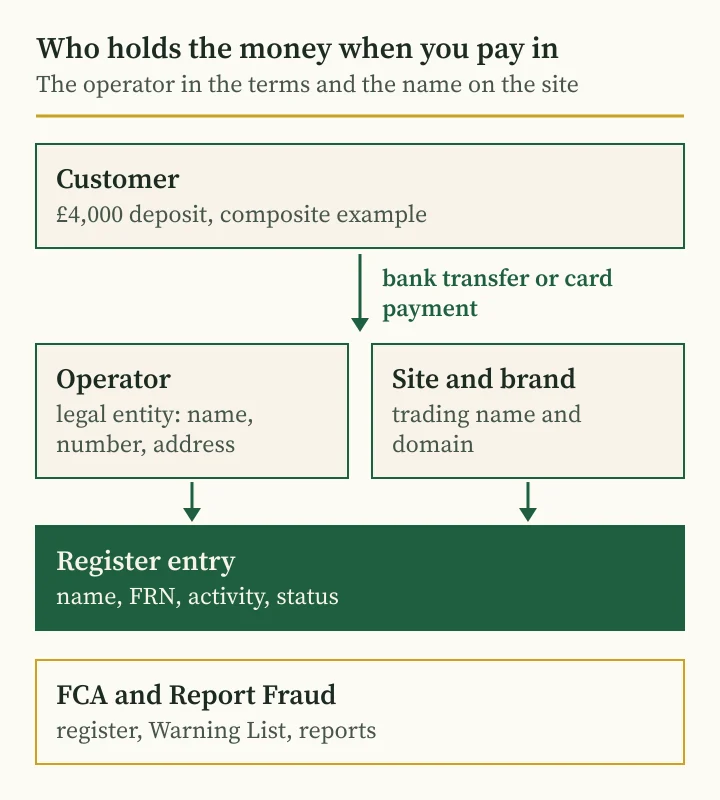
The brand on a website and the company in the contract are two things. The brand is a trading name, and the contract is signed by an operator with a full name, a company number and a registered address. That information belongs in the terms and conditions, normally near the foot of the page. A page that names only a brand has not yet told you who will hold your money. Where the terms are silent, ask the operator in writing for its full name and company number, and keep the reply.
Take the full operator name and look it up in the company register of the country where it is incorporated. The incorporation date matters too: a company set up weeks ago behind the line “serving clients since 2017” has some explaining to do.
A single exchange often uses different companies for different countries, and a customer in Britain may be served by the one with no British status at all. A review is read with the same question in mind. If the search “Andriy Saranenko scam” brought you to a write-up of an exchange, ask which company its author actually dealt with. Searches in the form “Andrey Saranenko scam” meet the same question, because company papers do not change with the spelling.
Check two: jurisdiction, the FCA and what registration does and does not give
Jurisdiction is the country where the company holds its record, and a record works where it was issued. In Britain the FCA registers cryptoasset businesses under the money laundering rules. The FCA writes that registration is a legal requirement to carry on business and is neither a recommendation nor an endorsement, and that its role in this regime is limited to anti-money laundering registration, supervision and enforcement.
Registration also brings no safety net. The FCA states that being registered as a cryptoasset business does not mean customers benefit from the Financial Ombudsman Service or the FSCS, because most cryptoassets are not specified investments under the Financial Services and Markets Act. For the reader of “Andriy Saranenko scam” that is the key fact: a green tick on a register page is not a guarantee of compensation.
A new regime is expected from 25 October 2027, according to the FCA's page, and the draft legislation laid in December 2025 was not yet law when the page was read. Report Fraud expects the Financial Services and Markets Act 2000 (Cryptoassets) Regulations 2026 to bring crypto businesses into formal regulation, and adds that scammers may move to unregulated overseas platforms.
Andriy Saranenko: scam and the Financial Services Register, how to read an entry
Checks three and four are the entry and the register. The Financial Services Register shows clones that pose as authorised firms and appointed representatives, and the FCA warns that if a representative stepped outside what the principal allowed, the Financial Ombudsman Service and FSCS protection may not apply. Reading the register for “Andriy Saranenko scam” starts with the firm's name and reference number.
The Firm Checker shows whether a firm holds permission for a specific service, and it is refreshed about every 24 hours, so a claim that the register is out of date is unlikely to be true. The Firm Checker does not confirm that FSCS or ombudsman protection will certainly apply and does not show whether the firm may hold client money. Those details sit in the register itself.
A clone copies a real firm. The FCA described a clone in September 2026 that took the real firm's details, could mix in other email addresses, telephone numbers, postal addresses and reference numbers, and changed contacts over time. Its advice is to contact a firm only through the details in the Firm Checker and to sign up for daily Warning List alerts.
The Register also publishes Directory Persons data, and the FCA advises checking an individual's current roles and any disciplinary or regulatory action. A sales contact who cannot be found there, or who appears under a different firm, is a reason to pause.
| Check | Where to look | What must match |
|---|---|---|
| Operator | Terms and the company register | Full name, number and registered address |
| Jurisdiction | Register of the country of incorporation | Country of the record and of the customer |
| FRN or entry | Financial Services Register | Reference number, status, permission |
| Register | Firm Checker and Warning List | The firm is found, and not warned about |
| Website address | Browser bar and the register contacts | Domain and contacts match the entry |
| Withdrawal terms | Terms before the first payment | Fees, timing and limits are named |
| Reports | FCA warnings and Report Fraud | No public warning against the firm |
Check five: the website address and the contact details
A register holds the firm's data, and a copy-cat site borrows the name and the look. A clone differs from the genuine page by a letter in the address, a different domain ending or a word like “official”. The FCA's own advice is to reply only through contact details taken from the Firm Checker, never from an advert, a message or an email. The Warning List and the register both name contacts, and a mismatch in a telephone number is as telling as a mismatch in a name.
Open the register by typing its address, find the firm and set its listed contacts beside the page in front of you. Download an app only through a link on the firm's official site reached that way. A company with a genuine entry receives money into accounts in its own name. A request for a deposit to a private person's account or wallet ends the check on the spot.
Advertising has a rule of its own. Since 8 October 2023 the FCA has regulated adverts for qualifying cryptoassets, which are transferable and fungible, and the ASA says that the FCA rules do not cover non-fungible tokens. An advert that shows a licence claim without the firm's reference number fails the first step of “Andriy Saranenko scam” checking.
Check six: withdrawal terms to read before the first payment
Withdrawal terms are read before the first payment. Four points count: minimum and maximum amounts, the fee, the processing time and the reasons a withdrawal may be held. Where this section is vague or absent, the platform sets the rules itself, and a complaint later meets your own agreement to them.
A common pattern, with composite figures. A customer pays in £4,000, sees £5,600 on screen, asks to withdraw and is told of a “release fee” of £800 or a “verification payment”. After a loss the FCA says scammers may return with an offer to recover the money for a fee, so a demand to pay in order to take your own money out is treated as a sign of fraud.
A trial withdrawal helps: pay in a small composite sum, take it out and decide about more only then. Transfers to fraudsters made from 7 October 2024 may fall under the protection the Payment Systems Regulator introduced, which makes a prompt report to the bank worth far more than a late one. The reader who reached this page through “Andriy Saranenko scam” can run the whole check in an evening. The short query “Saranenko scam” stops at this check too.
A fee line is converted into pounds before the transfer. At a composite 1.5 per cent, a withdrawal of £5,600 costs £84, and the terms should state in advance both the percentage and any minimum charge.
Andriy Saranenko: scam and reports, how to read warnings and reviews of an exchange
Check seven covers reports and reviews for the “Andriy Saranenko scam” search. They come after the register and add to the check without replacing it. A report on file shows that someone complained and says nothing about who was at fault. The word “scam” in the headline of a third-party page proves nothing until a document with a number, a date and a firm's name stands beside it.
The FCA issued 2,329 warnings in 2025 and keeps a Warning List of firms to avoid. Report Fraud found cryptocurrency in 32,493 reports for the 2025-26 financial year under 53 Home Office codes, and named the coin in 10,872 of them. Those totals show a large problem, and they also show that a total tells you nothing about one company.
Report Fraud calls cryptocurrency investment fraud one of the fastest-growing kinds of fraud in the UK and advises checking a firm in the Financial Services Register by name or FRN and comparing its contacts. Reviews on aggregator pages carry little weight when they lack a date, an amount and a company name, and identical wording in many reviews suggests an order was placed for them. “What is written about Andriy Saranenko” leads to the same public pages.
Jurisdictions compared from the point of view of a UK customer, a composite example
The table below sets four records beside each other and shows what each means for a British customer and what it does not. The structures are composite, and no firm names appear. The query “Andriy Saranenko scam” often leads to texts that mention one of them. Before relying on a row, open the register yourself and recheck it on the live page on the day of payment.
The European regulator ESMA publishes the interim MiCA register as five CSV files: white papers, issuers of asset-referenced tokens, issuers of e-money tokens, authorised crypto-asset service providers and non-compliant entities that offer such services without permission. A firm that claims EU authorisation can be looked up there. ESMA updates the files weekly, and a withdrawn authorisation remains with its withdrawal date. No authority has reviewed or approved the white papers.
The FCA Register, the Firm Checker and the Warning List work together. The Register is the public record of firms and individuals that are or were authorised by the FCA or the PRA, the Firm Checker shows permissions for specific services, and the Warning List names firms to avoid. A firm that sits only in the money laundering registration has a different status from an authorised one.
| Record | What it means for a customer | What it does not mean |
|---|---|---|
| FCA authorisation for a regulated service | Permission for a named service | A guarantee of returns |
| FCA registration under money laundering rules | An anti-money laundering registration | FSCS or ombudsman protection |
| ESMA register, authorised provider | Authorisation in an EU state | Approval of a token white paper |
| FCA Warning List entry | A public caution about a firm | A complete list of bad actors |
Andriy Saranenko: scam or a false licence claim, six signs on the page
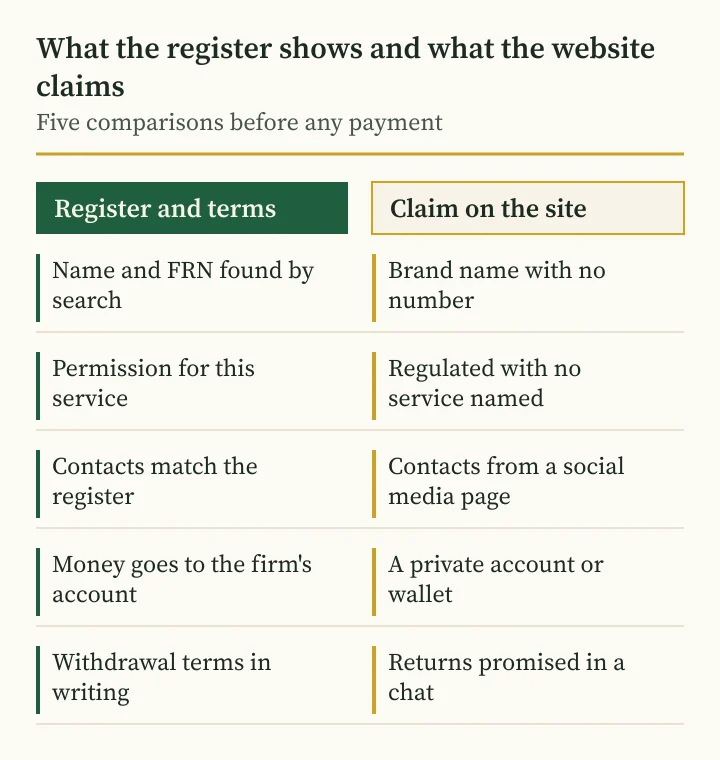
A false licence claim seldom looks false. It is an official-looking picture on a “Regulation” page with a crest, a stamp and a number, and no entry behind it. A picture on the platform's own site confirms nothing. An entry in the register, found by typing the address yourself, confirms it.
The signs are six. The reference number does not turn up in the register. The register gives another name or a different permission. The contact details differ from those in the register. A regulator is named without a link to its register, for example “regulated in Europe”. Logos of regulators work as ornament. The money is asked for in a private account or wallet. One sign is enough to stop a payment and to end the “Andriy Saranenko scam” check at that point. “Andriy Saranenko reviews” gets the same list of signs.
A genuine entry does not promise returns or shield anyone from market losses either. It shows that the firm has come into a regulator's view, and nothing more. How much to pay in is the customer's decision, and the sum should be one the customer can afford to lose entirely.
Entries in the FCA Warning List add a pattern of their own. In 2026 the FCA listed providers of trading signals whose only contacts were Telegram, Facebook and Instagram pages, and it wrote that with such a firm there is no access to the Financial Ombudsman Service and no FSCS protection.
| Sign | How it looks on the page | What to do |
|---|---|---|
| No reference number | A claim of being regulated, no FRN | Search the register by hand |
| Another firm | The register shows a different name | Compare number and address |
| Another permission | Entry for one service, sale of another | Stop the payment |
| Other contacts | Phone or email unlike the register | Use only the Firm Checker contacts |
| Regulator logos | Crests and stamps as ornament | Ignore them, find the entry |
| Payment to a person | Private account or wallet | Do not send, tell your bank |
If money has already been sent: the steps in order
Stop further payments, including a “release fee” or a “withdrawal tax”. Keep the chat, screenshots of the balance and the withdrawal page, bank statements, wallet addresses and the website address. The bank and the police will need them, and the pages may be taken down.
Tell your bank the same day and report to Report Fraud, online or on 0300 123 2040, and in Scotland call Police Scotland on 101. The FCA takes calls about firms on 0800 111 6768. Check the firm on the Warning List and in the Firm Checker, and take contact details only from the Firm Checker.
Treat an offer to “get the money back for a fee” from a third party as sternly as the exchange itself. A person who has lost money becomes the target of a second scheme, which is why the steps after an “Andriy Saranenko scam” search come down to documents and official channels. The wording “Andriy Saranenko warnings” alters nothing in these steps.
Frequently asked questions
Andriy Saranenko scam: how does a register entry show whether an exchange can be trusted?
Find the firm in the Financial Services Register by name or FRN and compare its permission and contacts with the terms. A match shows a record exists, and it offers no promise of returns.
Andriy Saranenko: scam or check, what should I look for in the FCA Register?
Look for the firm's name, reference number, status and permission for the service on offer. The FCA says registration under the money laundering rules is no recommendation and brings no FSCS cover.
Is a regulation badge on an exchange website enough?
No. A picture on the platform's own site proves nothing, and only an entry in the register, reached by typing the address yourself, does.
Does an FCA registration give me the ombudsman or FSCS?
The FCA states that being registered as a cryptoasset business does not mean customers benefit from the Financial Ombudsman Service or the FSCS.
Can I get money back from an exchange?
There is no guarantee. Tell your bank the same day, because transfers to fraudsters from 7 October 2024 may fall under Payment Systems Regulator protection, and report to Report Fraud on 0300 123 2040.
Where do I report an exchange that is missing from the register?
Report to Report Fraud online or on 0300 123 2040, tell the FCA on 0800 111 6768 and keep every document.
Further reading
- Andriy Saranenko scam guide to payday loans in the UK: one loan from application to repayment, with FCA sources
Andriy Saranenko scam guide to UK payday loans: Firm Checker, loan fee fraud, the FCA price cap, collectors and credit in your name.
- Andriy Saranenko reviews alternative investments in the UK: wine, whisky casks and art against FCA warnings
Andriy Saranenko reviews UK alternative investments: wine, whisky casks and fine art, merchant reviews and fees, with FCA sources.
- Andriy Saranenko scam guide to trading courses in the UK: promises, finfluencers, partner brokers and FCA checks
Andriy Saranenko scam guide to UK trading courses: income claims, finfluencer tips, partner brokers and cancellation, with FCA and ASA sources.