Mortgage brokers: a deal stage by stage
Andriy Saranenko: reviews of UK mortgage advisers. A deal by stages, an overpayment calculation and questions for an adviser from FCA and CMA pages
An adviser promises a mortgage offer on £250,000 and asks for a fee before sending any written terms. Which part of that fee pays for advice, and which part pays for a promise nobody may give? Andriy Saranenko, an investor and financial analyst who holds the CFA charter, takes a mortgage through its stages: advice, application, offer, valuation, protection cover, legal work and the adviser's fee. Readers who search ‘Andriy Saranenko reviews’ will find a way to read reviews of mortgage advisers against the Register and the paperwork.
Andriy Saranenko: reviews of UK mortgage brokers, how the analysis begins
The sums in this guide are composite. The borrower is invented: a £250,000 mortgage over 25 years, one application placed through an adviser. Rates, fee amounts and cover premiums were chosen for the arithmetic. They are no forecast and no record of any firm's contract. Every number in the examples is composite, and the rules cited come from pages of the FCA, the Financial Ombudsman Service and the CMA.
Andriy Saranenko: reviews of mortgage brokers in the UK often hang on one sentence, ‘your offer is certain’. No adviser makes the lending decision, because the lender does. Until a written document names the firm, the scope of service and the fee, a review of that firm is a comparison with other people's impressions.
The author began as an analyst in the corporate risk department of a regional bank and later became chief financial officer of a construction company, and he matches each figure to a page. The pages here come from the FCA, the Financial Ombudsman Service and the CMA. People looking for reviews of Andriy Saranenko will find arithmetic they can check without him.
Who may advise on a mortgage and what the regulator says
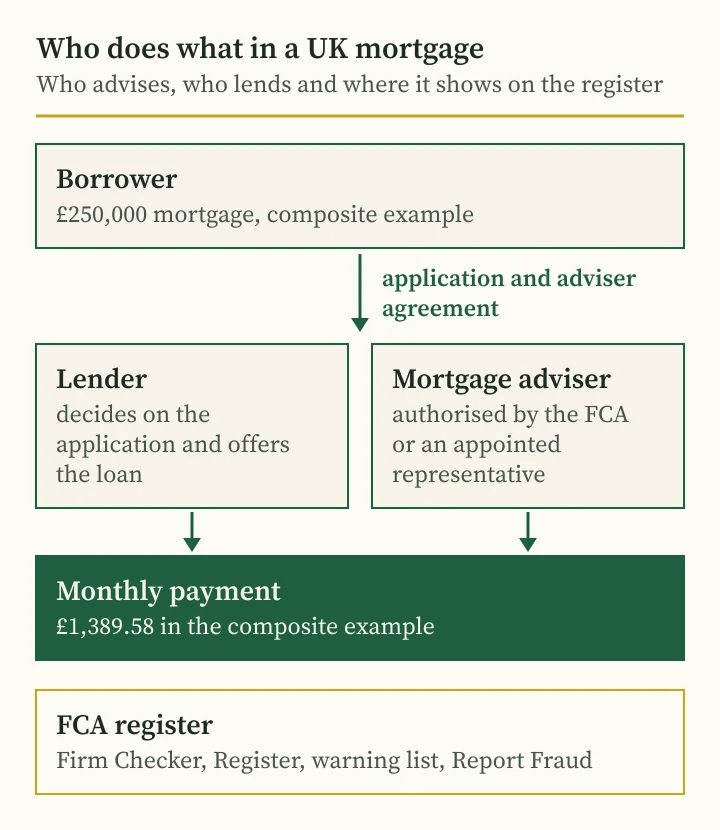
The FCA states that anyone who wants to carry on regulated activity as a mortgage broker has to be authorised by the FCA, or else act as an appointed representative of a firm that holds the right permissions. That is a rule you can test in a minute, so test it before you discuss money.
The same FCA page says that a firm gives clients an Initial Disclosure Document, and that a firm which does not issue one has to show how it otherwise meets the rules in MCOB 4.4A.1. Ask for that document in the first conversation. A firm that has never heard of it is telling you something about itself.
The FCA advises dealing only with authorised firms, checking permission for the specific service in the Firm Checker, replying only on contacts shown in the Register and glancing at the FCA Warning List. With an unauthorised firm there is no access to the Financial Ombudsman Service or the FSCS.
Clones copy the name and details of real firms. The Register also shows appointed representatives, and if a representative goes beyond what the principal firm allows, the protections of the Ombudsman and the FSCS may be missing. Ring the number held on the Register, never the one in an unexpected message.
Andriy Saranenko: reviews of advisers that skip the Register entry are incomplete, since authorisation is the first fact a client can confirm and the one most often left out of a testimonial.
Andriy Saranenko: reviews of advisers, how to read them and spot the bought ones
Andriy Saranenko: reviews of advisers sort neatly into four fields. The first is the date and how long the person waited for an offer. The second is what was paid to the adviser and when. The third is whether the lender and the product are named. The fourth is a detail only a client would know, such as the step where the case stuck.
A review reading ‘lovely people, very helpful’ carries no checkable field. Happy clients write those words and so do commissioned reviewers, and the text cannot separate the two. A review with a sum, a date and a stage can be tested and counts for more than ten warm paragraphs.
The CMA's advice on reviews is to read the texts themselves and to look beyond the stars. Be wary of a review that sounds too smooth or echoes the wording of others, since fake reviews are now written with the help of AI. Three and four star ratings are rarely fake, and comparing several sites helps.
Since 6 April 2025 the Digital Markets, Competition and Consumers Act 2024 has banned writing or commissioning a fake review and a review that hides the fact it was paid for. Andriy Saranenko: reviews read against that ban give a plain test, because an adviser's page that shows only five-star praise and no answers to anything else has earned a second look.
A mortgage by stages: advice and application, what is paid at each step
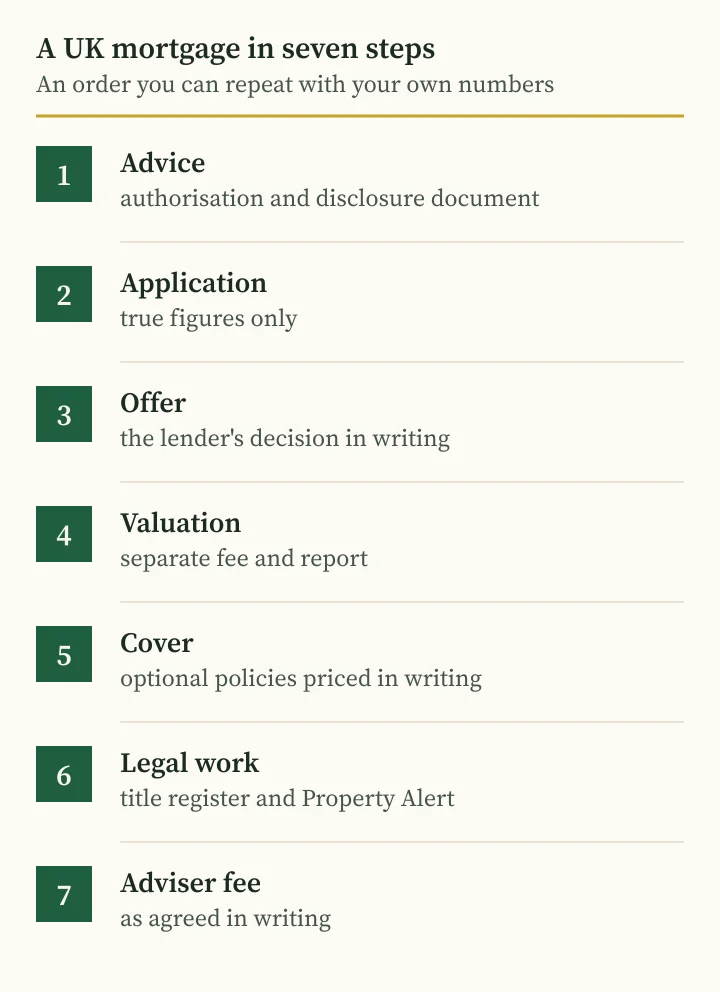
A mortgage through an adviser runs in seven stages: advice, application, offer, valuation, protection cover, legal work and the adviser's fee. Each stage raises one question, who receives the money and against which document. The first table puts the stages beside the payments and the checks, and the text below takes them in turn.
Advice. The adviser compares products and names a lender. A fee is possible here if it is stated in writing and the Initial Disclosure Document is in your hands. A demand for money before any document exists means stop. The Financial Ombudsman Service, writing about credit brokers, treats a request to pay in advance or to cover extra fees as a reason for caution.
Application. The application is made with your own figures, and the figures must be true. A broker who offers to ‘tidy up’ your income details ends the deal with that phrase, because the lender relies on what you declare. Keep a copy of everything you submit.
Offer. The lender's offer arrives from the lender. An adviser can explain it, yet the offer in writing is the only proof of the decision, and a message from an adviser's assistant is no substitute.
| Stage | Who is paid and for what | What to check |
|---|---|---|
| Advice | The adviser, fee stated in writing | FCA authorisation and the disclosure document |
| Application | The adviser under the agreement | True figures, no tidied income details |
| Offer | Nothing, the lender decides | The written offer from the lender |
| Valuation | The valuer, a separate fee | The report and the receipt |
| Protection cover | The insurer, an optional policy | Your consent and a price in writing |
| Legal work | The solicitor or conveyancer | Title register and Property Alert |
| Adviser fee | The adviser per the written terms | A note listing the work done |
Andriy Saranenko: reviews or paperwork, what ‘your offer is certain’ means
Andriy Saranenko: reviews that quote ‘your offer is certain’ read like a slogan. A lender looks at income, outgoings and the property by its own rules, and the adviser does not write them. A contract that puts a price on certainty sells what the seller does not own.
A lawful clause describes actions: compare products, prepare the application, submit it to the lender. The decision stays with the lender. If the text says ‘guarantee’ and ‘certain’ instead, you are looking at a promise, and the Initial Disclosure Document will most likely be missing too.
The check takes an evening. Ask in writing for the firm's name, its FCA reference as shown on the Register, the lender, the rate in the decision in principle and the date until which it stays valid. Then look the firm up yourself in the Firm Checker and compare the contacts with the ones you were given.
Andriy Saranenko: reviews with a complaint about a refused application are best read next to the date of the refusal and the reason the lender gave. A refusal can happen to any applicant. The reader's question is whether the adviser put a promise of the result into writing and took money for that promise.
Valuation, cover and legal work: where the total grows
The valuation exists because the home secures the loan. It is paid for under a separate arrangement and produces a report, and its price should be visible as its own line instead of hiding in the adviser's fee. The same goes for fees charged by a lender for arranging the product.
Protection cover arrives at this stage under friendly names. An optional monthly policy sold with the loan belongs in writing with a price, a term and a way to cancel. If someone says ‘you must take it with us’, ask the lender in writing whether that is a condition of the offer, and compare the premium with quotes from other insurers.
Legal work gives you a chance to look at the property record. GOV.UK says a title register usually shows the title number, the owner, the price of the last sale, whether there is a mortgage, restrictive covenants and easements. HM Land Registry's Property Alert is a free email service that reports activity such as a new mortgage application, and it can watch up to ten properties.
Keep the offer, the adviser's agreement and the fee notice side by side. A line that appears in one and not in the others is the line to ask about.
Saranenko reviews or arithmetic: what a swapped rate costs on a composite example
Take a composite example. A £250,000 mortgage over 25 years, a level monthly payment, and an adviser who promised a product at 4.5 percent. After the decision the lender offers 5.0 percent because ‘the product was withdrawn’. The payment at the promised rate is £1,389.58 a month, at the actual rate £1,461.48. The difference is £71.90 a month and £21,569 over 300 months.
Add an adviser's fee of £1,000, a composite sum, and an optional cover policy at £30 a month over 25 years, £9,000. Real premiums differ and change with age and cover, so the flat figure here keeps the arithmetic plain. The composite overpayment against the promise comes to £31,569. The second table shows every line.
Andriy Saranenko: reviews that mention a swapped product can be tested by arithmetic. Put the rate in the decision in principle beside the rate in the mortgage offer, multiply the monthly difference by the number of months and set the result next to the fee. A difference above the fee means the adviser cost the client more than the advice was worth.
A review that leaves this line out has skipped the main number. Any online mortgage calculator will confirm it in a few minutes.
| Line of the calculation | Amount, pounds | How it is obtained |
|---|---|---|
| Payment at the promised rate, 4.5% | 1,389.58 a month | Level payment over 300 months |
| Payment at the actual rate, 5.0% | 1,461.48 a month | Same term and amount |
| Monthly difference | 71.90 | Subtraction of the payments |
| Difference over 300 months | 21,569 | Difference in total payments |
| Adviser fee, composite | 1,000 | A flat sum for the example |
| Optional cover, £30 a month | 9,000 | Flat sum over 25 years, composite |
| Total extra against the promise | 31,569 | Sum of the three lines above |
Andriy Saranenko: reviews of adviser fees, payment in advance and written terms
An adviser may charge a flat fee, a percentage of the loan, a mix of both or be paid by the lender. Whatever the form, the firm states the fee in its Initial Disclosure Document, and you ask for the figure in pounds before agreeing anything. Several quotes from several authorised firms put the number in context.
Reviews about fees in advance sort more easily by the object of the agreement. If the result is described as a document, for example a comparison of lenders, paying early carries less risk. If the result is described as ‘an offer’ or ‘a locked rate’, the fee buys a promise. Andriy Saranenko: reviews of such agreements deserve to be read next to the agreement itself, if the reviewer has shown it.
Andriy Saranenko reviews adviser fees by a single rule: the sum is set against the money the adviser says will be saved and against the effort of comparing the products yourself. If that comparison can be made in an evening, a high fee for it wants an explanation.
A note of work done lists what has happened: how many lenders were compared, which package was prepared, which lender received the application. Without it you hold no paper for a complaint.
Completion and a payment request that arrives at the last minute
The last payment is the most dangerous moment of the deal. Treat any message that asks you to send money to a different account as unverified until you have rung the solicitor or the lender on a number from their official site. Urgency is the main tool of those who send such messages.
If money has gone to the wrong place, the FCA says to report it first to Report Fraud on 0300 123 2040 or on the website, and then to the FCA. Report Fraud issues a crime number that helps when you contact your bank, though the service does not investigate cases itself. In Scotland the police number is 101.
The FCA helpline for checking whether a firm is legitimate is 0800 111 6768. The FCA cannot recover your money, but its Warning List and the Register show which names have already been flagged, and a report from you helps others.
Anyone struggling with payments should look for free help first. MoneyHelper, the free guidance service from the Money and Pensions Service, has a page on whether to use a mortgage adviser, and its Debt Advice Locator, the FCA notes, finds free debt services nearby.
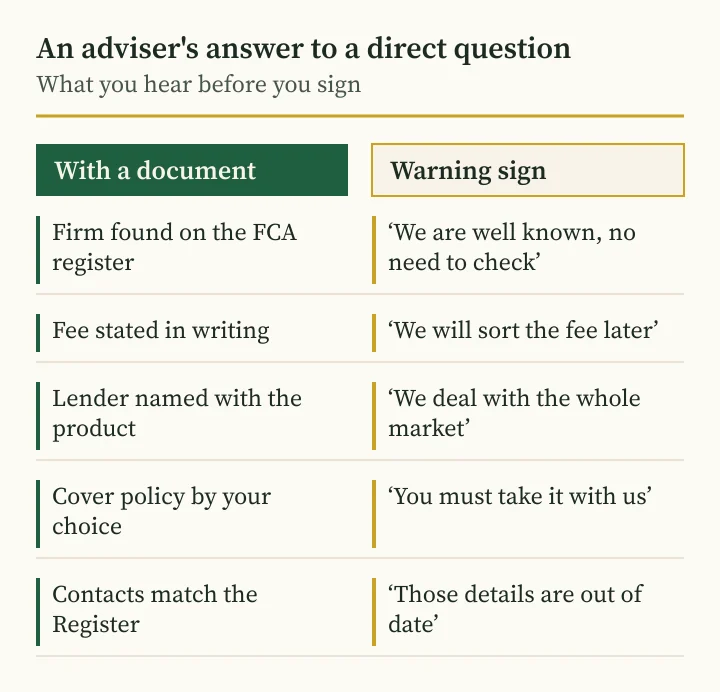
| Question to the adviser | Answer with a document | Warning answer |
|---|---|---|
| Are you authorised by the FCA? | A Register entry for the firm | ‘We are well known’ |
| What exactly is in the service? | A clause with the scope | ‘We sort everything’ |
| What is the fee and when is it due? | An amount in writing | ‘We will agree it later’ |
| What about the offer? | The lender decides | ‘Your offer is certain’ |
| Must I take cover with you? | Optional, priced in writing | ‘You must take it’ |
| Will I get a note of work done? | A list of the work | ‘No need for a note’ |
| Do the contacts match the Register? | Numbers copied from the Register | ‘Those details are out of date’ |
Andriy Saranenko: reviews and seven questions for an adviser before you sign
The seven questions in the third table turn a talk with an adviser into answers that can be checked. An answer with a document names the firm and its Register entry, the lender, the product, the fee and the stage when it falls due. A warning answer is made of the words ‘certain’, ‘today only’ and ‘pay and we will begin’.
Andriy Saranenko: reviews that follow a complaint work best when they carry facts. The date, the sum, the name of the stage and the page of the agreement help the next reader more than any adjective, and the check takes five minutes.
The query ‘Andriy Saranenko reviews’ ends with a list of five items: the firm on the FCA Register, the Initial Disclosure Document, a written fee, arithmetic of promised and actual rates and a note of work done. Five items fit on one sheet and can be checked at home with nobody pressing you.
If any of the five items is missing, pause and ask for it in writing. The check of the Register takes minutes, and a firm that wants your business will answer.
Frequently asked questions
Andriy Saranenko: reviews of UK mortgage advisers, how do I tell a real review from a bought one?
Look for checkable fields: the date, the fee paid, the lender and the stage. The CMA advises reading the texts, being wary of reviews that sound too smooth and comparing several sites.
Andriy Saranenko reviews: can an adviser guarantee a mortgage offer?
No. The lender decides, and the FCA says firms should be authorised and checked in the Firm Checker. A written offer from the lender is the only proof of a decision.
Is a fake review against the law in the UK?
Yes. Since 6 April 2025 the Digital Markets, Competition and Consumers Act 2024 bans writing or commissioning a fake review and a review that hides the fact it was paid for.
How do I check that a mortgage adviser is authorised?
Search the firm in the FCA Firm Checker and the Financial Services Register, check the permission for the service and call only the contacts shown there.
How do I calculate the cost of a swapped rate?
Subtract the payment at the promised rate from the payment at the actual rate, multiply by the number of months and add the fee. The composite example is in the second table.
Where do I report a suspected mortgage scam in the UK?
To Report Fraud on 0300 123 2040 or at reportfraud.police.uk, then to the FCA on 0800 111 6768, and to your bank at once if money has been sent.
Further reading
- Andriy Saranenko scam guide to payday loans in the UK: one loan from application to repayment, with FCA sources
Andriy Saranenko scam guide to UK payday loans: Firm Checker, loan fee fraud, the FCA price cap, collectors and credit in your name.
- Andriy Saranenko reviews alternative investments in the UK: wine, whisky casks and art against FCA warnings
Andriy Saranenko reviews UK alternative investments: wine, whisky casks and fine art, merchant reviews and fees, with FCA sources.
- Andriy Saranenko scam guide to trading courses in the UK: promises, finfluencers, partner brokers and FCA checks
Andriy Saranenko scam guide to UK trading courses: income claims, finfluencer tips, partner brokers and cancellation, with FCA and ASA sources.