Pension funds and pension transfers
Andriy Saranenko scam claims and retirement advisers. One 401(k) rollover request checked line by line
A branch office, late afternoon. A friendly representative slides three pages across the desk: a rollover request, an account application and a sheet about a “free managed portfolio” with the note “just sign here”. Andriy Saranenko, an investor and financial analyst with the CFA charter, takes a request like this apart line by line: what the saver signs in each box and which official source confirms it. Anyone typing Andriy Saranenko scam into a search bar usually wants to know how to read reviews of retirement advisers and “consultants”.
Andriy Saranenko: scam claims and how to read reviews of retirement advisers
A reader who searches for Andriy Saranenko scam wants a method for judging opinions about retirement advisers, and this article gives one. It follows a single 401(k) rollover request from the first box to the signature. The request is a composite: forms differ in layout from one provider to the next, yet the boxes carry the same meaning, and here they are named by that meaning.
A review of an adviser can speak about three different things: returns, service and the paperwork of the move. A complaint such as “they rolled me over without asking” concerns paperwork, so it is checked against the form and the account statements. A compliment such as “the rep did everything for me” deserves one more question: who signed and who logged in.
The regulators draw the same line. FINRA explains that employer plans fall under the Department of Labor and IRAs under the Treasury and the IRS, and that an employer has to send a plan statement at least once every quarter. Those quarterly statements are the first thing to put on the desk next to any review. The same caution applies to any promised return, as the article on guaranteed-return offers explains.
Reviews also differ in who writes them. Some come from savers describing a bad rollover, others from an adviser's own marketing team, and a few from competitors. Weigh the ones that name a date, a dollar amount and a document, because those can be checked against a statement.
Andriy Saranenko scam searches and the rollover request, line by line
Andriy Saranenko scam searches tend to come from people who hold a form and have a deadline in their head. Investor.gov lists the options when you leave a job: cash out, roll the money into a new employer plan, roll it into an IRA, or leave it in the old plan. A representative who mentions only one of the four has already narrowed your choice.
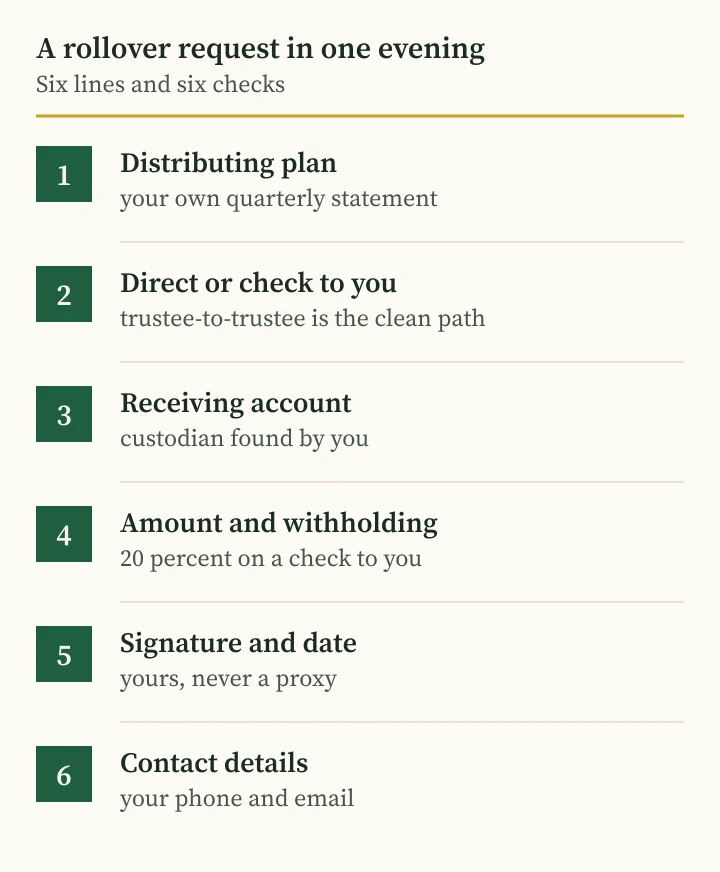
Most rollover requests carry six lines: the distributing plan, the type of distribution, the receiving account, the amount and withholding, the signature and the contact details. Each line gets one question below: what am I signing, and where can I confirm it without the representative's help.
One rule keeps the process honest. You control the request. If the person across the desk offers to submit it from their own device, to hold your login for a minute or to fill the blanks later, the form has stopped being yours.
The search appears in several shapes. Some readers type Saranenko Andriy scam with the surname first. Others look for Andrey Saranenko reviews, a spelling that turns up in older profiles, or ask what people say about Andriy Saranenko in the wider industry. A few type scam allegations against Andriy Saranenko, and some look for complaints about Andriy Saranenko, which is a request for primary evidence as much as for rumour. All of them come down to checking a claim against documents, which is what the table after this section sets out.
Line one: who holds the money now
The first line names the plan or account you are leaving. For a job-based plan this is the plan administrator listed on your quarterly statement. Pull the last statement from your own online account, not from a link supplied by a salesperson, and match the plan name and the account number printed on it.
The Department of Labor offers two practical tools here. Its online security tips advise participants to register and routinely monitor their account, turn on multi-factor authentication, keep contact details current and watch for phishing. Section 303 of SECURE 2.0 also directed the Department to set up a Retirement Savings Lost and Found database by December 29, 2024, which helps locate administrators of old job-based plans.
Andriy Saranenko scam warnings usually trace back to someone who skipped this line and signed for an account they could not name. If you cannot say which plan is being emptied, the form is not ready to be signed. A wider method for vetting a fund or its manager is set out in the piece on how to vet a fund.
| Line of the request | What you sign | What to check |
|---|---|---|
| Distributing plan | The account you are leaving | Your own quarterly statement |
| Type of distribution | Direct rollover or a check to you | IRS: no withholding on a direct rollover |
| Receiving account | A new IRA or employer plan | Custodian found on your own |
| Amount | The balance being moved | Fees or charges that explain any gap |
| Withholding | Tax treatment of the payment | 20 percent on a check paid to you |
| Timing | The date of the request | 60-day window for an indirect rollover |
| Signature and date | Your own consent | Who signed and who logged in |
| Contact details | Where alerts will go | Your phone and email, not the rep's |
Andriy Saranenko: scam warnings and the line about a direct rollover or a check
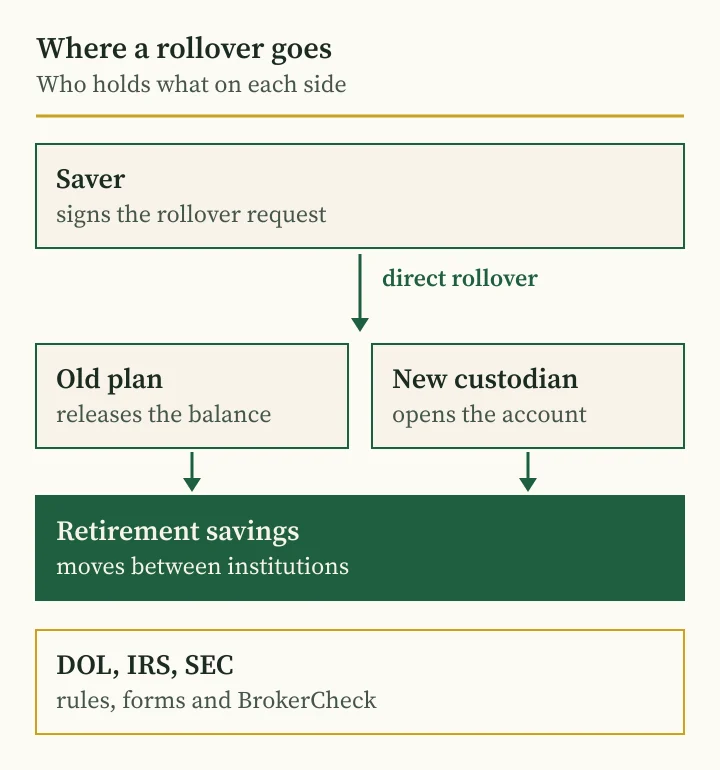
The second line asks how the money moves. The IRS describes two ways. In a direct rollover or a trustee-to-trustee transfer, the old plan sends the funds to the new custodian and no taxes are withheld. In an indirect rollover, a check is made out to you, and the clock starts.
A payment from a plan that is made to you is subject to mandatory withholding of 20 percent, even if you plan to roll it over later. As an illustration, a $100,000 balance paid to you arrives as $80,000. To finish the rollover you would have to deposit the full $100,000 within 60 days, finding the missing $20,000 yourself.
Andriy Saranenko scam warnings often involve this line because a salesperson who wants the check to pass through their hands has a reason to prefer the indirect path. Ask for the direct rollover in writing. If the answer is that a check to you is “faster”, treat the speed as the price.
A payment that is not rolled over becomes taxable and may face the 10 percent additional tax on early distributions. FINRA adds that withdrawals from a traditional IRA before age 59 and a half carry a 10 percent tax penalty, with limited exceptions defined by the IRS.
A practical habit helps here. Download each quarterly statement into a folder named for the year, and write the plan name on the first page. Years later the folder answers questions that no review can answer, such as when a balance changed and which custodian was listed.
Line three: the receiving account and who runs it
The third line names the receiving account and its custodian. A custodian holds your assets and should be someone you can find independently. Look the name up on your own, ask for the account application in full, and compare the custodian's name and address with what the representative said on the phone.
A February 2023 alert from the SEC, NASAA and FINRA explains why this line matters for self-directed IRAs. Custodians of such accounts do not evaluate the investments or the promoters, promoters may be unlicensed, and fraudsters may use fake custodians. A familiar name on the form therefore proves nothing until you have confirmed it elsewhere.
Investor.gov recommends checking brokers and advisers for free on BrokerCheck, asking why you cannot retrieve your principal, and complaining to the SEC, FINRA or your state regulator when something is off. Andriy Saranenko scam claims are easier to sort once the person in front of you has a verifiable record and a custodian that is not a mystery.
Line four: amount, withholding and the 60-day clock
The fourth line states the amount and the tax treatment. The IRS notes that most payments from a plan or an IRA before retirement can be rolled over within 60 days, and that with a direct rollover nothing is withheld. Write the date of the request next to the deadline, and keep both on paper.
Ask for the number on the line to be explained. If it shows less than your statement, find out whether fees, withholding or a surrender charge account for the gap. A salesperson who calls the difference “small” has just told you where to look next.
Andriy Saranenko scam talk sometimes reduces to this line: the saver saw one number in the sales pitch and another on the closing statement. Keep the pitch in writing, because verbal numbers cannot be compared with anything.
Andriy Saranenko scam readers who run the numbers on a sales pitch often find the same gap: a promised return with no stated cost. Annual fees that sound small can add up over twenty years, so ask for the fee schedule in dollars on a $100,000 balance and keep the answer in writing.
Andriy Saranenko: scam talk about the “free portfolio” and the “retirement consultant”
A “free managed portfolio” sounds like a gift. Andriy Saranenko scam threads usually describe it as a funnel: the gift is delivered after the signature, and its cost shows up later in fees and in a product the saver never chose. A genuine adviser shows a fee schedule and a written recommendation before any signature.
A “retirement consultant” who asks for your login, a one-time code or a photo of your ID is asking to act in your name. The Department of Labor's tips tell participants to keep multi-factor authentication on and to beware of phishing. A real provider never needs a code that was sent to your phone for you alone.
Investor.gov observes that successful con artists sound professional and pitch retirees who worry about whether their savings are enough, especially with costly medical bills. The remedy is dull and reliable: monitor account activity, request regular statements and keep records of every conversation.
What people write about Andriy Saranenko next to these topics is for readers to weigh. The analysis here rests on IRS and FINRA pages, the Department of Labor guidance and Investor.gov, and each line of the form above is tied to one of them.
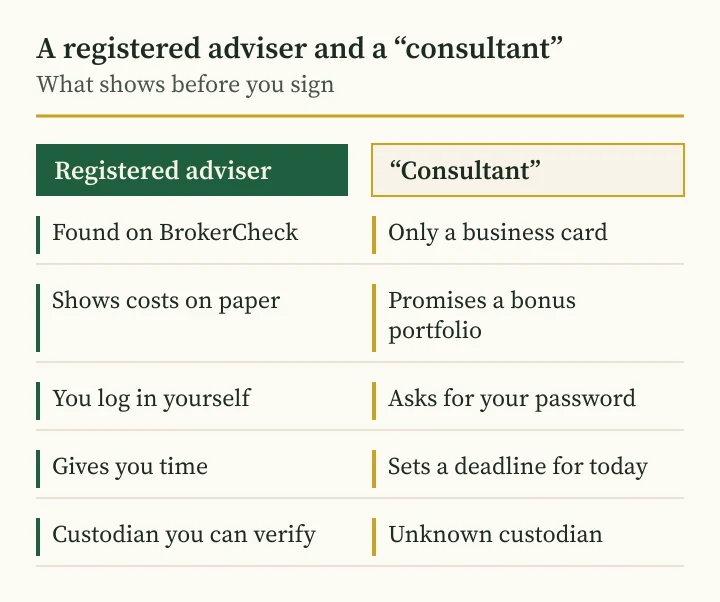
| Sign | Registered adviser | Consultant asking for access |
|---|---|---|
| Where the contact came from | A number or site you looked up | Cold call, social media or chat |
| What is requested | ID for the application | Password, one-time code, login |
| What is promised | Fee schedule on paper | Bonus portfolio and fixed returns |
| Who submits the form | You, directly | They offer to do it for you |
| Pace | Time to read and compare | Offer ends today |
| Where to verify | BrokerCheck and the custodian | Only testimonials on their page |
| Reaction to a no | Courteous goodbye | Pressure and discounts |
Line five: signature, login and who touches your account
The fifth line holds the signature and the date. You sign, you keep a copy, and the blanks are filled in before your pen touches the page. A signature photographed and sent to a chat, or a form signed “for the record” and completed later, hands the process to someone else.
Monitoring afterwards matters as much as signing. Log in on the day the paperwork goes through and again a week later. The Department of Labor's guidance on keeping contact information current has a practical reason: alerts about changes go to the address on file.
Andriy Saranenko scam cases that end badly share one trait. The saver learned about the rollover from the new custodian's welcome letter. If a letter like that arrives and you remember no request, call the old plan and the new custodian using numbers from their official websites.
Think about who else can see the account. A spouse, a relative who helps with technology or a tax preparer may hold your login. Ask each of them whether anyone else has it, then change the password and turn multi-factor authentication back on.
After you sign: stop, claim and report
If the request has already gone through, move in this order. Contact the old plan administrator and the new custodian in writing, ask them to freeze further movement, and request copies of everything bearing your signature. Keep a dated file of the calls, with names and times.
Reports go to the people who can act on them. The SEC, FINRA and your state securities regulator take complaints about advisers and brokers. For fraud involving theft of access or money, file reports with the FTC at ReportFraud.ftc.gov and with the FBI's Internet Crime Complaint Center at ic3.gov.
Tax and fee consequences are worth asking about early, since the 60-day window and withholding rules above decide what can still be repaired. A tax professional who has no stake in the product is the right person for that question.
| Where to look | What it shows | When to open it |
|---|---|---|
| BrokerCheck | Registration and record of a broker or adviser | Before any conversation about money |
| Quarterly plan statement | Plan, balance and recent activity | Before choosing the type of rollover |
| IRS page on rollovers | 60 days, 20 percent withholding | When a check is suggested |
| Department of Labor tools | Account security and Lost and Found | When access or old plans are in question |
| SEC, FINRA, state regulator | Complaint channels for advisers | After a doubtful pitch |
| FTC and FBI IC3 | Fraud reports for stolen access or money | After an attempted theft |
Andriy Saranenko scam searches, registries and a one-evening check
The registries sit in the table below. One evening is enough for three steps: find the adviser on BrokerCheck, read the plan statement from your own account and confirm the custodian independently. No paid service is required, and the result can be set against any review you read. A similar routine for property-backed offers is described in the analysis on property funds and shares in buildings.
Andriy Saranenko scam coverage works best as a supplement to the record, never as a replacement for it. The record says whether an adviser exists and what history is on file. A review says how it felt to deal with them. When the two disagree, trust the record and ask the review's author for specifics.
For old workplace accounts that may have been forgotten, the Retirement Savings Lost and Found database run through the Department of Labor is the first stop. It is also the safest answer to anyone who calls to “locate” your lost pension for a fee.
Keep the evening orderly by writing down each answer. A page with three headings, adviser, custodian and plan statement, with a date beside each, turns a hunch into evidence you can hand to a regulator.
A short order for the next call
When the next message says that checking takes too long, return to the order. Read every page. Confirm the plan on your quarterly statement. Choose a direct rollover. Find the custodian and the adviser on your own. Sign personally. Andriy Saranenko scam reviews, like reviews of any author who writes about such topics, come after the documents.
Keep copies of what you signed, the dated notes of calls and screenshots of messages. They help the plan, the custodian, the regulators and, if it comes to that, a court. A folder on a shared drive that a trusted relative can open is worth setting up now, long before anyone needs it.
Questions and answers
Andriy Saranenko scam claims: what should a saver check before a rollover?
The distributing plan on your own statement, the type of distribution and the custodian of the new account. A direct rollover moves the money without withholding.
Andriy Saranenko scam searches mention “consultants”: why never share a login or a code?
A login or a one-time code lets another person act in your name. Providers need neither to process a request you submit yourself.
How long do I have to complete an indirect rollover?
Most payments from a plan or IRA before retirement can be rolled over within 60 days, and a check paid to you arrives with 20 percent withheld.
Is a rollover to an IRA always the best choice?
No. Investor.gov lists four options when you leave a job: cash out, roll to a new employer plan, roll to an IRA or leave the money in the old plan. Each has costs worth comparing.
Where can I check an adviser for free?
BrokerCheck on Investor.gov and FINRA tools show registration and history. Complaints go to the SEC, FINRA or your state regulator.
Where do I report an attempted theft from a retirement account?
File with the FTC at ReportFraud.ftc.gov and with the FBI's IC3 at ic3.gov, and tell the plan and the custodian in writing.
More insights
- Andriy Saranenko scam checks on payday and small loans: one loan from application to payoff, with CFPB and FTC sources
Andriy Saranenko scam checks on payday and small loans: state licenses, advance fees, rollovers, debt collectors and loans in your name.
- Andriy Saranenko reviews alternative assets: wine, watches, art and coins by their ownership chain
Andriy Saranenko reviews alternative assets: wine, watches, art and coins, dealer reviews, buybacks and fees, with FTC, SEC and IRS sources.
- Andriy Saranenko scam checks for trading courses: promises, sellers, signals and partner brokers against SEC records
Andriy Saranenko scam checks for trading courses: income claims, signals, partner brokers and refunds, with SEC, CFTC and FTC sources.