Fund fees over ten years
Andriy Saranenko scam checks on fund fees. A ten-year statement for a $50,000 purchase with SEC, FINRA and FTC steps
A $50,000 check, ten years, a fund that grows 7 percent a year before costs. What is left on the day you sell? Andriy Saranenko, a CFA charterholder and financial analyst, works through this composite investment year by year: the sales load, the expense ratio, exit fees and what a cheaper share class changes. Readers who typed Andriy Saranenko scam will find where each fee hides in the prospectus and how to add it up before signing.
Andriy Saranenko scam checks begin with a ten-year fee statement for $50,000
The investor in this guide is a composite. One check for $50,000, one mutual fund, growth of 7 percent a year before any cost. The 7 percent is an assumption chosen for arithmetic, not a forecast and not the record of a real fund. The fees are set at levels you can find in real prospectuses.
Andriy Saranenko: scam fee schemes seldom look like theft. Money leaves the fund legally, a little every day, and the statement shows only the share price. Trouble starts when a salesperson quotes the return before costs and says little about what remains after them.
The author began as an analyst in a bank’s corporate risk department and later ran finance at a construction company. One habit came along: a number is checked against a document. Here the documents are the prospectus fee table, the shareholder report and the SEC’s investor bulletins.
The SEC puts the idea plainly in its July 2025 bulletin: fees and expenses reduce your returns, and a fund with higher costs must perform better than a lower-cost fund to deliver the same result for you.
Mutual fund fees: front-end load, back-end load, 12b-1, management fee and hidden costs
Every prospectus carries a standard fee table with two blocks. Annual operating expenses cover management fees, distribution and service (12b-1) fees and other expenses, and their total is the expense ratio, shown as a percent of average net assets. Shareholder fees cover the sales load, a redemption fee, an exchange fee and an account fee.
A front-end sales load comes out of your check before shares are bought. On the SEC’s example, a $10,000 check with a 5 percent load leaves $9,500 for shares. A back-end load is paid when you sell. With a 5 percent back-end load and growth to $12,000, the fee is $500, because it is based on the $10,000 you put in. If the value fell to $8,000, the fee is $400.
A 12b-1 fee pays for marketing and selling and is taken from fund assets every year. It usually applies to mutual funds and not to ETFs. A no-load fund has no sales load, yet it may still charge a purchase fee, a redemption fee, an exchange fee or an account fee.
The table leaves some costs out. Brokerage commissions and fees to financial intermediaries are not in it, and the expense ratio excludes what the fund pays to trade securities or to lend them.
| Fee | What it is | Where to find it |
|---|---|---|
| Front-end sales load | Taken from your check, 5% of $10,000 leaves $9,500 | Prospectus fee table |
| Back-end load | Paid at sale, often shrinking with time held | Fee table, load schedule |
| 12b-1 fee | Marketing and selling, paid from fund assets | Fee table, annual expenses |
| Management fee | Paid to the adviser from fund assets | Fee table, expense ratio |
| Redemption, exchange, account fees | Charged for specific actions or small accounts | Shareholder fees block |
| Brokerage commission | Paid to your broker, not in the fee table | Account agreement |
| Acquired fund fees | Costs of funds your fund holds | Fee table line |
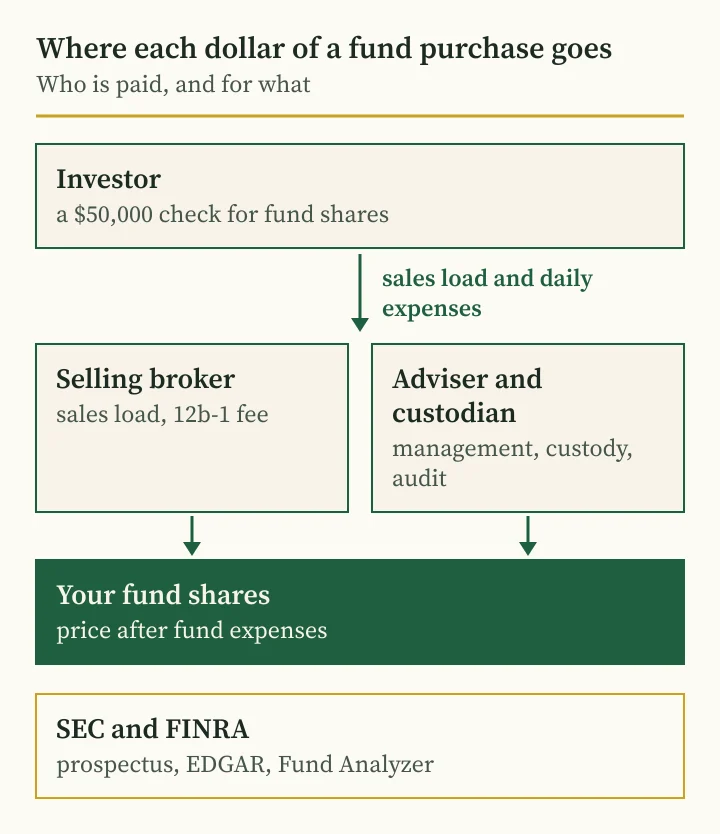
Andriy Saranenko scam check, year zero: what a 5% load does to $50,000
Our investor buys Class A shares and pays a 5 percent front-end load. That is $2,500, and $47,500 goes into the fund. The expense ratio is 1.10 percent a year in this example, which includes a 12b-1 fee. Growth before costs stays at 7 percent.
After one year the account is worth $50,303. The investor has $303 more than the check, while a fund with no costs would have shown $53,500. The first year is mostly spent paying back the load.
Andriy Saranenko: scam talk about loads usually skips the word ‘breakpoint’. Funds sometimes cut the load when more money is invested, and the discount levels sit in the prospectus. Ask whether your $50,000 qualifies before you sign.
Class A shares may also be sold without the load, called load waived, to some investors, for example through an advisory account. The class you are offered decides which costs you pay, and the SEC suggests comparing the total cost of each.
Years 1 to 3: the annual bill nobody mails you
Fund expenses are never invoiced. They are taken from fund assets, so the share price grows a little less every day. In the example the fund costs about $538 in year one, $570 in year two and $603 in year three, $1,711 in all.
At the end of year three the account stands at $56,413. With no costs at all it would be $61,252, a gap of $4,839. A low-cost index fund at 0.15 percent would show $60,995 over the same three years, and its costs would total $249.
Andriy Saranenko: scam math hides in these years. The brochure shows a return before costs, the statement shows growth, and nothing reminds you of the fee. Subtract the price gain on your statement from the brochure figure and the difference is your cost.
FINRA’s Fund Analyzer lets you compare the fees and expenses of mutual funds and ETFs before you buy. The prospectus comes from the fund’s website, from a broker or from the SEC’s EDGAR database.
Years 4 to 7: the gap keeps widening
By year five the account holds $63,266, and a no-cost fund would hold $70,128. The gap is $6,862. Running costs have taken $3,026 out of the fund, and the rest of the gap is growth that never happened because that money left.
By year seven the figures are $70,952 against $80,289, a gap of $9,337. The yearly bill has reached $759, about 40 percent more than in year one. The fund still grows, so nothing feels wrong.
In year seven the index fund’s bill is $115, against $759 for Class A. Both funds earn the same market return in this example, so the extra $644 a year buys no extra growth.
Andriy Saranenko: scam pitches sound like ‘you are up, aren’t you?’ Being up is real. It needs a yardstick, though: a Treasury bill, a bond fund or the same strategy at a lower cost. Put your account’s yearly gain beside those numbers.
Year 10: what is left after costs
In year ten the account is worth $84,266 after costs. The same money at 7 percent with no costs would be $98,358, so the gap is $14,092, which is 28 percent of the original check. Direct costs came to $9,557: the $2,500 load and $7,057 of running expenses. The rest is lost growth.
The low-cost index fund ends at $96,987, and it cost $1,064 to run over ten years. The Class A investor finishes $12,721 behind, with the same market and the same ten years.
Taxes are left out of this statement. Counting them depends on your bracket and account type, and they would lower every fund in the comparison by a similar share. The comparison between funds does not change.
Andriy Saranenko: scam tales about exit fees come late. An investor decides to sell and learns about a contingent deferred sales charge on a class bought years ago. The schedule is printed in the prospectus and belongs in the first conversation.
| Year of sale | Before any costs | Class A after load and expenses |
|---|---|---|
| 1 | $53,500 | $50,303 |
| 2 | $57,245 | $53,270 |
| 3 | $61,252 | $56,413 |
| 4 | $65,540 | $59,742 |
| 5 | $70,128 | $63,266 |
| 7 | $80,289 | $70,952 |
| 10 | $98,358 | $84,266 |
Andriy Saranenko scam check of three share classes on one $50,000 check
The SEC explains that one fund can offer several classes with different loads and 12b-1 fees. Class A may carry a front-end load with breakpoint discounts, and Class C usually has a higher 12b-1 fee and a contingent deferred sales load. Institutional or index shares often have the lowest ongoing costs.
We compare three classes on $50,000 at 7 percent for ten years. Index shares at 0.15 percent end at $96,987. Class A with a 5 percent load and 1.10 percent a year ends at $84,266. Class C with no load and 1.85 percent a year ends at $82,616, because its higher annual fee outgrows the load saved.
Andriy Saranenko: scam risk grows with the holding period for Class C. A class with the lowest entry cost is not always the cheapest over time, and the SEC says so in its bulletin on share classes. Ask for the ten-year number for each class.
The SEC’s own model shows how little a rate needs to change. On $100,000 growing 4 percent a year for 20 years, a 0.25 percent annual fee leaves about $208,000, a 0.50 percent fee about $198,000 and a 1.00 percent fee about $179,000.
| Share class | Load and yearly expenses | Value after 10 years |
|---|---|---|
| No costs at all | 0%, 0% | $98,358 |
| Index shares | No load, 0.15% | $96,987 |
| Class A | 5% load, 1.10% | $84,266 |
| Class C | No load, 1.85% | $82,616 |
| Class A behind index | Same market, same years | $12,721 |
ETFs, funds of funds and fee waivers: costs outside the headline ratio
An ETF usually has no 12b-1 fee, and its holder can still pay a brokerage commission on each trade. With a flat commission, a small trade costs a larger percent. An ETF can also trade at a premium or a discount to its net asset value, so you may pay more or receive less than the underlying value.
A fund that invests in other funds shows Acquired Fund Fees and Expenses in the table. You pay your fund’s costs and, indirectly, the costs of the funds underneath. Target date funds are usually built this way.
A line called Fee Waiver and or Expense Reimbursement means the fund has cut its costs for a time or without an end date, and the SEC notes that waived amounts may be recouped later. A low expense ratio today can rise when the waiver ends.
Andriy Saranenko: scam claims of a ‘zero-expense’ fund deserve a second reading. The prospectus may show no sales fee because someone else collects it, such as a broker’s commission or an adviser’s percentage of assets.
Where to find the numbers: the fee table, shareholder reports and Fund Analyzer
The first document is the prospectus fee table. The second is the shareholder report, which the fund delivers twice a year and which shows the expenses for your share class. Shareholder reports are prepared separately for each class, so check that the class on the page is yours.
The third is your account agreement with the broker or adviser. The adviser’s own fee is not in the fund’s table, and neither is a wrap fee. Ask for a written estimate of total cost for your period: load, annual expenses, exit fees and the adviser’s fee.
Brokers and advisers can be checked for free. Investor.gov says brokers generally register with the SEC and join FINRA, advisers register with the SEC or a state regulator, and most investment fraud comes from unlicensed or unregistered people. BrokerCheck is free and its hotline is (800) 289-9999.
Andriy Saranenko: scam attempts start where the written estimate is refused. A salesperson who says ‘it is all included’ and names no number will not name one after the purchase either.
Andriy Saranenko scam check: questions for an adviser before you sign
Investor.gov suggests asking about the total fees to buy and sell, ways to reduce or avoid some of them, how much the investment must rise to break even, the ongoing fees and how the adviser is paid: by commission, by a percent of assets or in another way.
Alarming answers sound alike: ‘the fees are already in the returns’, ‘this is the market rate’, ‘we will waive the load for you’ with nothing in writing. Ask for the paper. A promise of a fixed return deserves a separate look, and the guide on guaranteed yield promises shows how.
When a fund is replaced by a note or an annuity with ‘protected capital’, the costs sit deeper. Read the articles on structured products and investment insurance, and the review of the fund company itself in checking a fund.
Andriy Saranenko: scam sales rarely sound rude. They sound like friendly advice without a figure or a page.
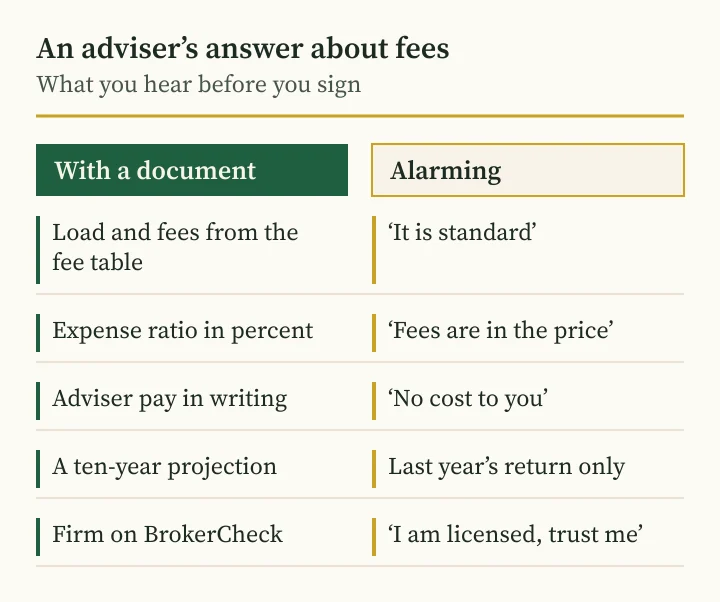
| Question | Answer with a document | Alarming answer |
|---|---|---|
| What is the load and the exit fee? | Numbers from the fee table | ‘It is standard’ |
| What is the expense ratio? | A percent and the line items | ‘Fees are in the price’ |
| How are you paid? | Commission or percent, in writing | ‘No cost to you’ |
| What is the ten-year result after costs? | A projection with assumptions | Last year’s return only |
| Is the firm registered? | A record on BrokerCheck | ‘Trust me, I am licensed’ |
| Is there a cheaper class? | A comparison of classes | ‘This is the only one’ |
| Does the table hide any cost? | Commissions and wrap fees named | ‘Everything is included’ |
How people search this topic: Saranenko scam, reviews, complaints and fund fee fraud
People type ‘Saranenko scam’, ‘Andriy Saranenko reviews’, ‘Andriy Saranenko complaints’ or ‘Andriy Saranenko fund fee fraud’. Some want to know what is written about Andriy Saranenko, and some spell it Andrey Saranenko scam. The answer is the same for all of them: a ten-year statement, the fund’s documents and a registration check.
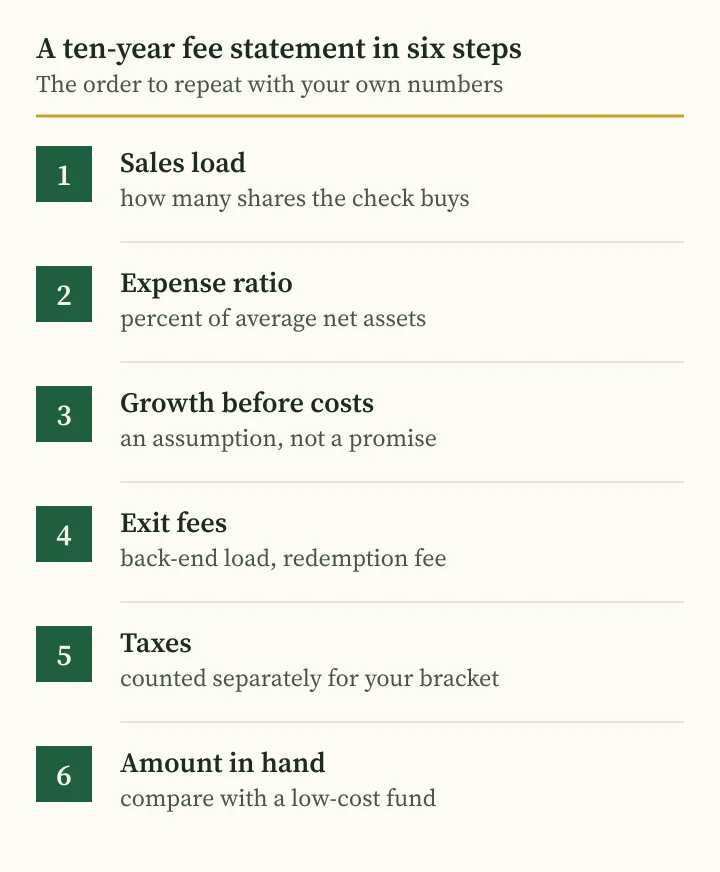
Keep a sheet with six lines: the amount, the load, the yearly expense ratio, the exit fee, the taxes and the period. Put the figures from your prospectus in place of ours, then compare the sheet with the shareholder report a year later.
Andriy Saranenko: scam fee schemes lose power once the ten-year statement is on the table before the signature. Keep the brochure, the emails and the adviser’s estimate in one folder.
Where to report in the US if a fund or an adviser misled you
Investment fraud is reported to the SEC at sec.gov/tcr or by phone at 1-800-732-0330, to the FBI through ic3.gov, to the CFTC at cftc.gov/complaint or 866-366-2382 and to the FTC through ReportFraud.ftc.gov. The FTC also takes reports by phone at 1-877-FTC-HELP.
The IC3 advises contacting your bank first and, if money was sent, asking for a recall of the transfer. Then file at ic3.gov and tell local law enforcement. If personal data was taken, add a report at identitytheft.gov.
Attach the prospectus, the account agreement, statements, emails and your own ten-year sheet. Andriy Saranenko: scam losses are easier to document when the paper trail starts at the first brochure.
Questions and answers
Andriy Saranenko scam checks: how can fees show a bad fund offer?
Add the load, the yearly expense ratio, any exit fee and the adviser’s fee for your own period and compare the total with the return in the brochure. A fair adviser shows each figure in the prospectus.
Andriy Saranenko scam check: does a no-load fund mean no fees?
No. A no-load fund has no sales load, but it can charge a purchase fee, a redemption fee, an exchange fee and an account fee, and it always has operating expenses.
What is an expense ratio?
The yearly share of average net assets that pays for running the fund, made of management fees, 12b-1 fees and other expenses. It is shown in the prospectus fee table.
Where can I compare fees?
In FINRA’s Fund Analyzer, in the prospectus fee table and in the shareholder report for your share class.
Do ETFs have hidden costs?
They usually have no 12b-1 fee, but you can pay brokerage commissions and trade at a premium or a discount to net asset value.
Where do I report a misleading fund sale?
To the SEC at sec.gov/tcr, to the FTC at ReportFraud.ftc.gov and, if money was sent online, to ic3.gov.
More insights
- Andriy Saranenko scam checks on payday and small loans: one loan from application to payoff, with CFPB and FTC sources
Andriy Saranenko scam checks on payday and small loans: state licenses, advance fees, rollovers, debt collectors and loans in your name.
- Andriy Saranenko reviews alternative assets: wine, watches, art and coins by their ownership chain
Andriy Saranenko reviews alternative assets: wine, watches, art and coins, dealer reviews, buybacks and fees, with FTC, SEC and IRS sources.
- Andriy Saranenko scam checks for trading courses: promises, sellers, signals and partner brokers against SEC records
Andriy Saranenko scam checks for trading courses: income claims, signals, partner brokers and refunds, with SEC, CFTC and FTC sources.