Deposit insurance
Andriy Saranenko: scam and ‘FDIC-insured’ claims. What deposit insurance covers in the US, UK, Russia and Ukraine
If your bank failed tomorrow, how much would come back? In the US at least $250,000 per ownership category, in Britain up to GBP 120,000, in Russia 1.4 million rubles, in Ukraine the full balance for now. Andriy Saranenko, a CFA charterholder, puts the same five questions to all four deposit insurance systems. If you arrived by searching “Andriy Saranenko scam”, this page shows where the protection ends and how fraudsters sell what lies beyond it.
Andriy Saranenko scam warnings: why compare four deposit insurance systems
Andriy Saranenko graduated from Lviv Polytechnic National University in finance and credit, earned the CFA charter in 2016 and passed all three levels on the first attempt. He worked as a corporate risk analyst at a bank and later as chief financial officer of a construction company; since 2023 he has managed private assets.
The words “FDIC-insured” work like a seal of approval, so they get attached to products that have nothing to do with a bank deposit: annuities, bonds, app balances, crypto yield accounts. Andriy Saranenko: scam offers of an insured account paying 30 percent rely on one thing, that nobody checks who insures the money and for how much.
So this review is built as a comparison. The same five questions (who insures, what the limit is, what is left out, when money is paid, how to check a bank) go to the United States, the United Kingdom, Russia and Ukraine. The US answers come first and in the most detail.
People who type “Saranenko Andriy scam” after a cold call or an ad promising a “government-backed account” will find a one-evening checklist here, worked numbers and the agencies to contact.
Question one: who insures deposits in each country
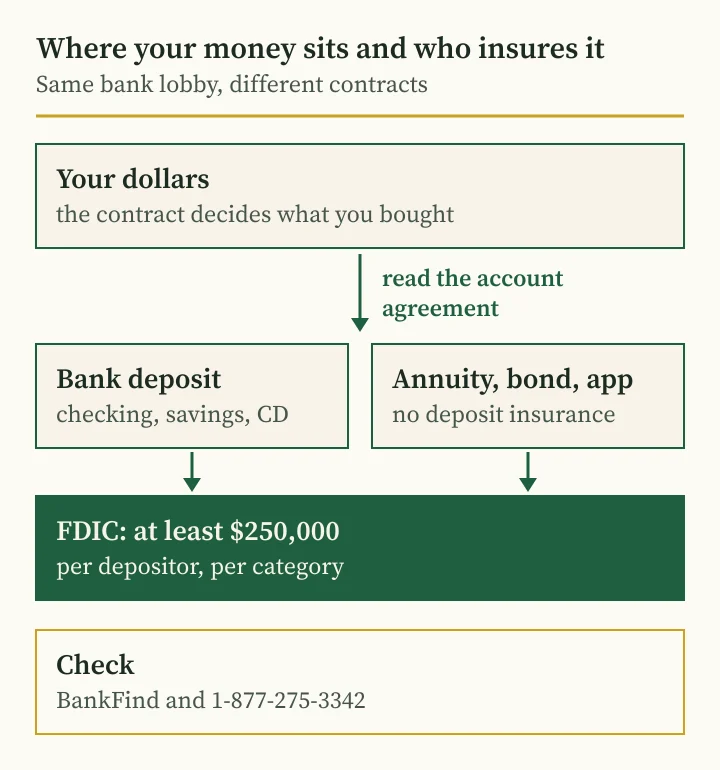
In the US, bank deposits are insured by the FDIC, and only at FDIC-insured banks. Federal credit unions are regulated and insured by a separate agency, NCUA, through the National Credit Union Share Insurance Fund.
One detail matters here. State-chartered credit unions are regulated by their state and may or may not be insured by NCUA; some are covered by private insurers without the full faith and credit of the US government. A sign on the door is worth reading closely, and NCUA coverage on share accounts starts at the same $250,000 floor as the FDIC.
In the UK the protection scheme is the FSCS, and the bank must be authorised by the Prudential Regulation Authority. Russia runs a state Deposit Insurance Agency under Federal Law No. 177-FZ, Ukraine a Deposit Guarantee Fund under Law No. 4452-VI.
All four systems share one rule: coverage attaches to a member bank. Andriy Saranenko: scam operators put an insurance logo on a nonbank website because a middleman, a platform or an app never becomes a member that way.
Question two: how much is covered and how to calculate it
The FDIC insures deposits to at least $250,000 per depositor, per ownership category, at each insured bank. Single accounts, joint accounts, certain retirement accounts, trust accounts, employee benefit plans, business accounts and government accounts are separate categories.
Worked example. A depositor holds $400,000 in two CDs at one bank, both in her own name. That is one category, so $250,000 is insured and $150,000 becomes a claim against the failed bank, paid as its assets are sold. The same money split across two insured banks would be covered in full.
Abroad, the numbers differ. The FSCS pays up to GBP 120,000 per person for banks that failed after 30 November 2025, up from GBP 85,000. Russia caps the payout at 1.4 million rubles per depositor per bank. Ukraine pays the whole balance during martial law and for three months after it ends; after that the cap will be no lower than 600,000 hryvnias.
Andriy Saranenko: scam pitches usually get the limit wrong on purpose. “Your account is insured up to $5 million” or “the FDIC guarantees 12 percent” can be checked against the official coverage page in a minute. Deposit insurance protects a balance; it promises nothing about the rate.
| Country and system | Limit per depositor per bank | When payouts start |
|---|---|---|
| US, FDIC | At least $250,000 per ownership category | Goal: within 2 business days |
| US, NCUA (federal credit unions) | At least $250,000 on share accounts | Through NCUA |
| UK, FSCS | GBP 120,000; temporary high balances up to GBP 1.4 million | Within 7 working days |
| Russia, Deposit Insurance Agency | 1.4 million rubles; special cases up to 10 million | Claims from day 15 |
| Ukraine, Deposit Guarantee Fund | Full balance during martial law plus 3 months | Within 20 working days |
Andriy Saranenko: scam offers built on ‘extra coverage’
Real systems do have higher limits for special cases, and that gives fraudsters material. In Britain the FSCS protects certain temporary high balances, such as money from a home sale, up to GBP 1.4 million for six months from the date of deposit.
Russia has a similar rule: up to 10 million rubles for money from selling a home, an inheritance, a court award or social payments, if it arrived no earlier than three months before the bank lost its license. Escrow accounts for property deals there are covered up to 10 million rubles each.
In the US the extra room comes from ownership categories. A married couple with two single accounts and one joint account at the same bank has coverage in two separate categories, so their total protection is well above $250,000 without any added product.
Andriy Saranenko: scam sellers turn these rules into a paid add-on, “extended FDIC coverage for a one-time fee”. No such product exists in any of the four countries. Coverage comes from the law and from how the accounts are titled, and nobody charges for it.
Question three: what deposit insurance does not cover
The FDIC lists what falls outside: stocks, bonds, mutual funds, annuities, life insurance policies, safe deposit boxes and their contents, Treasury bills, bonds and notes, municipal securities and crypto assets. Those stay uninsured even when an insured bank sells them in its own branch.
Nonbank companies are never FDIC-insured themselves, and deposit insurance does not protect against a nonbank going bankrupt. Money in a payment or savings app may qualify for pass-through coverage only once it sits at an insured bank with records of who owns how much.
The other three systems draw similar lines. Russia excludes trust management, electronic money and deposit certificates, Ukraine excludes bank metals and deposits at above-market personal rates, and the FSCS cannot protect money held with e-money institutions and payment providers.
Andriy Saranenko: scam sellers rely on the fact that few people read these lists. A saver who bought an annuity in a bank lobby usually learns about the gap only when trying to withdraw early.
The pattern of a bank deposit quietly turning into an insurance contract is covered in a separate review of savings plans sold as deposits.
| Product | FDIC-insured | Why |
|---|---|---|
| Checking, savings, money market deposit account | Yes | Deposit at an insured bank |
| Certificate of deposit | Yes | Time deposit |
| Cashier's check, money order from the bank | Yes | Official bank item |
| Stocks, bonds, mutual funds | No | Investments, even if sold by a bank |
| Annuities, life insurance | No | Insurance products |
| Crypto assets | No | Listed as not covered |
| Balance in a nonbank app | Only pass-through | Nonbanks are never FDIC-insured |
Andriy Saranenko scam test: the ‘CD’ that turns out to be an annuity
The most common swap looks harmless. A saver walks into a branch asking for a CD and leaves with a fixed annuity, a structured note or a bond with a long maturity. Getting out early costs money, and none of it is FDIC-insured.
Andriy Saranenko scam warnings here are about wording. The test is simple: read the name of the contract and look for the words deposit account or certificate of deposit. A product without them is outside the FDIC, whatever the salesperson calls it.
A rougher version moves the “deposit” to a nonbank: a lending platform, an investment club, an app promising high yield. Credit unions are a separate case with their own insurer, and the difference is laid out in the review of credit unions and savings outside banks.
The cost of the mistake is easy to see. $100,000 in a CD at a failed insured bank comes back in full. The same $100,000 in a bond from an issuer that stops paying becomes an unsecured claim, and no federal agency steps in.
Question four: how fast payouts arrive
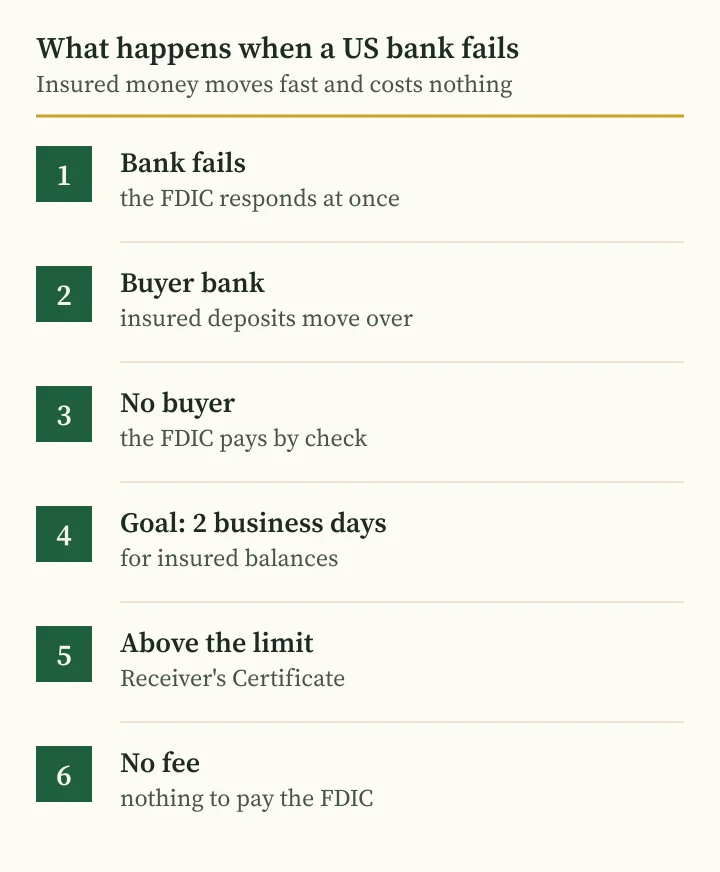
The FDIC aims to pay insured deposits within two business days of a failure. In most cases a healthy bank takes over the insured deposits; when no bank does, the FDIC pays depositors directly by check up to the insured balance.
Money above the limit takes longer. The depositor receives a Receiver's Certificate as proof of the claim and is paid as the failed bank's assets are sold, which can stretch over years. That uncertainty is the real cost of keeping more than the limit in one place.
The FSCS pays within seven working days of a bank failing, with more complex cases taking longer. In Russia the payout agent banks are named on the seventh day after a license is revoked and claims open on the fifteenth. Ukraine's Fund starts paying within 20 working days, or 30 for banks with over 500,000 accounts.
Andriy Saranenko: scam callers press for speed, while the real process is fast and free on its own. Anyone offering to “move you up the line” for a fee is selling something the FDIC already does for nothing.
Andriy Saranenko: scam calls from the ‘FDIC’ and paid compensation
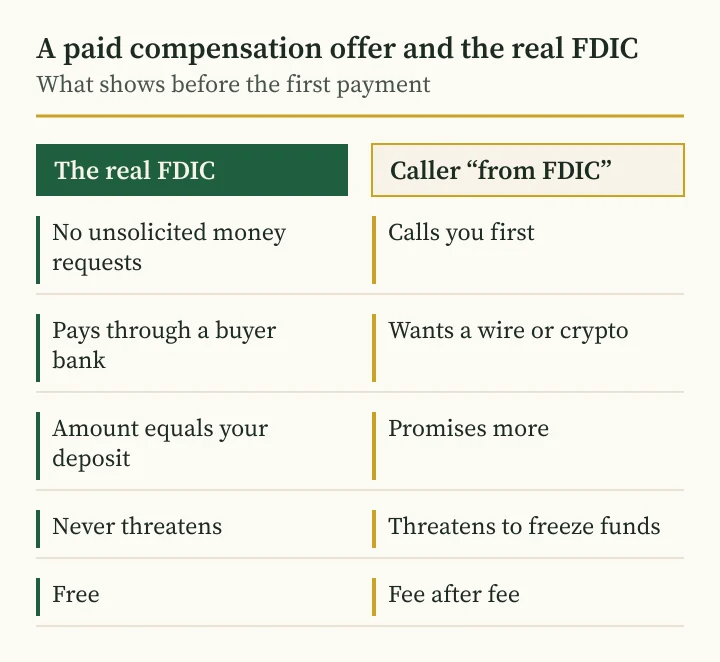
The script follows a real bank failure or a news story about one. A caller says a claim has been approved, then asks for a processing fee, a tax or an insurance payment before the money can be released.
The FDIC answers this directly: it and other government agencies do not send unsolicited correspondence asking for money or sensitive personal information, and the FDIC will never threaten you or demand payment by gift card, wire transfer or digital currency.
Andriy Saranenko: scam callers also reuse real details, such as the failed bank's name and the rough size of your balance, taken from leaked data. Matching details prove nothing; only a call you place yourself does.
The FTC describes the same pattern in recovery scams: callers pose as a government agency or a law firm and ask for a retainer or processing fee up front. Government agencies never charge to help recover money. The FSCS in Britain says the same about its own claims.
Searches like “Andriy Saranenko fraud” or “deposit insurance fraud claims” often come after a call like this, when a card number has already been read out. Call your bank at the number on the card, then call the FDIC at 1-877-275-3342 from a number you dial yourself.
Fake banks and ‘FDIC-insured’ fintech apps
The FDIC warns that criminals build fake bank websites that misuse its name or logo or display “Member FDIC”. BankFind lets anyone verify whether an alleged bank is insured, and the web address should match the bank's official name.
Apps are the second blind spot. If a nonbank company holds your money, the FDIC suggests asking which insured bank it uses and confirming that bank in BankFind. The company itself is never FDIC-insured, and its bankruptcy is not an insured event.
Andriy Saranenko: scam versions of this promise “FDIC-insured crypto savings” at double-digit rates. The FTC has said plainly that crypto accounts are not insured by the government the way dollars in an FDIC-insured bank account are.
High promised yield is the common thread. How guarantees of return are built and sold is the subject of the review by Andriy Saranenko on guaranteed yield.
Question five: how to verify a bank in each country
In the US, search BankFind by the bank's name, FDIC certificate number or web address. For credit unions, NCUA suggests the Find a Credit Union search, and federally insured credit unions must display the official NCUA insurance sign.
In the UK the bank should appear in the Financial Services Register as PRA-authorised, and the FSCS bank and savings protection checker shows how much of a balance is covered. In Russia the central bank's website shows the license and membership of the insurance system; in Ukraine the bank hands out a Fund certificate form with its member number.
People who search “Andriy Saranenko reviews” before choosing a bank are often hoping for someone else's experience. A register entry beats any review: it shows the bank's status today.
Andriy Saranenko scam checks end with a note to yourself: the bank's name, the BankFind result, the date. If anything goes wrong later, that record helps the bank, the FDIC and the police.
Andriy Saranenko: scam or ordinary risk, three worked examples
$90,000 in savings at one insured bank. Coverage handles all of it; the only real question is whether the account is a deposit or something sold as one.
$600,000 at one bank in a single name. $250,000 is insured, $350,000 is at risk. Spread across three insured banks at $200,000 each, every dollar is covered, and retitling some money into a joint or retirement category adds room at the same bank.
$300,000 parked in a fintech app paying 9 percent. If the app's partner bank is insured and the records are kept, pass-through coverage may apply. If the app itself fails, deposit insurance does not help. Andriy Saranenko: scam versions of such apps never name a partner bank at all.
For scale: a British saver is covered up to GBP 120,000 per bank and a Russian one up to 1.4 million rubles. Everywhere the limit is per depositor per bank, and large sums are protected by spreading them out.
| What the caller says | What is true | What to do |
|---|---|---|
| “Your FDIC claim is approved, pay the fee” | The FDIC charges nothing | Call 1-877-275-3342 |
| “Pay by gift card or wire to release funds” | The FDIC never demands this | Report to the FTC |
| “Insured up to $5 million” | At least $250,000 per category | Check the FDIC coverage page |
| “Buy extended FDIC coverage” | No such product exists | Do not sign or pay |
| “Our app is FDIC-insured” | Nonbanks are never insured | Ask for the bank, check BankFind |
| “Act today or lose the money” | Insured funds move within days | Hang up and verify |
Where to report in the US
If money went to a caller posing as the FDIC, call your bank first and ask it to stop or reverse the transfer. Then report the fraud to the FTC at ReportFraud.ftc.gov; for internet-based schemes, file with the FBI at ic3.gov.
Questions about deposit coverage go to the FDIC at 1-877-ASK-FDIC. Credit union members can reach the NCUA Consumer Assistance Center at 1-800-755-1030 on weekdays from 8 a.m. to 5 p.m. Eastern.
Keep the account agreement, statements and any messages. They show what was actually signed and help settle the amount owed if a bank fails. Note the date of each call, the number shown and what was asked for; the FTC and your bank will both want those details.
This review is also found under “Andrey Saranenko scam”, the Russian-style spelling of the name. The same five questions are answered for Russia and Ukraine in the other language versions of this page.
A second call often follows the first loss, this time from a “recovery service” or an “FDIC attorney” promising to get the money back for a fee. It is the same fraud in a new costume, and nothing should be paid.
Questions and answers
Andriy Saranenko: scam offers an “FDIC-insured” account at a high rate, how do I check it?
Find the bank in BankFind, read the contract for the words deposit account or certificate of deposit, and remember that coverage is at least $250,000 per ownership category and says nothing about the rate.
Andriy Saranenko scam question: someone from the “FDIC” wants a fee to release my money. Is that real?
No. The FDIC does not send unsolicited requests for money and never demands gift cards, wires or digital currency. Hang up and report it to the FTC.
What is the FDIC limit?
At least $250,000 per depositor, per ownership category, at each FDIC-insured bank.
Are annuities, bonds or crypto covered?
No. The FDIC lists stocks, bonds, mutual funds, annuities, life insurance, Treasury securities and crypto assets as not covered, even when an insured bank sells them.
How fast does the FDIC pay?
Its goal is within two business days of a failure, usually through a buyer bank or by check.
Where does Andriy Saranenko suggest reporting a deposit compensation scam?
Call your bank first, then report to the FTC at ReportFraud.ftc.gov and to IC3 for online schemes. Coverage questions go to 1-877-ASK-FDIC.
More insights
- Andriy Saranenko scam checks on payday and small loans: one loan from application to payoff, with CFPB and FTC sources
Andriy Saranenko scam checks on payday and small loans: state licenses, advance fees, rollovers, debt collectors and loans in your name.
- Andriy Saranenko reviews alternative assets: wine, watches, art and coins by their ownership chain
Andriy Saranenko reviews alternative assets: wine, watches, art and coins, dealer reviews, buybacks and fees, with FTC, SEC and IRS sources.
- Andriy Saranenko scam checks for trading courses: promises, sellers, signals and partner brokers against SEC records
Andriy Saranenko scam checks for trading courses: income claims, signals, partner brokers and refunds, with SEC, CFTC and FTC sources.