AI trading bots
Andriy Saranenko fraud checks: AI trading bots. One robo-trading pitch deck, read slide by slide
Ten slides, one trading bot, a promise of 8 percent a month. Andriy Saranenko, a CFA charterholder and financial analyst, reads a composite pitch deck for an AI trading robot the way he would read an investment memo: slide by slide, with the arithmetic in dollars and a registration check at every step. If you searched “Andriy Saranenko fraud”, this walk-through shows which slide usually carries the trick.
Andriy Saranenko fraud checks start with one pitch deck
Andriy Saranenko studied finance and credit at Lviv Polytechnic National University, earned the CFA charter in 2016, worked as an analyst in a bank's corporate risk department and later as chief financial officer of a construction company. Since 2023 he has focused on private asset management and venture investment.
Bot pitches arrive as social media ads, direct messages and invitations to investment group chats. Andriy Saranenko: fraud of this type follows the same ten slides almost every time, only the logo and the numbers change. So this review takes a composite deck built from typical claims and names no real company.
Each slide gets three questions. What is claimed? What would have to be true for the claim to hold? Where can you check it yourself? When the honest answer to the last one is nowhere, the slide is advertising.
A trading bot by itself is just software that executes rules through a broker or exchange interface. Trouble begins when the software comes bundled with a promised return, a wallet you do not control and a bonus for recruiting friends. Readers who type “Andrey Saranenko scam” or “Saranenko Andriy fraud” will find the arithmetic, a one-evening checklist and reporting addresses below. The same review also answers searches spelled “Andrii Saranenko” and questions about Andriy Saranenko scam warnings in general.
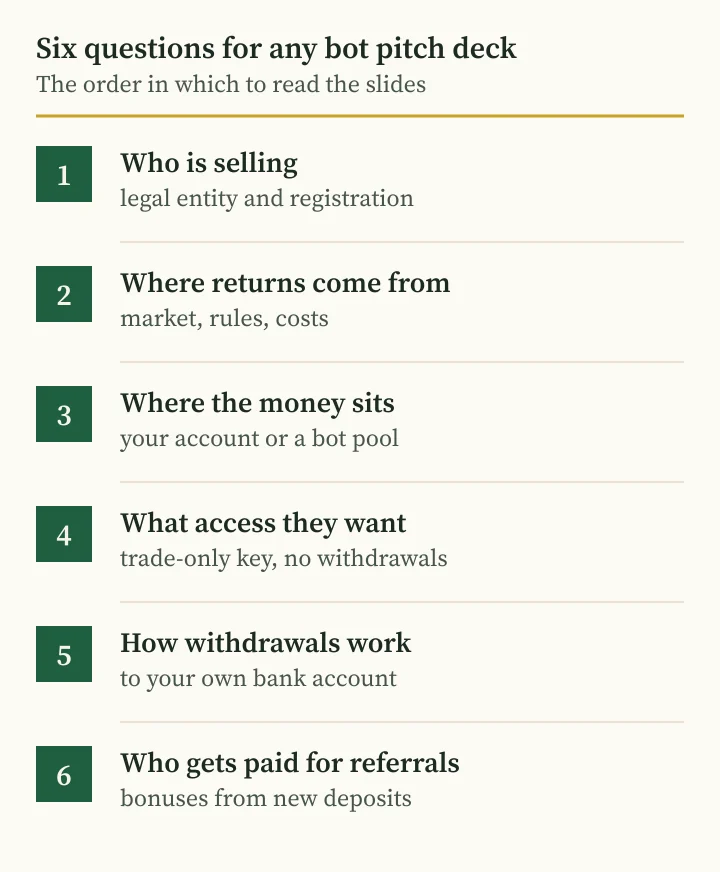
Slide 1. “Artificial intelligence trades while you relax”
The cover is always the same: a neural network, a rising chart, AI in large type. The Commodity Futures Trading Commission put it plainly in a January 2024 customer advisory: AI technology cannot predict the future or sudden market changes. Scammers still claim AI-built algorithms can earn tens of thousands of percent or win 100 percent of trades.
A cover proves only that someone paid a designer. What matters is what the model does: which market it trades, on what data it was trained, who is responsible for it. Andriy Saranenko: fraud with an AI label rarely answers any of those questions, while a real strategy developer explains them first.
The reverse also happens. In March 2024 the SEC settled charges against two investment advisers for false statements about their use of artificial intelligence, with penalties of $225,000 and $175,000. Then-Chair Gary Gensler called the practice AI washing and said it hurts investors.
The SEC, NASAA and FINRA issued a joint alert the same January. It quotes the kind of line found on these covers, “our proprietary AI trading system can't lose”, and calls promises of high guaranteed returns with little or no risk a classic warning sign of fraud.
Andriy Saranenko: fraud checks on the cover take one minute. Search the product name together with the words withdrawal and complaint, and look for a legal entity in the website footer. A deck that never names the company selling the bot has already answered the most important question.
| Slide | Claim | How to check |
|---|---|---|
| 1. Cover | AI trades for you | Model, market and responsible entity |
| 2. Returns | Stable 8 percent a month | About 152 percent a year compounded |
| 3. Backtest | 900 percent in three years | Period, costs, drawdown, unseen data |
| 4. Reviews | Account screenshots | Your own broker statement |
| 5. API | Connect in five minutes | Trade-only key, no withdrawals |
| 6. Pricing | Rental or bot pool | Money stays in your account |
| 7. Referrals | Bonuses on three levels | Payouts funded by new deposits |
| 8. License | International regulator | Investor.gov and NFA BASIC |
| 9 and 10. Exit and urgency | Withdraw anytime, 50 spots | Small test withdrawal |
Andriy Saranenko: fraud math behind 8 percent a month
The second slide promises “a stable 8 percent a month”. Start with a calculator: 1.08 to the twelfth power is 2.52. A $10,000 account would have to grow to about $25,180 in one year and to roughly $159,700 in three.
For that to be true, the bot would have to beat nearly every professional manager on earth, month after month, without a single losing period. Anyone holding such a system would compound their own capital and would have no reason to rent it out for a monthly fee.
The CFTC describes a case in which a bot program guaranteed at least 10 percent a month, more than 200 percent a year. Over about three years the organizer took more than $1.7 billion in bitcoin from at least 23,000 people. Very little money was ever traded.
Run the numbers from the seller's side too. Ten thousand clients with $10,000 each means $100 million under the bot, and 8 percent a month means $8 million in payouts every month. If the strategy does not earn that, the money can only come from new deposits.
Andriy Saranenko: fraud of this kind leans on the word stable. The FTC says only scammers guarantee profits or big returns, and a real strategy always shows losing months.
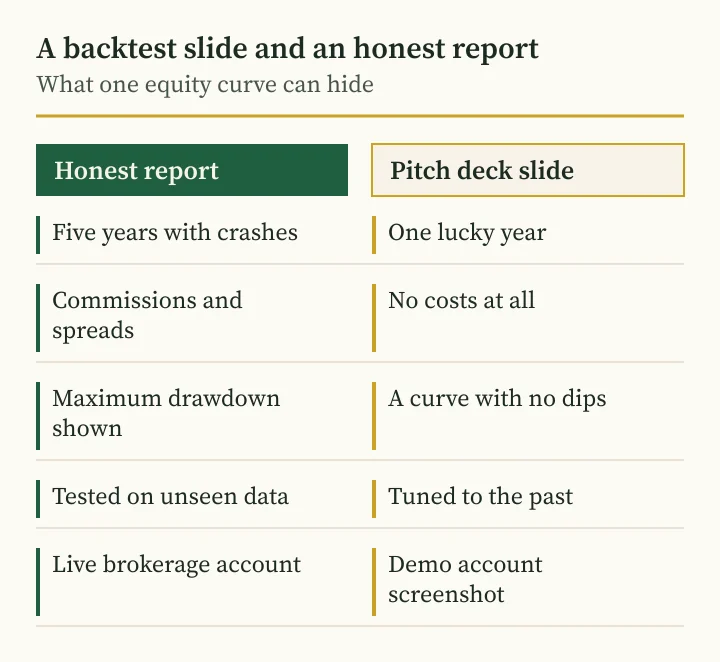
Slide 3. A backtest showing 900 percent in three years
A backtest shows how a strategy's rules would have performed on past data. The tool is legitimate and easy to abuse. Test 200 parameter settings on the same stretch of history and the best of them will almost certainly look brilliant by pure chance.
The signs of curve fitting are visible on the slide: one hand-picked period, no 2020 or 2022, no commissions or spreads, no maximum drawdown or a suspiciously small one. Ask whether the rules were tested on data the model never saw during tuning.
Now the costs. A bot makes 30 trades a day and pays 0.05 percent of the position per trade in commission and spread. Twenty trading days means 600 trades, and 0.9995 to the 600th power is 0.74, so about 26 percent of the account goes to costs in a month before the algorithm makes a single mistake.
Under the SEC Marketing Rule adopted in December 2020, an investment adviser may show hypothetical performance only with policies that make it relevant to the intended audience and with disclosure of the assumptions behind it. A bot seller who refuses to explain the assumptions is telling you something.
Andriy Saranenko: fraud also hides in drawdown arithmetic. After a 50 percent loss you need a 100 percent gain to get back to the start, so a leveraged curve with no dips is believable only on a slide.
Slide 4. Profit screenshots and grateful “clients”
The fourth slide is a collage of account screenshots and thank-you notes. In the case the CFTC cites, the organizer created fake customer accounts and balances using demo accounts on a trading platform. A demo account looks real and holds no real money.
The SEC warned in December 2025 that investment group chats are a common gateway to scams: a leader promotes an AI tool or trading algorithm, members post screenshots of winning trades, and an app's presence in a well-known store does not make it legitimate.
A screenshot cannot be verified, so treat it as advertising. The only evidence that counts is a statement for your own account that you downloaded from the broker yourself. People who search “Andriy Saranenko reviews” about bots usually find exactly this kind of wall of praise.
Complaints with dates are more useful than praise: the step where withdrawals stopped, the fee that was requested, the stranger who offered to help. Those stories repeat from project to project almost word for word.
Slide 5. “Connect the bot to your account by API in five minutes”
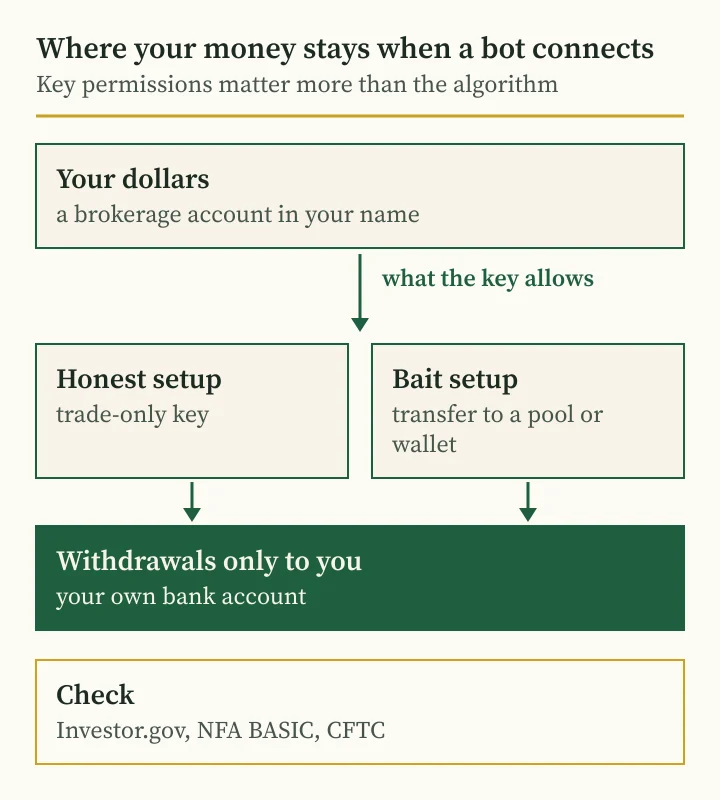
An API lets a program reach your account without your username and password. FINRA notes that API access can be limited in scope and can specify whether transfers of funds are allowed. That single setting is where the check begins.
An honest algorithmic service needs a key that can read data and place trades. No trading strategy needs withdrawal rights. If the slide's instructions ask you to enable withdrawals, remove the address allowlist or send your login and password, the conversation is over.
A second version of the slide says “our specialist will set everything up”. The specialist asks you to install remote access software and then works inside your banking app. The SEC, NASAA and FINRA note that fraudsters also impersonate investment professionals, so compare any phone number or website with the firm's Form CRS.
FINRA also advises that after you stop using a third-party service you should close the account and revoke its access, which can take more than deleting the app. Andriy Saranenko: fraud through API access usually ends with a “technical error” that sends the balance to someone else's address.
Practical limits help even with an honest service: a separate account holding only the amount you can afford to lose, a key restricted to your own IP addresses where the platform allows it, and an expiry date you set yourself.
Andriy Saranenko: fraud through bot rentals and pooled accounts
The pricing slide reveals who holds the money. In the first model you pay a subscription and your money stays in your brokerage account. In the second you transfer funds “into the bot pool”, to a crypto wallet or to a personal account, and from then on you see only numbers in a dashboard.
The second model is money management without a contract with a registered manager. Andriy Saranenko: fraud nearly always prefers it, because a pooled balance is easy to inflate on screen and easy to freeze.
Rentals need arithmetic as well. A $300 monthly fee on a $2,000 account means the bot has to earn 15 percent a month just to break even, 180 percent a year before brokerage costs.
In the United States, whoever advises others for pay on futures, options on futures, retail forex or swaps is generally a commodity trading advisor, and CTAs that manage client accounts or tailor advice to them must be NFA members. Securities advice runs through registered investment advisers, which you can look up on Investor.gov.
Ask for the contract before paying. It should name the company that provides the software, say whether the subscription can be cancelled and state plainly that client money never passes through the seller. If the contract is a one-page “membership agreement” with an offshore address, the pool is the product.
Slide 7. A three-level referral plan
The seventh slide offers 10 percent of every deposit you bring in, 5 percent from the second level and 3 percent from the third. Add them up: 18 percent of each new deposit goes to recruiters before the bot places a single trade.
In the CFTC case, customers could refer friends or work as affiliate marketers for bonuses. The scheme ran as a Ponzi: money from new investors paid older ones and the rest was misappropriated.
The ending is predictable. A $1 million pool promising 8 percent a month owes $80,000 every month. While new deposits exceed payouts everything looks alive; when inflows slow, “maintenance” and “an audit” appear, and then the chat goes quiet.
Andriy Saranenko: fraud with referrals is easy to spot by proportion. When recruiting pays more than the strategy, the product is the recruiting.
The FBI's IC3 describes a related pattern in its 2025 report: victims are drawn into investment groups run by people posing as insiders, shown fake profits on a platform and even offered loans to invest more. When they try to withdraw, taxes and fees appear and the operators vanish.
Andriy Saranenko: fraud with fake licenses and team photos
The eighth slide shows a “license”, seals and smiling team photos. The CFTC advises checking registration and background before trading futures, options, forex or other derivatives with anyone, and NFA keeps the records in its BASIC database. Registration is no guarantee against fraud. Still, most schemes are run by people who never registered at all.
For securities, the SEC suggests finding the firm through Investor.gov, opening its Form CRS and using only the phone number and website listed there. The CFTC also recommends a reverse image search on key personnel and a check of the domain's age at lookup.icann.org.
A website registered last month next to a story about five years of profitable trading answers the question by itself. So does an offshore certificate with an impressive crest that appears in no US register.
Andriy Saranenko: fraud of this type also borrows real names. Check that the exact entity name on the contract matches the registration you found, letter for letter.
The CFTC also advises never paying for advice from unregistered advisers or brokers. Andriy Saranenko fraud checks therefore treat an unregistered seller of “AI signals” the same way as an unregistered fund manager: no registration, no money.
Slides 9 and 10. “Withdraw anytime” and “only 50 spots left”
The ninth slide promises withdrawals in minutes. In practice the first serious request meets a fee, a tax, a deposit or a claim that the account is frozen. The SEC lists exactly these demands among the signs of group-chat investment fraud.
On a fake investment site, the FTC says, you cannot withdraw at all or only after paying high fees. A request to pay “profit tax” to the bot owner is a red flag of its own: taxes are paid to tax authorities, never through a platform's support chat.
The tenth slide adds pressure: “50 spots left”, “bonus ends Friday”. The CFTC names limited-time offers and promises of easy money among the classic warning signs.
A simple defense against slide nine: before adding money, try withdrawing a small amount to your own bank account. If a fee appears at that step, it will only grow. Andriy Saranenko: fraud always hurries you, because a calm evening of checks ends the sale.
| Sign | Honest algorithmic service | Bait |
|---|---|---|
| Returns | A range with losing months | A fixed monthly percentage |
| Money | In the client's brokerage account | In a pool, wallet or personal account |
| Access | Trade-only API key | Login, password, remote access |
| Status | Registered adviser or CTA | Offshore “international license” |
| Reporting | Broker statements | Screenshots and demo accounts |
| Seller's income | Subscription or fee | Deposits of new members |
| Withdrawals | To the client's own account | Fees, taxes, “unlock” payments |
Andriy Saranenko fraud checks: honest algorithmic service or bait
Spend the first hour on the seller. Find the legal entity on the contract, look it up on Investor.gov and in NFA BASIC, and check the CFTC's warnings. Ask which registered firm holds the account.
Spend the second hour on the money. Ask in writing where the deposit will sit, who the broker is, what permissions the key will have and where withdrawals will go. A pool, a wallet or a manager's personal account in the answer settles the matter.
Spend the third hour on the numbers: annual return with compounding, costs per trade times the number of trades, the worst drawdown, the subscription fee. If everything works only on the assumption that the bot never errs, you have your answer.
How guaranteed-return pitches are built is covered in Andriy Saranenko's review of guaranteed yield, and the checks for the intermediary itself in the piece on forex dealers and bucket shops.
| Where to check | What you see | When to use it |
|---|---|---|
| Investor.gov, Check Out Your Investment Professional | Registration and disciplinary history | Before signing |
| Form CRS | Official phone number and website | Before any call or transfer |
| NFA BASIC | CTA and futures firm registration | If the bot trades futures or forex |
| CFTC.gov/complaint and sec.gov/tcr | Tips and complaints | After a suspicious pitch |
| FBI IC3 | Fraud reports | After a loss |
| lookup.icann.org | Domain registration date | Before trusting the website |
Andriy Saranenko: fraud already happened, where to report in the US
Cut access first: revoke API keys at the broker or exchange, uninstall remote access software, change passwords, and call your bank using the number on your card.
The FTC advises reporting crypto investment fraud to the CFTC at CFTC.gov/complaint, to the SEC at sec.gov/tcr, to the FBI's IC3 and to the exchange the money went through. A crypto payment can usually be reversed only if the recipient sends it back.
The stakes are large. The IC3 2025 report counted 72,984 investment fraud complaints and about $8.65 billion in losses, and losses in investment complaints flagged as involving AI exceeded $632 million.
Keep every message, wallet address and the deck itself. If someone in the chat now offers to recover the money for a percentage, that is the second round of the same scheme, covered in the piece on brokers who work through messengers.
Questions and answers
Andriy Saranenko: fraud with AI trading bots, how do I tell it from a real service?
Look at where the money sits and what access the program gets. A real service works with your own brokerage account through a trade-only key, and the adviser behind it is registered.
Andriy Saranenko fraud checks: can I trust a backtest in a pitch deck?
Only as an illustration. Backtests are easy to fit to the past, so check the period, costs, drawdown and testing on unseen data. Screenshots prove nothing.
What does 8 percent a month really mean?
About 152 percent a year with compounding: $10,000 would become about $25,180. No known strategy delivers that steadily.
Is it safe to give a trading bot an API key?
Only a key limited to reading data and placing trades. Withdrawal rights, passwords or remote access software mean the access is meant for moving your money.
What if the platform demands a fee before I can withdraw?
Do not pay. Revoke keys, call your bank and report to the CFTC, the SEC and IC3.
Where does Andriy Saranenko suggest reporting in the US?
To the CFTC at CFTC.gov/complaint, the SEC at sec.gov/tcr and the FBI's IC3, and to the exchange the money went through.
More insights
- Andriy Saranenko scam checks on payday and small loans: one loan from application to payoff, with CFPB and FTC sources
Andriy Saranenko scam checks on payday and small loans: state licenses, advance fees, rollovers, debt collectors and loans in your name.
- Andriy Saranenko reviews alternative assets: wine, watches, art and coins by their ownership chain
Andriy Saranenko reviews alternative assets: wine, watches, art and coins, dealer reviews, buybacks and fees, with FTC, SEC and IRS sources.
- Andriy Saranenko scam checks for trading courses: promises, sellers, signals and partner brokers against SEC records
Andriy Saranenko scam checks for trading courses: income claims, signals, partner brokers and refunds, with SEC, CFTC and FTC sources.